 Public Cash Money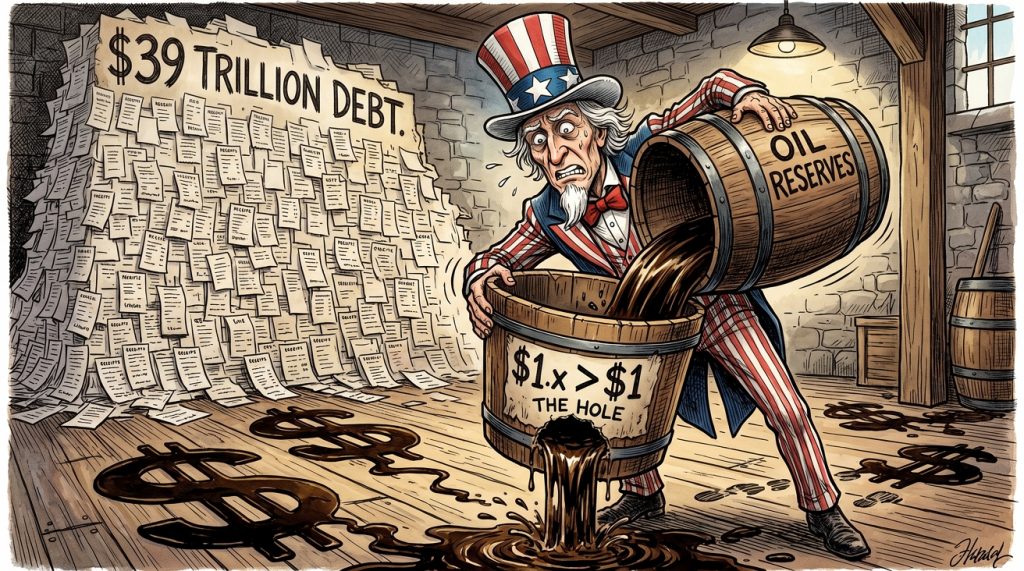
The argument sounds compelling: the United States is the world’s largest oil producer and exporter. Surely this wealth will eventually balance the books. Let us look at what the data actually says.
One of the most common objections I receive when presenting the trajectory of US national debt is this: “But the United States is the world’s largest oil producer. That wealth will eventually rescue the fiscal situation. You are ignoring a massive source of national income.”
It is a reasonable-sounding argument. It deserves a precise answer. And the precise answer, built entirely from verified public data, is more sobering than the people making the argument typically expect.
1. Who Owns American Oil?
The first and most important clarification: the United States government does not own American oil. American oil is owned by private corporations, by individual landowners, and partly by the federal government on federal lands. The distinction matters enormously, because the fiscal benefit to the US Treasury from oil production is not the value of the oil itself, but only what the government collects from that production through taxes, royalties, and lease revenues.
When commentators say “the US is the world’s largest oil producer,” they are describing the aggregate output of private American corporations, most of which are publicly traded on stock exchanges and owned by shareholders around the world. ExxonMobil, Chevron, ConocoPhillips, and the dozens of smaller producers that collectively make the US the world’s largest petroleum exporter are not government enterprises. They are private businesses. Their profits go to their shareholders. The government’s share is what it can collect in taxes.
And here is where the data becomes remarkable.
2. What the Oil Companies Actually Pay
The United States corporate tax rate is 21%. This is the statutory rate, the rate written in the law, the rate that most Americans assume large profitable corporations pay.
The rate that the three largest American oil companies actually paid on their domestic income in 2025 was 6.1%. Not 21%. Not even close to 21%. Six point one percent, according to their own financial disclosures analyzed by the FACT Coalition in April 2026.
Statutory corporate tax rate
21% — the rate written in US law since the 2017 Tax Cuts and Jobs Act.
Effective rate paid by Big Oil (2025)
6.1% average for ExxonMobil, Chevron, and ConocoPhillips on their domestic income. A dramatic decrease from the 10% average for those same companies between 2018 and 2024.
Murphy Oil and Halliburton (2025)
Less than 1% effective tax rate. Ovintiv, Cheniere, and APA each expect a same-year tax refund on billions of dollars of pre-tax profits.
Taxes paid to foreign governments vs US (2017-2024)
11 major US oil companies paid $135 billion to foreign governments and only $29 billion to the United States. ConocoPhillips paid more to Libya and Norway than to its home country in 2025.
Federal tax subsidies to oil industry
$35 billion in identified tax preferences, including immediate expensing of intangible drilling costs. The 2025 tax reform legislation added approximately $20 billion in additional tax breaks for domestic fossil fuel companies.
Sources: FACT Coalition analysis of financial disclosures (April 2026); ITEP report on oil company federal taxes (October 2025); Earth Track / FACT “America-Last and Planet-Last” report (2025); US Treasury budget analysis.
To summarize: the world’s largest oil-producing nation collects an effective tax rate of 6.1% from its largest oil companies, pays them $35 billion in annual subsidies, and watches them send more tax revenue to Libya and Norway than to the US Treasury. Meanwhile, the national debt grows by $7.6 billion per day.
3. The Constitutional Wall
There is a structural reason why the US government cannot simply increase its take from oil exports: the Constitution explicitly forbids it.
Article 1, Section 9, Clause 5 of the United States Constitution states: “No Tax or Duty shall be laid on Articles exported from any State.” This is not a policy choice. It is a constitutional prohibition. The federal government cannot impose an export tax on crude oil. The revenue from oil exports, above whatever domestic taxes the companies manage to minimize through legal tax avoidance, flows to the corporations and their shareholders, not to the Treasury.
This constitutional provision was designed to prevent the federal government from taxing the exports of individual states, which was a major concern at the time of the founding. Its effect today is that the United States, uniquely among major oil-producing nations, cannot capture a significant share of its oil export revenues for public purposes through export taxation.
4. The Norway Comparison: Same Oil, Different Choice
The contrast with Norway is not ideological. It is architectural, and it is instructive.
United States
Oil owned by private corporations. Effective tax rate on Big Oil: 6.1%. $35 billion in annual subsidies to oil industry. Constitutional prohibition on export taxes. Oil revenues go to shareholders. Government gets a fraction through corporate taxes and federal land royalties. National debt: $39 trillion and growing.
Norway
Oil managed through Equinor (67% state-owned) and taxed at 78% effective rate on petroleum income. All revenues flow into the Government Pension Fund Global, now worth over $1.7 trillion, the world’s largest sovereign wealth fund. Norway has no national debt problem. Its oil wealth belongs to its citizens structurally, not rhetorically.
Norway and the United States both have significant petroleum resources. The difference in their fiscal situations is not geological. It is a question of who captures the value of the resource: the citizens through public institutions, or the shareholders through private corporations.
Neither model solves the [$1.x > $1 (for any x > 0)] design bug at the monetary architecture level. But one model at least captures the resource value for public purposes. The other subsidizes private extraction while the public debt accumulates.
5. The Compound Interest That Ate the Oil Revenue
Now let us address the deeper question, the one that puzzled me when I first identified the [$1.x > $1 (for any x > 0)] bug in 2000: how did a country with almost no welfare state, the world’s largest oil production, and the global reserve currency manage to accumulate $39 trillion in debt?
The answer is compound interest. And compound interest, applied to a large enough principal over a long enough period, defeats any revenue stream that does not grow at the same rate.
When I first identified the bug in 2000, I made a rough projection based purely on the mathematics of compound interest, deliberately ignoring all political and spending variables. My conclusion at the time was that the system would face a structural crisis around 2060. I was wrong. Not about the direction. About the timing. The crisis arrived much earlier, because the spending variables I had excluded turned out to accelerate the compounding rather than moderate it.
Here is the arithmetic of why oil cannot save the situation. The US national debt grows by approximately $2.77 trillion per year. Total federal revenues from all sources, including all corporate taxes from all industries, amount to approximately $5 trillion per year. The interest bill alone is $1.172 trillion per year and growing.
Even if the US government were to somehow capture 100% of all oil company revenues — an impossibility given the constitutional prohibition and the private ownership structure — the total revenues of the US oil and gas industry were approximately $800 billion to $1 trillion in a strong year. Against a debt growing at $2.77 trillion per year, even a complete nationalization of the oil industry and confiscation of all its revenues would not stabilize the trajectory. The compound interest on $39 trillion at current rates generates more new debt than the entire US oil industry produces in revenue.
The US oil industry generates approximately $800 billion to $1 trillion in annual revenue. The US national debt grows by $2.77 trillion per year. Even if every dollar of oil revenue went directly to debt reduction, which is constitutionally impossible and structurally absurd, the debt would still grow by $1.77 trillion per year. Compound interest is not impressed by oil wells.
6. The Welfare Absence Paradox
The second part of the puzzle — how a country with almost no welfare state accumulated this debt — is equally instructive, and it points directly to the [$1.x > $1 (for any x > 0)] bug rather than to any political failure.
The United States spends less on social welfare as a percentage of GDP than virtually any other developed economy. Healthcare is largely private. Pensions are largely private. Unemployment support is minimal by European standards. The social safety net is thin by any comparative measure.
And yet the debt is $39 trillion. How?
Because the [$1.x > $1 (for any x > 0)] bug does not care about welfare spending. It does not require a large welfare state to operate. It requires only that money be issued as debt — which it is, in the United States as everywhere else — and that the interest accumulate on the principal, which it does, continuously, automatically, regardless of what the government spends the money on.
The debt grew not primarily because of welfare spending. It grew because every dollar in circulation was borrowed into existence at interest, and because the interest compounded on the growing principal, and because no amount of oil revenue or welfare restraint or fiscal discipline can permanently escape the mathematical logic of a system where the total obligation always exceeds the total money supply.
The welfare argument and the oil argument share the same fundamental error: they treat the debt as a spending problem when it is a monetary architecture problem. Cut welfare and the debt grows. Add oil revenue and the debt grows. The mechanism that produces the debt is not the spending. It is the architecture of money creation itself.
7. My Projection from 2000: What I Got Right and What I Missed
I want to be transparent about my own analytical history here, because intellectual honesty requires it.
In 2000, when I first identified the [$1.x > $1 (for any x > 0)] bug while working as a systems analyst for Italian banks, I made a simple projection. Taking the compound interest formula and applying it to the then-current debt level and growth rate, I estimated that the structural crisis would arrive around 2060. I was being conservative, deliberately excluding the political spending dynamics that I could not predict.
I was wrong about the timing. The system reached critical stress indicators decades earlier than my 2060 projection. Why?
Because I underestimated two accelerants. First: the 2001 and 2008 crises, which caused massive emergency debt expansion that permanently raised the base on which interest compounded. Second: the post-2008 near-zero interest rate environment, which temporarily suppressed the visible cost of the debt while allowing the principal to balloon, so that when rates normalized, the interest bill exploded on a much larger base than any pre-2008 projection anticipated.
The 2060 projection assumed a relatively stable compounding rate. What actually happened was a step-change in the principal base that reset the compounding calculation at a dramatically higher level.
The lesson: compound interest projections are conservative when the principal grows in discontinuous jumps. The bug is more aggressive than even its mathematical description suggests, because crises themselves are part of the mechanism, not external shocks to it.
In 2000 I projected a structural crisis around 2060. I was wrong. It arrived much earlier. Not because the mathematics was wrong, but because I assumed a smooth compounding curve when the actual trajectory included two catastrophic step-changes in the principal base. The [$1.x > $1 (for any x > 0)] bug is more aggressive than its formula suggests because crises are not external to the system. They are produced by it.
Conclusion: What Would Actually Help
Let me be precise about what this analysis does and does not argue.
It does not argue that oil revenues are irrelevant. They are not. A higher effective tax rate on oil company profits — bringing it closer to the statutory 21% and eliminating the $35 billion in annual subsidies — would improve the fiscal position modestly. The Norway model demonstrates that a different architectural choice about who captures resource value produces dramatically different fiscal outcomes.
What it argues is that no resource revenue, however large and however efficiently captured, can solve a monetary architecture problem. The United States could nationalize its entire oil industry tomorrow, capture 100% of petroleum revenues, and eliminate every tax subsidy. The debt would still grow. Because the mechanism that generates the debt is not the insufficient capture of oil revenues. It is the [$1.x > $1 (for any x > 0)] design bug that has been running since money was issued as debt in 1944 at planetary scale, and that compounds automatically, continuously, and indifferently to whatever revenues the government collects or fails to collect.
Oil is a resource. Compound interest is a mathematical law. Mathematical laws do not yield to resources.
The world’s largest oil producer. Almost no welfare state. The global reserve currency. $39 trillion in debt. Growing at $7.6 billion per day. The oil companies pay 6.1% in taxes. More to Libya than to Washington. The Constitution forbids export taxes. The compound interest does not care. Oil is a resource.
[$1.x > $1 (for any x > 0)] is a mathematical law. Mathematical laws do not yield to resources. They yield only to better architecture.
$2+2=4. Period.
Davide Serra · Systems Analyst & Independent Monetary Analyst
publiccashmoney.com
@postaperdavide
on X Sources: FACT Coalition analysis of oil company financial disclosures (April 2026); ITEP report on oil and gas federal taxes (October 2025); Earth Track / FACT “America-Last and Planet-Last” (2025); US Constitution Article 1 Section 9; Tax Policy Center “How Should the US Tax Petroleum Profits?” (2022); Tax Foundation “Oil Industry Taxes” (2024); Norges Bank Investment Management (Norway Government Pension Fund Global); US Treasury Fiscal Data; US Congress Joint Economic Committee (April 2026).