 Public Cash Money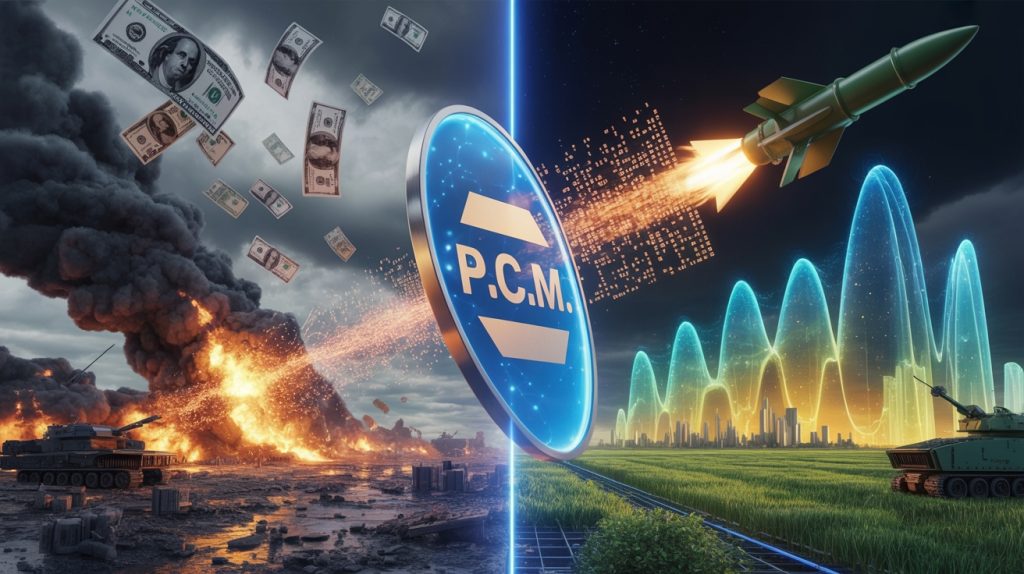
Many people approach the Public Cash Money (P.C.M.) proposal with outdated economic “reflexes.” Let’s clear the air, starting with the biggest myth: The Great Confusion:
Private Debt vs. Monetary Thermoregulation (MT)
“Wait, are you saying interests shouldn’t exist? How can a bank survive?”
Before you read any further, we must clear the most dangerous misunderstanding in economics. There are two types of “Debt,” and they have nothing in common.
1. Private Debt (The Micro Level) If you borrow money from a bank to buy a house or start a business, you are engaging in a private contract. You are paying for a service (access to capital now) and for the risk the lender takes. In this case, interests are legitimate, necessary, and obvious. They ensure the banking system functions and provide the incentive for capital to flow. This is why the P.C.M. paradigm targets a stable inflation range (2% to 4%): to maintain this vital circulation and keep the banking infrastructure healthy.
2. Public “Debt” – The MT (The Macro Level) What we call “Public Debt” is fundamentally different. It is not a loan from a “Global Bank” to a “Nation.” It is the total amount of money circulating in the economy.
- The Bug: Currently, this money is issued as debt with interest by central banks. But since only the principal is issued, the money to pay the interest does not exist. This creates a mathematical trap where the system must grow or borrow forever just to avoid collapse.
- The Solution (MT): In the P.C.M. paradigm, this is no longer “Debt.” It is Monetary Thermoregulation. The State issues the necessary liquidity based on real-world productivity. There is no interest on this primary issuance because you cannot “owe” interest on the very blood that makes the body run.
The Bottom Line: We are not abolishing interests for you, your business, or your bank. We are fixing the architectural bug of the State’s money issuance. We are separating the “Blood Supply” (Monetary Thermoregulation) from the “Blood Transfusions” (Private Loans).
Once you understand this distinction, the rest of the P.C.M. mathematics will finally make sense.
1: If the State issues money, won’t we get hyperinflation?
FALSE. In fact, the P.C.M. paradigm is the first system in history to treat inflation as a technical thermostat, not a political tool.
The Great Deception: Why did the USD lose 95% of its value since 1950? Many believe that inflation is a natural disaster or caused by “printing money.” That is a lie. Under the current debt-based system, inflation is a mathematical requirement. Because of the “Interest Bug” ($1.x > $1), the total debt is always higher than the total money in circulation. To prevent immediate collapse, the system must constantly devalue the currency to make the old debt “cheaper” to pay with new, devalued money. This is why your purchasing power evaporated by 95%: you are paying for a bug in the monetary architecture.
The P.C.M. Solution: Monetary Thermoregulation (MT) Under P.C.M., money is not born as debt. Therefore, we don’t need to destroy its value to keep the system alive. We use a “Safety Corridor”:
- The Treaty Range: Within the E.Q.U.A. international agreement, a sustainable inflation range (CPI) is established (e.g., between 2% and 4%). This range is the “safety corridor” for the entire system.
- The Governance Limit: Each government sets its specific inflation target within that range. No exceptions.
- The Emission Trigger (Treasury): New money is issued ONLY if the actual inflation is below the chosen limit. If the system “cools down,” we inject liquidity to support productivity.
- The Withdrawal Trigger (Finance): If inflation rises above the limit, the Ministry of Finance MUST withdraw money from circulation (draining liquidity through the fiscal valve) until the balance is restored.
The result? We replace the systemic devaluation of the last 70 years with a mathematical balance. We don’t “print money” to fund debt; we regulate the Fungible Value Index (I.V.F.) to ensure your work retains its value over decades.
Under P.C.M., inflation is no longer a hidden tax used to hide bankruptcy; it is the sensor that dictates the precise volume of money the economy needs to breathe.
2. Won’t such a radical shift cause a systemic shock or a total collapse?
NOT AT ALL. The P.C.M. is designed as a seamless “Software Update” for the economy, not a destructive revolution. Here’s how the transition handles the existing mess:
- Debt Stabilization: Existing debt isn’t canceled or “vanished” overnight (which would cause a global heart attack). It remains exactly where it is. However, as debts reach their maturity, they are repaid using P.C.M. Dollars (Value-based) instead of Debt-Dollars.
- The Transition Bridge: We aren’t stopping the machine; we are changing the fuel while the engine is running. By phasing out debt-issuance, we gradually stop the exponential growth of the “Interest Monster” without freezing the markets.
- The Inflation Safety Valve: If critics argue that increasing the money supply to fund this transition will cause prices to spike, the P.C.M. has a built-in “Thermostat”: the Inflationary Surcharge (Addizionale Inflattiva).
If the I.V.F. (Fungible Value Index) detects an overheating of the money supply relative to real-world production, the system automatically triggers a temporary surcharge to absorb the excess liquidity. It’s a self-regulating loop. Unlike the Fed, which reacts to inflation months too late by crushing the middle class with interest rates, the P.C.M. manages liquidity in real-time based on mathematical certainty.
In short: We aren’t jumping off a cliff; we are finally building a bridge to solid ground. 🏛️🌉
3. Who guarantees that inflation data isn’t being manipulated by those in power?
THE SYSTEM ITSELF. In 1944, at Bretton Woods, we had to rely on human “reports” and opaque central bank spreadsheets because real-time auditing didn’t exist. Today, relying on a government “Consumer Price Index” (CPI) is like using a paper map in the age of GPS.
The P.C.M. framework utilizes an automated, decentralized verification layer:
- Real-Time Data Harvesting: Instead of “surveys,” an AI layer aggregates anonymized transaction data directly from POS (Point of Sale) terminals and digital exchanges. We don’t guess the price of bread; we see it in real-time.
- The Blockchain as an “Immutable Ledger” (Not a Currency): Let’s be crystal clear—P.C.M. is NOT a “blockchain coin” or a crypto-token. God forbid. P.C.M. is an I.V.F. (Fungible Value Index) infrastructure. We use Blockchain technology exclusively for what it was actually invented for: distributed, unforgeable storage.
- Public Auditability: Every citizen, academic, and organization can monitor the data flow on the distributed ledger. No one can “edit” the inflation numbers to make a politician look better. The data is transparent, public, and mathematically verified.
By using the Blockchain as a secure vault for data—not as a speculative asset—we eliminate the “human factor” in monetary management. You don’t have to trust the P.C.M. managers; you just have to verify the code. Verification over Trust. 🏛️🔓
4. Is P.C.M. a single global currency?
FALSE. The P.C.M. paradigm does not aim to erase national identities or create a one-size-fits-all global money. Instead, it introduces a framework for Economic-Equivalent Areas.
- National Sovereignty: There will be PCM Dollars, PCM Euros, PCM Swiss Francs, and so on. Any nation can freely choose to adopt the P.C.M. infrastructure to issue its own currency based on its internal productivity (I.V.F.), finally freeing itself from the debt-trap of private central banking.
- The E.Q.U.A. Concept: To manage international trade and the FOREX market without the “dominance” of a single debt-heavy reserve currency (like the current USD), we introduce the E.Q.U.A.
- What is E.Q.U.A.? It is a Supranational Unit of Account. It is NOT a currency you can spend at the grocery store. It is a mathematical “anchor” used to settle balances between different P.C.M. areas.
- How it works: National P.C.M. currencies are pegged to the E.Q.U.A. based on their real economic performance. This prevents the “currency wars” and predatory devaluations we see today. If a nation produces real value, its currency remains strong against the E.Q.U.A. by design, not by market manipulation.
In short: P.C.M. restores real power to nations. It provides the “tracks” (the infrastructure) and the “anchor” (E.Q.U.A.), but every country remains the conductor of its own train. 🏛️ sovereignty 🔓
5. Will the Banking System be destroyed?
ABSOLUTELY NOT. The P.C.M. paradigm doesn’t seek to destroy the banking sector; it seeks to rehabilitate it. In the current debt-trap, banks have become “debt-pushers.” Under P.C.M., they return to their true vocation: being the professional guardians and allocators of capital.
The banking architecture remains intact, but with clearly defined, non-conflicting roles:
- The Central Bank (The Regulator): Its role shifts from “manipulating interest rates to save the system” to pure supervision and control. It becomes the high-tech auditor of the I.V.F. (Fungible Value Index), ensuring that the money supply remains perfectly balanced with real productivity. It is the guardian of the mathematical rules, not a political player.
- Commercial Banks (The Engine of Growth): They focus on their essential dual mission: Safekeeping Savings and Funding the Real Economy. They provide loans to individuals and businesses based on real P.C.M. liquidity. Without the “Interest Bug” ($1.x > $1) distorting the market, banks can finally focus on evaluating the quality of projects, not just collecting compound interest.
- Investment Banks (The Risk Takers): They remain the primary players for all speculative assets and high-risk ventures. They operate in a transparent market where risks are clearly defined and separated from the “public” money supply used for essential services.
The result: A stable, professional banking system that serves society instead of enslaving it. We aren’t removing the banks; we are removing the “cancer” of debt-issuance that is currently killing them from the inside.
6. What is the P.C.M. stance on Speculation? Will it be banned?
ABSOLUTELY NOT, but it will be strictly segregated. The P.C.M. paradigm introduces a revolutionary distinction between Infrastructure (Public Survival) and Speculation (Private Risk).
In the current debt-based system, when a hedge fund bets on the price of wheat and loses, the systemic shock trickles down to your grocery bill. In the P.C.M. world, we apply a simple, brutal, and moral test: “Who pays for your speculation?”
- THE INFRASTRUCTURE (The Sacred Zone): Oil, grain, gas, water, and the monetary supply itself. These are the lifeblood of the community. Speculation on these assets is STRICTLY FORBIDDEN. Why? Because if you bet on the price of bread and win, the community pays higher prices. If you lose, the community faces shortages. Result: Prohibition.
- THE SPECULATIVE ZONE (The Fertile Ground): Gold, Silver, Crypto, Private Company Stocks, and Luxury Assets. If you want to bet your fortune on a new tech startup, a meme-coin, or the price of gold, the P.C.M. system offers you a playground of total freedom.
The Golden Rule of P.C.M. Speculation:
“If the answer to ‘Who pays for your loss?’ is ‘Me and my private partners,’ then you have total freedom. If the answer is ‘The community/The taxpayers,’ then the activity is illegal.”
Why this works: Under P.C.M., we don’t “kill” the spirit of the risk-taker. We just make sure that if a speculator jumps off a financial cliff, they don’t drag the grocery store, the gas station, and the pension fund down with them. We protect the Monetary Infrastructure so that the “Speculative Zone” can exist without destroying civilization every 10 years.