Articles

A collection of all theoretical and analytical articles regarding the P.C.M. monetary paradigm

mutual due

The Principle of Mutual Necessity: The Stone Upon Which Everything Else Is Built

Before the mathematics. Before the history. Before Venice 1374 and Bretton Woods 1944. There is a principle so simple, so self-evident, and so systematically ignored that its rediscovery changes everything. I have written fifteen articles in this series. I have traced the origin of our monetary system to the bankers of Venice in 1374. I […]

The Principle of Mutual Necessity: The Stone Upon Which Everything Else Is Built Read More »

redestribution

If You Need to Redistribute, You Have Already Failed. A Note on Welfare, Parasites, and the Rivers That No Longer Exist.

This is not a socialist argument. It is not a libertarian argument. It is something older and simpler than both — the wisdom of a farmer born in 1921 who understood society better than most economists with a Nobel Prize. Confucius said: “Give a man a fish and you feed him for a day. Teach a

If You Need to Redistribute, You Have Already Failed. A Note on Welfare, Parasites, and the Rivers That No Longer Exist. Read More »

galivspcm

Two Different Things. Always. Forever. Monetary Policy Is Not Economic Policy.

The most consequential confusion in modern economics — and why the best academic frameworks in the world make it worse, not better. I want to start with a question that sounds obvious but is almost never asked in the right way. What is monetary policy for? The standard answer — the one in every textbook,

Two Different Things. Always. Forever. Monetary Policy Is Not Economic Policy. Read More »

pcm vs mmt

P.C.M. vs. M.M.T.: Why They Look Similar from a Distance and Are Completely Different Up Close

Both reject the idea that a sovereign state can “run out of money.” Both use inflation as the primary constraint on monetary issuance. Beyond that, they are built on fundamentally different foundations — and those differences determine everything. The most common misreading of P.C.M. — Public Cash Money — by people who have some economics

P.C.M. vs. M.M.T.: Why They Look Similar from a Distance and Are Completely Different Up Close Read More »

fiat due

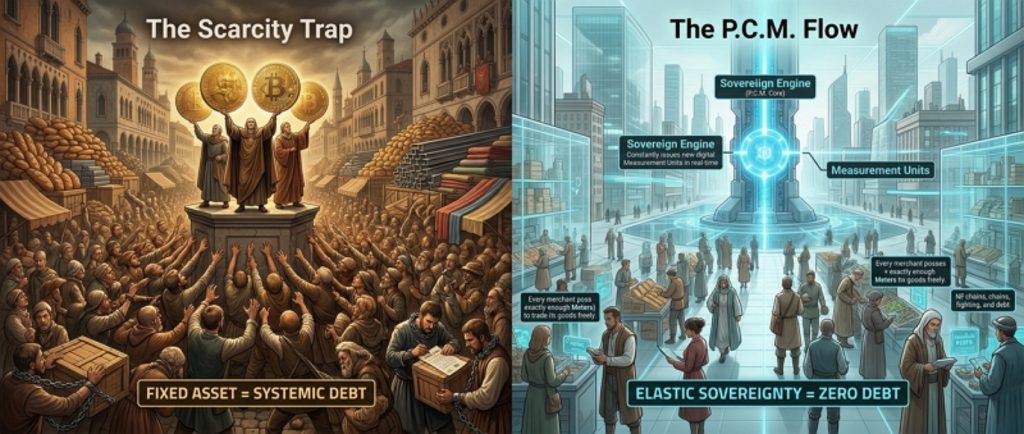
The Inconvenient Truth: Why Money MUST be “Fiat” (But NOT Debt)

The sound-money community (Gold and Bitcoin) has identified the correct symptom—inflation—but prescribed the wrong medicine: fixed scarcity. Here is the systemic reality: A sovereign civilization requires an elastic currency. The problem isn’t “Fiat”; the problem is Debt-Rental ($1.x). 1. Money is a Meter, Not a Trophy Imagine a construction site where the number of “Meters”

The Inconvenient Truth: Why Money MUST be “Fiat” (But NOT Debt) Read More »

definf

The Two Monsters: Why Both Inflation and Deflation Destroy Economies

A theoretical and historical analysis of the two fundamental monetary pathologies — and why anchoring money to productive capacity is the only architecture that eliminates both by design. In previous articles I have argued that money — what I call the F.V.I., the Fungible Value Index — is not a good. It is not a

The Two Monsters: Why Both Inflation and Deflation Destroy Economies Read More »

ecoequivalent due

ECO-EQUIVALENT AREAS: THE END OF MONETARY CAGE

Why the Euro Failed and How E.Q.U.A. Will Fix Global Trade. When we say “Eco-Equivalent,” we are talking about Economics, not Ecology. The current global monetary system, and specifically the Eurozone experiment, has proven a painful mathematical truth: you cannot use the same ruler to measure two different realities. 1. The Euro Lesson: Germany vs.

ECO-EQUIVALENT AREAS: THE END OF MONETARY CAGE Read More »

gaugeyoutube

The Ball Is 20 Centimeters. Can the Centimeters Generate More Centimeters?

The single most important distinction in monetary theory — explained with a ball, a thermometer, a clock, and a GPS. And why getting it wrong has produced $600 trillion of financial instruments that represent nothing real. I have been writing about monetary theory for 26 years. I have explained the $1.x design bug, the history

The Ball Is 20 Centimeters. Can the Centimeters Generate More Centimeters? Read More »

growth

When You Work, You Produce Value. Not Dollars. And That Distinction Changes Everything.

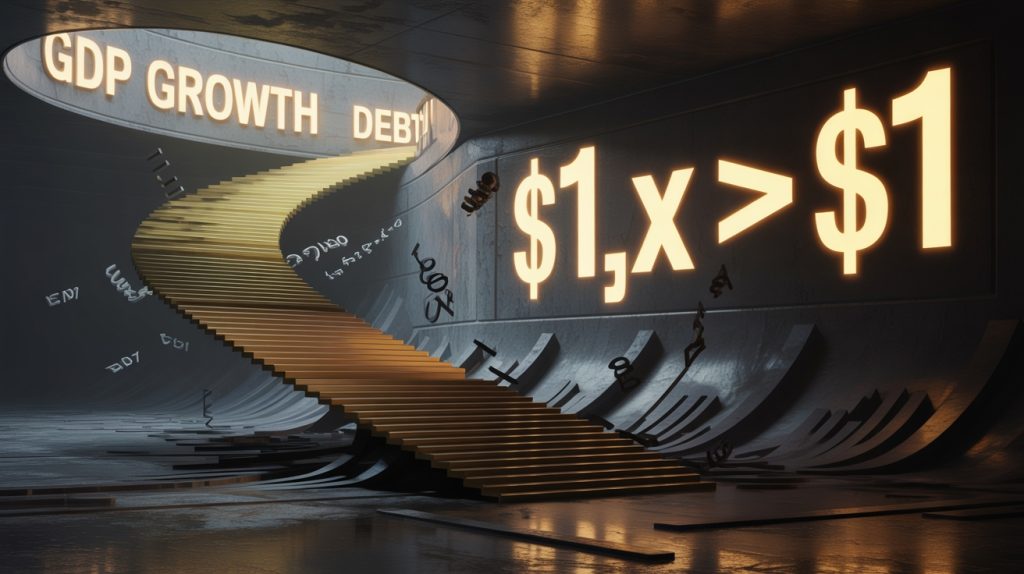
The clearest explanation of why economic growth does not solve the debt problem — and why, in the current monetary architecture, growth makes it worse. I want to start with something so obvious that it is almost never said out loud. When you go to work — when you bake bread, write code, treat a

When You Work, You Produce Value. Not Dollars. And That Distinction Changes Everything. Read More »