 Public Cash Money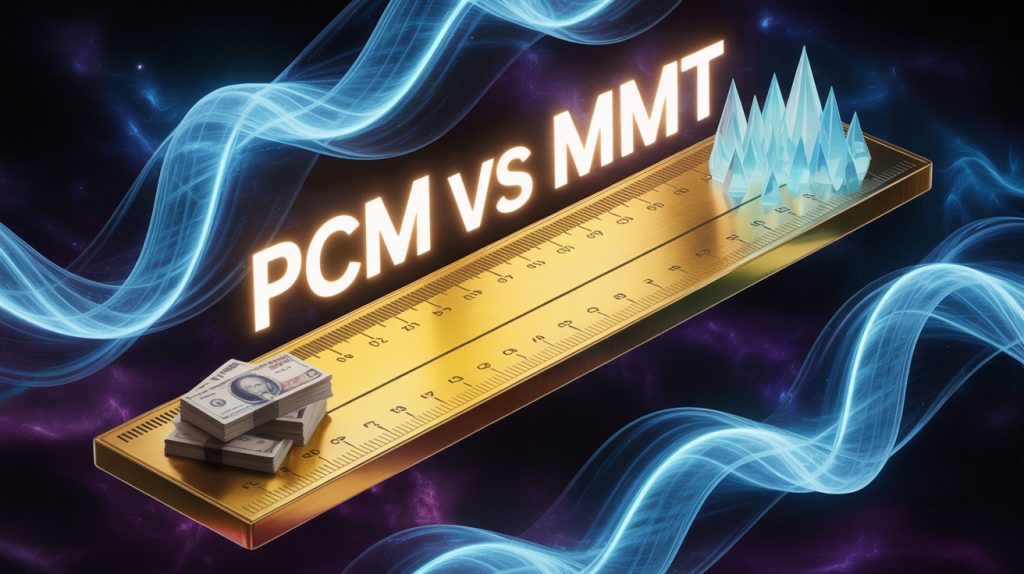
Both reject the idea that a sovereign state can “run out of money.” Both use inflation as the primary constraint on monetary issuance. Beyond that, they are built on fundamentally different foundations — and those differences determine everything.
The most common misreading of P.C.M. — Public Cash Money — by people who have some economics background is to say: “Oh, this is basically Modern Monetary Theory.” It is not. The surface resemblance is real. The structural difference is fundamental. And understanding the difference is not an academic exercise — it is the difference between a patch on a broken system and a replacement of the broken system itself.
Let me explain precisely where the two frameworks agree, where they diverge, and why the divergence matters more than the agreement.
1. Where They Agree: The Surface
MMT and P.C.M. share one foundational observation: a sovereign state that issues its own currency — in which it denominates its own debt, and which it controls the supply of — cannot be forced into involuntary default. It can always issue more currency to meet its obligations. The constraint on issuance is not solvency. It is inflation. This observation is correct, and both frameworks build on it.
Both also reject the household analogy for government finance — the idea that a government must “balance its books” the way a household must. A household cannot print money. A sovereign currency issuer can. The constraints are genuinely different. Both frameworks are correct on this point.
That is where the agreement ends.
2. The First Fundamental Difference: Who Controls the Inflation Constraint?
MMT argues that the inflation constraint should be managed by fiscal policy — by taxation. When too much money is in circulation and inflation rises, the government taxes to drain the excess. When the economy is sluggish and inflation is low, the government spends and reduces taxes. The instrument of monetary stability is the democratic legislature, acting through the tax code.
This is politically attractive. It restores fiscal sovereignty to elected governments. It removes the mystique of central bank independence. It says: the people’s representatives should decide how much money is in circulation, through the democratic process of taxation and spending.
But it has a structural weakness that MMT acknowledges but does not solve: the democratic process operates on electoral cycles of four to five years. Inflation operates on monthly data. The political incentive of any government approaching an election is to spend more and tax less — regardless of what the inflation constraint requires. MMT assumes that governments will act on the inflation constraint with the discipline of an engineer managing a thermostat. History suggests they act with the discipline of a politician managing their re-election.
P.C.M. removes this weakness by removing the discretion entirely. The inflation constraint in P.C.M. is not managed by a legislature. It is managed by a constitutional bracket — 2-4% — monitored in real time by an AI engine on a public blockchain, with an automatic stabilizer that activates without a parliamentary vote, without a central bank meeting, without any human decision at all. The thermostat is mathematical, not political. It cannot be overridden by an election. It cannot be adjusted by a lobbying campaign. It is, by design, incorruptible.
MMT inflation control
Managed by fiscal policy — taxation and spending decisions by elected legislatures. Politically accountable. Subject to electoral cycles, lobbying, and the permanent temptation to defer the inflation constraint until after the next election.
PCM inflation control
Managed by constitutional bracket — automatic, mathematical, real-time. AI measures. Blockchain records. Stabilizer activates without human discretion. Cannot be overridden by politics. Cannot be manipulated by power. Cannot be deferred by convenience.
3. The Second Fundamental Difference: The Nature of Money Itself
This is the deepest difference — and it is expressed most precisely in the language each framework uses.
MMT never challenges the fundamental nature of money. It accepts money as it currently exists — as a liability of the sovereign issuer, as a tool of fiscal policy, as an instrument that can be created and destroyed to manage economic conditions. MMT improves the management of the current instrument. It does not question what the instrument is.
P.C.M. begins by questioning what the instrument is — and proposing a different answer that changes everything downstream.
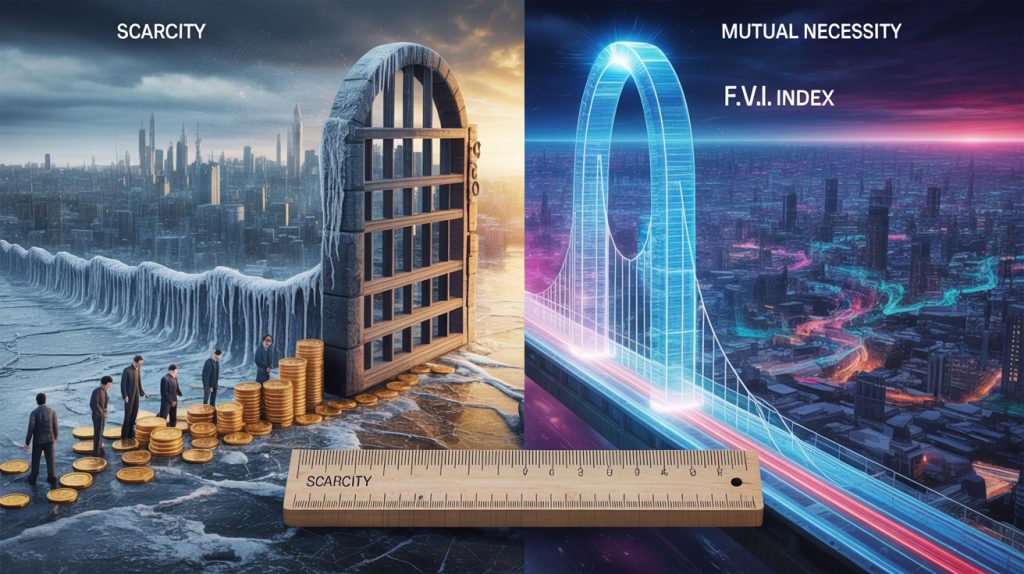
In P.C.M., money is the F.V.I. — Fungible Value Index. Not a good. Not a commodity. Not a store of value. An index — a measurement tool. The centimeters on a ruler. The degrees on a thermometer. The ruler does not contain the wall it measures. The thermometer does not contain the heat it records. The F.V.I. does not contain the value it represents. It measures it.
This distinction is not semantic. It is structural. A ruler has no intrinsic value. It cannot be hoarded to generate returns. It cannot be speculated on. It does not carry an interest obligation at the moment of its creation — because a ruler is not borrowed into existence. It is issued as a public measurement tool, available to everyone, charged to no one.
When money is understood as an index rather than a good, the entire conceptual framework of monetary policy changes. You do not “own” the centimeters on a ruler. You use them. You do not “accumulate” degrees of temperature. You measure them. The F.V.I. is the same: a public infrastructure for measuring and facilitating the exchange of real value. It is owned collectively, by the productive capacity it represents. It is issued proportionally to that capacity. It is governed, not managed. Thermoregulated, not administered.
MMT says: the government can issue more money and use taxation to control inflation. P.C.M. says: the government does not issue money at all in the sense MMT means. The Treasury issues an index — a ruler calibrated to the productive capacity of the economy. The ruler does not belong to the government. It belongs to the economy it measures. And it cannot charge rent on the act of measurement.
4. The Third Fundamental Difference: Public Debt
MMT reframes public debt but does not eliminate it. In MMT, government bonds are understood not as debt in the household sense — obligations that must be repaid from income — but as monetary instruments that drain reserves from the banking system and provide a safe asset for savers. The “debt” is real, but its significance is reinterpreted. It is not a burden to be eliminated. It is a tool to be managed.
P.C.M. eliminates public debt as a category. Not reframes it. Eliminates it.
When the Treasury issues F.V.I. directly — not by borrowing from private banks, not by issuing bonds that carry interest obligations — there is no debt. There is only issuance. The concept of “public debt” in P.C.M. is replaced by a different concept entirely: Monetary Thermoregulation.
Monetary Thermoregulation is not debt. It is the adjustment of the monetary temperature — the expansion or contraction of the F.V.I. supply — to maintain the productive capacity of the economy within the conditions that allow it to function optimally. When the economy grows, more F.V.I. is issued — not borrowed, issued — to represent the additional productive capacity. When the economy contracts, F.V.I. is withdrawn through the automatic stabilizer. No obligation is created. No interest accrues. No compound growth of liability is embedded in the act of issuance.
The $39 trillion in US national debt is, in P.C.M. terminology, not a debt. It is the accumulated evidence of seven centuries of misidentifying monetary issuance as borrowing — of charging rent on the centimeters of a ruler that should have been free to use from the beginning.
5. The Fourth Fundamental Difference: Scope
MMT is a national framework. It works for countries with full monetary sovereignty — the United States, the United Kingdom, Japan, Australia. Countries that issue their own currency, denominate their own debt in that currency, and float freely in currency markets. MMT explicitly does not apply to Greece, to Ecuador, to any country that has surrendered monetary sovereignty or borrowed in a foreign currency. It is a framework for the privileged minority of nations that happen to control their own money supply.
P.C.M. is a global framework. Through the E.Q.U.A. architecture — the Eco-Equivalent Quantitative Unit of Account — it provides a mechanism by which every nation, every eco-equivalent area, every economy regardless of size or current monetary sovereignty can participate in a stable, transparent, incorruptible global monetary system. No nation is excluded because it is too small or too weak. No nation has a structural advantage because it happens to issue the global reserve currency. The playing field is level — not by political declaration, but by mathematical design.
6. E.Q.U.A.: The Reference That Is Never Emitted
This brings us to perhaps the most technically innovative element of the P.C.M. framework — one that has no equivalent in MMT.
E.Q.U.A. is not a currency. It will never be emitted. No one will ever buy groceries with E.Q.U.A. It is a reference unit — the monetary equivalent of Greenwich Mean Time. Every country keeps its own time. Every country issues its own F.V.I. But all of them are calibrated against the same meridian. E.Q.U.A. is that meridian.
The dollar-PCM will be worth X E.Q.U.A. The euro-PCM will be worth Y E.Q.U.A. The rupee-PCM will be worth Z E.Q.U.A. These ratios are not decided by central banks or diplomatic agreements. They emerge automatically from the relationship between each area’s real inflation rate and the E.Q.U.A. reference. An area that maintains lower inflation sees its currency appreciate against E.Q.U.A. An area with higher inflation sees its currency depreciate. The FOREX market adjusts automatically, continuously, without political intervention.
But here is the question that any serious analyst must ask: how do you establish the initial calibration? How do you determine what $1(pcm) is worth in E.Q.U.A. relative to €1(pcm)? You need a common reference point that is independent of any single area’s monetary policy — a measurement that every area accepts as fair because it is anchored to something universal.
The answer is the Common Base Basket — and this is where P.C.M. goes beyond anything that existing monetary theory, including MMT, has articulated.
7. The Common Base Basket: Hours of Human Life, Not Prices
The Common Base Basket for E.Q.U.A. calibration is composed of universally consumed essential goods — bread, water, basic shelter, minimum energy, basic clothing. These are not chosen arbitrarily. They are chosen because they satisfy the most fundamental Mutual Necessities of human existence — the goods that every human being, in every area, in every culture, requires simply to stay alive and productive.
But — and this is the crucial innovation — the basket is not calibrated in price terms. It is calibrated in labor time terms. Not “how many dollars does a kilo of bread cost” but “how many minutes of average labor does a kilo of bread cost.”
Why does this matter? Consider the example:
CountryPrice of 1kg breadMinutes of avg labor
SwitzerlandCHF 3.00 (avg wage CHF 37/hr)~5 minutes
India₹40 (avg wage ₹125/hr)~19 minutes
Nigeria₦800 (avg wage ₦600/hr)~80 minutes
In price terms, Nigerian bread is “cheap.” In labor time terms, it costs sixteen times more than Swiss bread — sixteen times more human life to acquire the same kilo of nutrition. A calibration based on prices would systematically undervalue the purchasing power of workers in developing economies. A calibration based on labor time measures what actually matters: how much of a human life — the only truly universal currency — is required to access the fundamental necessities of existence.
This is not a theory of global equality imposed by political fiat. It is a measurement methodology that uses the only unit of account that is genuinely universal: human time. An hour of human life in Nigeria is worth exactly as much as an hour of human life in Switzerland — not in monetary terms, but in the only terms that the Principle of Mutual Necessity recognizes as fundamental. Both hours are irreversible. Both hours are finite. Both hours represent the same irreplaceable quantity of human existence.
The E.Q.U.A. calibration based on labor time does not equalize wages across areas — that would be economically incoherent and would destroy the productive diversity of the global economy. It simply ensures that the reference unit against which all currencies are measured is anchored to something that is genuinely universal and genuinely incorruptible: the proportion of average human working time required to access the most fundamental necessities of life.
The traditional PPP asks: how much does bread cost? The E.Q.U.A. Common Base Basket asks: how many minutes of your life does bread cost? The first question compares prices. The second question compares real purchasing power. The first answer can be manipulated by monetary policy. The second answer cannot — because an hour of human life is the same everywhere.
8. The Complete Comparison: PCM vs. MMT
MMT
Money: Sovereign liability, tool of fiscal policy. Inflation control: Taxation — political, discretionary, electoral. Public debt: Reframed as monetary instrument, not eliminated. Scope: National — only for monetarily sovereign states. Global reference: None — floating exchange rates. Measurement anchor: Official CPI — subject to methodological distortion.
PCM
Money: F.V.I. — Fungible Value Index. Not a good. A measurement tool. Inflation control: Constitutional bracket — automatic, mathematical, incorruptible. Public debt: Eliminated as category. Replaced by Monetary Thermoregulation. Scope: Global — every eco-equivalent area, via E.Q.U.A. Global reference: E.Q.U.A. — never emitted, only referenced. The monetary Greenwich. Measurement anchor: Common Base Basket calibrated in labor time — universal, incorruptible.
Conclusion: A Patch vs. A Replacement
MMT is an important and intellectually serious framework. It correctly identifies that sovereign currency issuers are not constrained by solvency in the way households are. It correctly challenges the austerity narrative that has caused enormous unnecessary suffering in countries that could have issued their way out of recessions. It deserves serious engagement.
But MMT is a patch. It operates within the existing monetary architecture — accepting money as a sovereign liability, accepting debt as a policy tool, accepting the official inflation measurement as the constraint, accepting national monetary sovereignty as the framework. It makes the existing system work better. It does not replace the existing system.
P.C.M. is a replacement. It begins by questioning what money is — and answering with a fundamentally different definition. F.V.I., not sovereign liability. Index, not good. Ruler, not commodity. From that different foundation, everything downstream is different: the inflation constraint is mathematical not political, public debt is eliminated not reframed, the global architecture includes everyone not just the monetarily privileged, and the reference unit is anchored to human labor time not to official statistics.
The neologisms are not marketing. F.V.I. is not a rebranding of “money.” Monetary Thermoregulation is not a rebranding of “fiscal policy.” E.Q.U.A. is not a rebranding of “reserve currency.” Each term describes a structurally different thing — and the structural difference is the point.
A patch on a broken system makes the system more comfortable to inhabit. A replacement of the broken system removes the source of the discomfort. P.C.M. is a replacement. MMT is a very good patch.
Both are better than what we have. Only one addresses the $1.x design bug at its root.
MMT asks: how do we manage money better? P.C.M. asks: what is money, really? The first question produces better policy. The second question produces a different system. The wall needs better measurement. Not a better way to rent the ruler. $2+2=4. Period.