 Public Cash Money
The problem with 1971 was not that Nixon abandoned gold. Gold was always the wrong anchor. The problem was that in the precise moment when the architecture could have been redesigned correctly, nobody in the room asked the right question
There is a version of the 1971 story that almost everyone tells. Nixon, facing a currency crisis, unilaterally abandoned the gold standard — the foundation of Bretton Woods — and unleashed fifty years of monetary instability, inflation, and debt accumulation. In this version, gold was the hero, Nixon was the villain, and the solution is to go back to where we were before August 15, 1971.
This version is wrong. Not because Nixon did the right thing — he did not. But because it misidentifies both the crime and the victim.
Gold was never the right anchor. It had already proven insufficient in the 1870s, catastrophic in the 1930s, and mathematically impossible to maintain by the late 1960s. When the US gold stock fell to $10 billion against $40 billion in dollar liabilities — when European central banks were literally sending ships to collect their gold — the gold window had to close. Nixon had no choice about that. Herbert Stein, one of the advisors in the room at Camp David, confirmed it in a 1998 interview: the decision itself was not controversial among the economists present. It was mathematically necessary.
The crime was not closing the gold window. The crime was what Nixon and his advisors did — and did not do — in the three days that followed.
1. Camp David, August 13-15, 1971: What Was on the Table
From Friday afternoon to Sunday evening, President Nixon convened fifteen of his most senior economic advisors at the presidential retreat at Camp David, Maryland. The meeting was secret — participants were instructed not to tell their families where they were going. The decisions made that weekend would affect the material lives of every person on earth for the next fifty years.
The key figures in the room, and what each of them wanted:
Richard Nixon
Cared primarily about domestic political optics. Wanted to look bold and decisive to the American public. Was facing re-election in 1972. The international monetary architecture was secondary to the political narrative.
John Connally (Treasury)
Wanted to use the closure of the gold window as a weapon — to “bludgeon” surplus countries like Germany and Japan into revaluing their currencies. His famous line: “The dollar is our currency, but it is your problem.”
Arthur Burns (Fed Chairman)
Worried about foreign reaction to closing the gold window. Loved wage and price controls as an inflation tool. Wanted to save the fixed exchange rate system if possible.
Paul Volcker (Treasury Undersecretary)
Had spent his career trying to save the Bretton Woods fixed exchange rate system. Deeply uncomfortable with the decision. Would later become Fed Chairman and fight inflation with historically high interest rates.
George Shultz (OMB)
Student of Milton Friedman. Wanted floating exchange rates — let markets determine currency values. Hated price controls. Got floating rates but had to accept controls as part of the political package.
Five agendas. Five visions of what should happen next. And according to Herbert Stein, who was in the room, one stunning absence: there was no discussion at Camp David of what outcome was actually sought in international monetary policy. They discussed tactics. They did not discuss architecture.
Three days. The most powerful economic minds in America. The moment when the global monetary architecture was being redesigned from scratch. And according to a participant’s own testimony, nobody discussed what the new architecture should achieve. They fixed the immediate problem. They did not ask what should replace what they were dismantling.
2. The Question Nobody Asked
When you remove gold as the anchor of a monetary system, you face an immediate and unavoidable question: what replaces it? What does the dollar represent, if not a fixed quantity of gold? What prevents the monetary system from expanding without limit? What connects the unit of account to the real economy it is supposed to measure?
At Camp David, this question was not asked. It is not a matter of interpretation — it is documented. Herbert Stein stated explicitly in a 1998 interview that the participants were unclear whether closing the gold window even implied floating the dollar. The question of what the new anchor would be was simply not on the agenda.
The options available in 1971, had anyone thought to ask:
Option 1 — New fixed rates: Keep exchange rates fixed but at new, more realistic levels. This was Volcker’s preference. It was attempted briefly at the Smithsonian Agreement in December 1971 and collapsed by 1973.
Option 2 — Floating rates: Let markets determine currency values. This was Shultz and Friedman’s preference. It was what ultimately happened. It solved the immediate problem — the gold drain stopped — and created a different structural problem: without any anchor to real value, the monetary system could now expand without limit, constrained only by the willingness of markets to absorb the debt.
Option 3 — Anchor to productive capacity: This option was not on the table. Not because it had been considered and rejected. Because the intellectual framework of the economists in the room — shaped by decades of thinking about gold, fixed rates, and floating rates — did not include it as a conceivable alternative. The idea of anchoring money to the productive capacity of the economy, governed by a constitutional inflation bracket, monitored in real time, was not part of the vocabulary available to the participants.
It was available in principle. The mathematics existed. The conceptual foundation existed — Keynes had sketched it in 1936 and developed it further in his Bancor proposal of 1944. But it had been defeated at Bretton Woods, buried in the academic literature, and excluded from the mainstream by the incentive structure of an economics profession shaped — as I documented in article 14 — by a prize funded by a central bank.
The right question was not asked at Camp David not because the people in the room were stupid. They were among the most brilliant economic minds of their generation. The right question was not asked because the system that trained those minds had systematically excluded it from the available vocabulary. You cannot ask a question that your intellectual formation has made unthinkable.
3. The Old Software on New Hardware
Here is the precise nature of the error that was made on August 15, 1971.
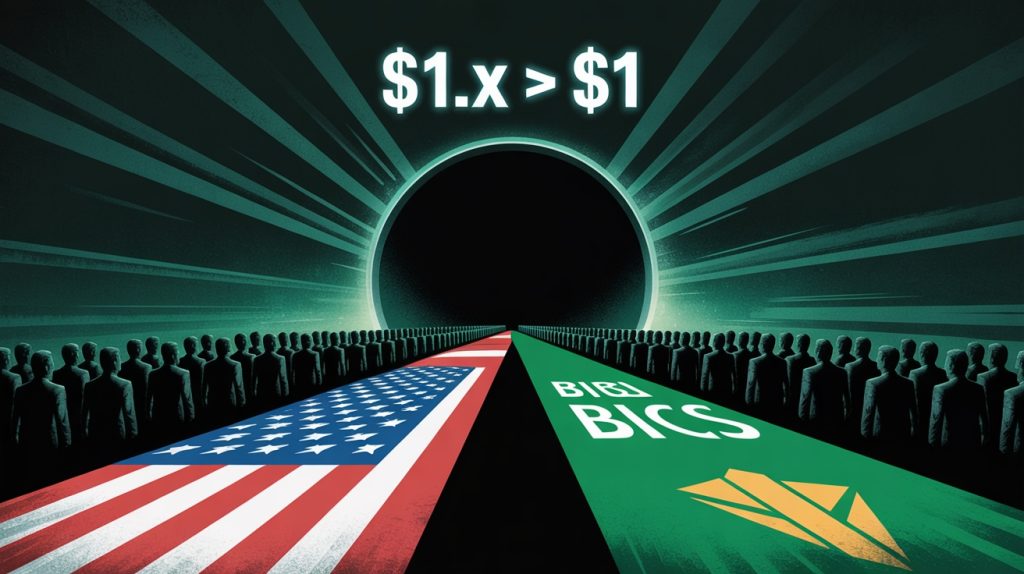
Before that date, money was debt — but debt constrained by gold. The $1.x > $1 design bug was running, but its worst effects were partially contained by the physical limit of the gold supply. You could not expand the money supply faster than your gold reserves allowed. The bug generated debt and inflation, but the gold constraint imposed a ceiling — however arbitrary and economically irrational that ceiling was.
On August 15, 1971, the ceiling was removed. Money remained debt — every dollar still borrowed into existence, still carrying an interest obligation that was never issued alongside the principal. But the physical constraint that had partially contained the bug was gone. The $1.x design bug was now running on fiat infrastructure — infinitely expandable, constrained only by market confidence and political will.
It is precisely the situation a software engineer faces when they migrate an application with a known bug from old hardware with limited memory to new hardware with unlimited memory. On the old hardware, the bug caused occasional crashes — painful but bounded. On the new hardware, the bug runs unimpeded. The application does not crash immediately. It expands. It consumes more and more resources. And the crash, when it finally comes, is proportionally larger — because the system has had decades to accumulate the consequences of a bug that was never fixed.
US national debt in 1971: approximately $400 billion. US national debt today: $39 trillion. A 97-fold increase in fifty-three years. Not because Americans became reckless. Because the bug that was always in the architecture was finally unchained from the only constraint that had been limiting its growth.
4. What 1971 Could Have Been
This is the hardest part of the analysis — and the most important. Because the question is not just what went wrong, but what could have gone right.
In August 1971, for the first and — so far — only time in modern monetary history, the architecture of the global monetary system was genuinely up for redesign. The gold anchor had demonstrably failed. The Bretton Woods fixed rate system was collapsing. There was a brief window — days, perhaps weeks — in which the question “what should money be anchored to?” was genuinely open.
The technology of 1971 could not have implemented a P.C.M. system in its full form. There were no real-time inflation measurement systems. There were no public blockchains. There was no AI. The mutual guarantee mechanism that P.C.M. requires — the incorruptible, publicly verifiable ledger that prevents any government from manipulating its own inflation data — was technically impossible.
But the conceptual foundation could have been established. The principle could have been declared: money will henceforth be anchored not to gold, not to debt, but to the productive capacity of the economy, measured by inflation within a constitutional bracket. The implementation would have been imperfect — as every monetary system’s implementation is imperfect. But the direction would have been correct. And the $1.x design bug, instead of being unchained, would have been named, targeted, and placed on the path to correction.
Instead, the decision at Camp David was to let the dollar float — to anchor it to nothing except market confidence and the political willingness of the US government to manage its own debt. It was the minimal intervention. The path of least institutional resistance. The solution that required no new thinking, no new architecture, no confrontation with the interests that had been extracting rent from the $1.x system for decades.
It was also — as its architects themselves later acknowledged — a political success and an economic failure. The Dow Jones rose 33 points on August 16, 1971 — its largest single-day gain in history to that point. The New York Times editorial board applauded the boldness. Nixon was re-elected by a historic landslide in 1972. And the stagflation of the 1970s, the debt accumulation of the 1980s, the financial crises of the 1990s and 2000s, and the $39 trillion of national debt in 2026 followed, in sequence, from the decision made in three days at a mountain retreat in Maryland.
5. The Predator Unchained
In the years before 1971, the gold standard functioned as a chain on the predator — the $1.x design bug that generates debt faster than the economy can service it. The chain was crude. It was irrational. It caused deflations and depressions when gold supply failed to keep pace with economic growth. It was the wrong chain for the wrong reason. But it was a chain.
On August 15, 1971, the chain was removed. The stated reason was correct: gold was insufficient and anachronistic. But removing the chain without changing the predator’s diet meant that the predator was now free to consume without limit.
The correct response to a predator on a chain that is causing damage is not to remove the chain and hope for the best. It is to change the predator’s diet — to redesign the system so that the predator no longer needs to consume what it was consuming. In monetary terms: to remove the debt structure that makes continuous expansion necessary, and replace it with an architecture anchored to real productive capacity.
That would have required confronting the “printer owners” — the institutions that had been extracting rent from the $1.x system since Venice in 1374 and had institutionalized their privilege in the Federal Reserve Act of 1913. It would have required the kind of institutional courage that redesigned the global monetary system at Bretton Woods in 1944 — and that was not present in the room at Camp David in 1971.
Instead, the chain was removed. The predator was unchained. And for fifty-three years, it has been eating.
6. Why 1971 Matters Now
The reason this history matters in 2026 is not nostalgic. It is not to assign blame to people who made decisions half a century ago under enormous pressure in conditions of genuine uncertainty.
It matters because we are approaching another Camp David moment. The $39 trillion in national debt, the $1.172 trillion in annual interest, the CBO’s projection of a debt spiral threshold around 2031 — these are the arithmetic equivalent of the $10 billion gold stock against $40 billion in liabilities that made the 1971 decision unavoidable. The current architecture is failing by the same mathematical logic that made the gold standard fail.
The difference is that in 2026, unlike in 1971, the alternative architecture exists — not just as a concept, but as a technically implementable framework. The AI that can measure real inflation in real time exists. The blockchain that can provide the incorruptible public ledger exists. The mathematical framework of Monetary Thermoregulation — anchoring money to productive capacity within a constitutional bracket — has been developed and documented.
The question is whether, when the next Camp David moment arrives, the people in the room will ask the question that was not asked in 1971: not “how do we fix the immediate crisis?” but “what should money be anchored to, if we are redesigning the architecture from scratch?”
In 1971, the question was not asked because the intellectual framework of the time had made it unthinkable. In 2026, the question is thinkable. It is being asked — in this series, and by a growing number of people who have read this series and others like it. The window is narrower than it was in 1971, because the debt has accumulated for fifty more years. But it is open.
1971 was not the funeral of gold. Gold was already dead, killed by its own scarcity in a growing economy. 1971 was the day the predator was unchained instead of retrained. The chain was wrong and removing it was right. What replaced it was the mistake. Nothing replaced it. And fifty-three years later, we are living with the consequences of that empty space. $2+2=4. Period.