 Public Cash Money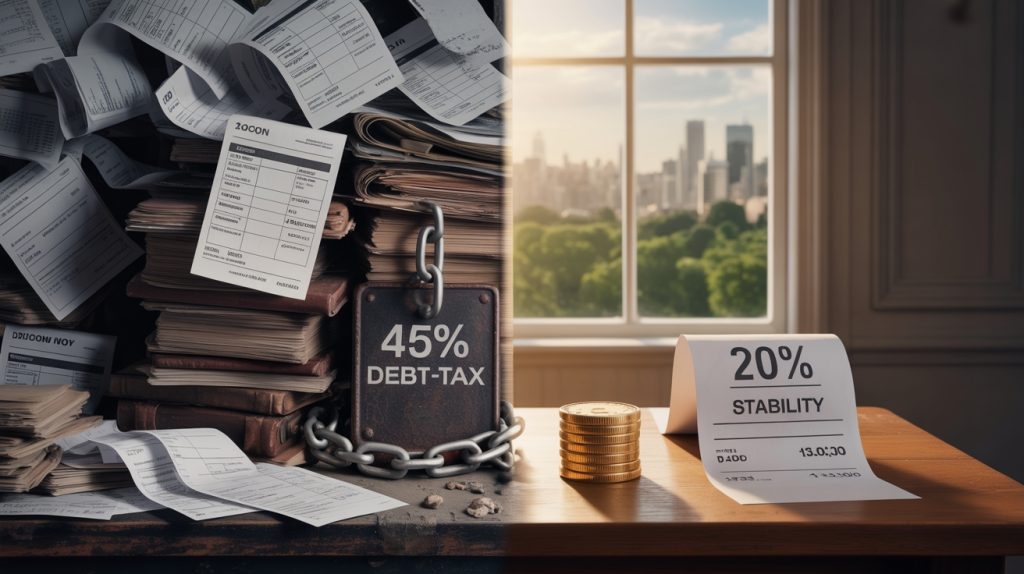
The most common objection to P.C.M. is: “People already pay too many taxes. Would they accept an Inflationary Surcharge on top of everything else?” The answer is: in P.C.M., there is no “everything else.”
When I explain the Inflationary Surcharge — the automatic, one-time levy on large deposits that activates when real inflation approaches the constitutional bracket — the most common reaction is immediate and understandable: “People are already crushed by taxes. You want to add another one?”
The reaction is understandable because it assumes the current tax architecture remains in place and the Inflationary Surcharge is added on top of it. That assumption is wrong. It is precisely backwards.
In P.C.M., the Inflationary Surcharge is not a new tax on top of existing taxes. It is a monetary stabilization mechanism that replaces the need for most of the existing tax system. To understand why, we need to understand why taxes exist in the first place — and what changes when you remove the structural reason for most of them.
1. Why Governments Tax: The Real Reason Nobody Teaches
The official explanation for taxation is that governments need money to fund public services. This explanation is correct — but incomplete in a way that matters enormously.
In a debt-based monetary system, the government cannot simply issue the money it needs. It must borrow it — by issuing bonds, which creates debt, which generates interest, which requires more borrowing. To service this debt — to pay back principal and interest — the government must extract money from the economy it governs. This extraction is called taxation.
Taxes in the current system serve two functions simultaneously. The first is the one everyone knows: funding public services. The second is the one nobody talks about: managing a monetary system that cannot self-fund because every dollar it spends was borrowed at interest and must eventually be returned with that interest attached.
Remove the debt. Remove the interest. And the second function of taxation — the one that generates the crushing complexity of the current tax code — disappears entirely. What remains is only the first function: funding the services that the society has chosen to provide collectively.
Taxes in the current system are not just about funding services. They are about servicing a monetary architecture that was designed to perpetually indebted the state to the institutions that create its money. Remove that architecture, and most of the tax burden goes with it.
2. Capital vs. Current: The Distinction That Changes Everything
Before we can design a tax system for P.C.M., we need to establish a distinction that public accounting already recognizes but that monetary reform rarely discusses explicitly.
There are two fundamentally different categories of public expenditure.
The first is capital expenditure — the construction of physical infrastructure that generates value over decades. A hospital, a school, a road, a railway line, a power grid, a water system. These are investments, not costs. They create durable productive capacity that serves the economy for generations. In P.C.M., these are financed by direct Treasury issuance of F.V.I. — not debt, not taxation, but the direct creation of monetary representation for real value being added to the economy. The hospital exists. It generates real output — healthcare — for forty years. The F.V.I. issued to build it is absorbed by the real value it creates. This is Monetary Thermoregulation applied to infrastructure investment.
The second is current expenditure — the ongoing cost of running the infrastructure that has been built. Doctors’ salaries. Nurses’ salaries. Medicines. School supplies. Teachers’ salaries. Road maintenance. Energy for public buildings. These are not investments. They are recurring costs that must be covered by recurring revenue. If you financed them by continuous monetary issuance, the money supply would expand permanently, the Inflationary Surcharge would activate permanently, and the bracket would become not an exception but a structural feature.
The correct instrument for covering current expenditure is a tax on current economic activity. And the simplest, most transparent, most enforceable, and most equitable instrument for that purpose is a Value Added Tax — applied to every transaction, at the point of exchange, on the consumption of real goods and services.
3. The Rough Mathematics: A First-Order Estimate
I want to show the arithmetic that supports this claim. I want to be explicit about what these numbers are and what they are not.
Methodological note. The following calculation is a first-order estimate — what engineers call an “envelope calculation.” It uses verified official data for inputs and applies simple arithmetic to produce an order-of-magnitude result. It is not a precise policy proposal. The actual VAT rate required in a P.C.M. system would depend on many factors that this calculation cannot capture: the precise definition of what constitutes capital vs. current expenditure, the transition path from the current system, the distribution of consumption across income levels, and the specific services the society chooses to fund publicly. What the calculation does establish is that the order of magnitude is plausible — that a single VAT can cover public current expenditure at a rate that is not obviously higher than the current total tax burden on ordinary Americans.
US total federal spending FY2025 (verified, USAFacts/CBO)$7.1T
Minus: net interest on debt (disappears in PCM)-$0.97T
Minus: Social Security (becomes autonomous INPS)-$1.4T
Minus: Medicare/Medicaid (partly capital, partly current — estimate 50% becomes capital investment financed by F.V.I. issuance)-$0.75T
Estimated current expenditure to cover via VAT~$3.98T
Note: these are rough estimates. Real-world implementation would require detailed classification of each expenditure category. The purpose is order-of-magnitude, not precision.
US nominal GDP 2025 (verified, IMF)$30.6T
Personal consumption as % of GDP (verified, BEA)~68%
Estimated VAT base (consumption)~$20.8T
Required average VAT rate ($3.98T / $20.8T)~19-22%
Note: VAT base adjustments (exemptions for basic necessities, higher rates for luxury goods) would shift the distribution but not the total. The average rate would remain in this range.
Approximately 19-22% average VAT rate to cover all public current expenditure — with no income tax, no payroll tax, no corporate tax, no capital gains tax, no estate tax, no property tax at the federal level.
4. The Comparison That Changes the Conversation
Let us now compare this with what an ordinary American actually pays today.
Current US system
Federal income tax: 22% (median bracket). Payroll tax: 7.65% (employee share). State income tax: ~5% average. Sales taxes: 6-9% on purchases. Property taxes: ~1-2% of home value annually. Plus: corporate taxes embedded in prices, fuel taxes, phone taxes, utility taxes…
Effective total burden on median household: 38-45% of gross income.
PCM system
VAT on consumption: ~20% average (differentiated by category — essentials lower, luxuries higher). INPS contribution: voluntary above minimum, proportional to desired pension level. Inflationary Surcharge: exceptional, automatic, only on large deposits, only when inflation approaches bracket ceiling.
Effective total burden on median household: approximately 20% of consumption — paid only when spending, not when earning.
The comparison is not perfectly apples-to-apples — the current system includes state and local taxes that would need their own analysis in a PCM framework. But the order of magnitude is clear: a median American household currently pays 38-45% of its income in various taxes. In P.C.M., it would pay approximately 20% of its consumption in a single, visible, unavoidable VAT — and nothing else at the federal level.
In P.C.M., you do not pay tax when you earn. You pay tax when you spend. You pay one rate, on one instrument, visible on every receipt. No income tax return. No payroll deductions. No corporate tax embedded invisibly in the price of everything you buy. One tax. Transparent. Universal. Proportional to consumption.
5. Why VAT Is the Right Instrument
The choice of VAT as the single tax instrument in P.C.M. is not arbitrary. It has several properties that make it uniquely suited to the architecture.
First, it is collection-proof in a blockchain economy. In the current system, VAT and sales tax evasion is possible because transactions can be hidden or misreported. In a P.C.M. economy where the F.V.I. runs on a public blockchain and every transaction is recorded as part of the same infrastructure that measures inflation, evasion becomes structurally difficult. You cannot hide a transaction from the inflation meter without hiding it from the VAT system simultaneously. The same technology that makes P.C.M. monetarily incorruptible makes it fiscally transparent.
Second, it is naturally progressive without being declared as such. Essential goods — food, basic clothing, medicines, public transport — can carry a low rate or zero rate. Luxury goods and discretionary consumption carry a higher rate. The wealthy, who spend more on discretionary goods, pay more in absolute and proportional terms without requiring a complex progressive income tax structure that consumes vast administrative resources and generates enormous compliance costs.
Third, it does not penalize work. The most economically destructive feature of the current tax system is that it taxes the act of earning — through income tax and payroll tax — before the money has been used for anything. This creates a structural disincentive to productive work and a structural incentive to structure income in ways that reduce taxable liability. VAT taxes consumption, not production. It does not penalize the worker for working. It only applies when the worker chooses to spend.
6. The INPS: Not a Tax, a Choice
The one element of the current fiscal system that survives in P.C.M. — in modified form — is the contributory pension system. I call it INPS, using the Italian acronym, but the principle is universal.
In P.C.M., there is a minimum universal pension — guaranteed to every citizen as a matter of right, financed by the Treasury’s direct F.V.I. issuance as a Mutual Necessity expenditure. It is not generous. It is not comfortable. It is the minimum required for dignified survival. Everyone receives it. No contribution required.
Above that minimum, the pension is voluntary and proportional. You contribute more during your working life, you receive more in retirement. This is not a tax. It is a savings instrument — a long-term allocation of current consumption in exchange for future security. The state manages it. The mathematics are transparent. The contribution is your choice, above the minimum guaranteed level.
The funds collected are not spent by the state. They are held — in real assets, in inflation-protected instruments — and returned to contributors in retirement. The state does not need these funds to operate. It has the F.V.I. issuance mechanism for that. The INPS funds are genuinely the contributors’ money, held in trust, available when needed.
Conclusion: The Inflationary Surcharge in Context
Now we can return to the original question. Would people accept an Inflationary Surcharge?
In the current system, where they already pay 38-45% of their income in taxes: no, understandably not.
In P.C.M., where the Inflationary Surcharge is the exceptional, automatic, one-time stabilization mechanism that activates only when inflation approaches the constitutional ceiling, applied only to large deposits above a defined threshold, in a system where the only regular tax is a single VAT of approximately 20% on consumption: the question changes entirely.
The Inflationary Surcharge is not a tax. It is a thermostat. It is the automatic cooling mechanism of a monetary system designed to maintain stable temperature. Most people will never pay it — because they do not hold deposits above the threshold. Those who do will pay it rarely and in small amounts — because the constitutional bracket is designed to prevent the conditions that would trigger it from persisting.
These numbers are rough. The real-world implementation of a P.C.M. tax architecture would require detailed modeling of expenditure categories, consumption distributions, and transition mechanics that no single article can capture. I am not presenting a precise policy proposal. I am presenting an order-of-magnitude demonstration that the arithmetic works — that a single, simple, transparent VAT can cover the genuine current expenditure needs of a modern state at a rate that is substantially lower than the total tax burden citizens currently bear.
The rest is implementation detail. Important detail — but detail that should be worked out by the people who will live under the system, not pre-decided by any single analyst writing articles on the internet.
One tax. Paid when you spend, not when you earn. Visible on every receipt. Approximately 20% average on consumption. Instead of 38-45% on everything. This is not a tax increase. It is a tax system replaced. $2+2=4. Period.