 Public Cash Money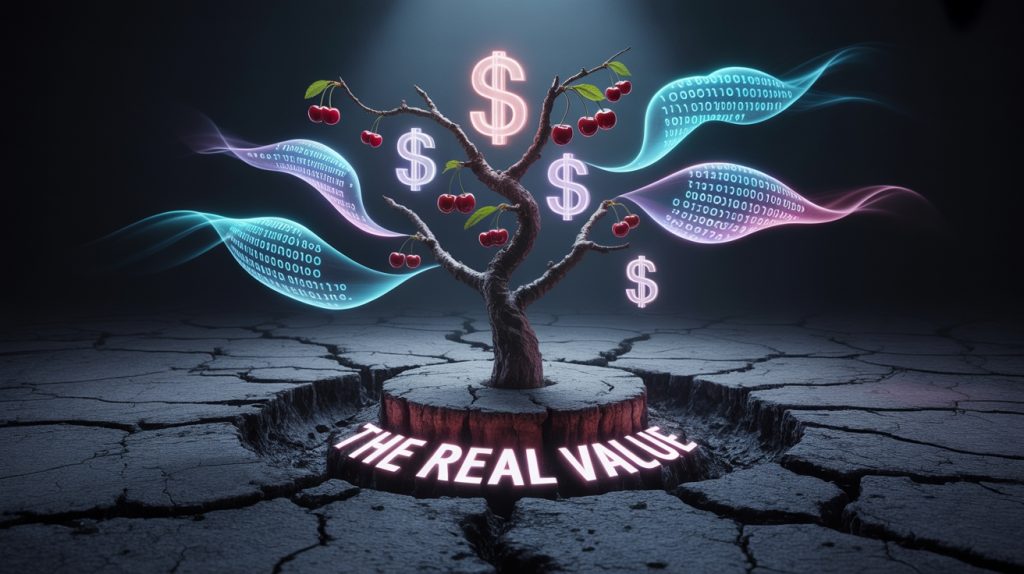
The most important question in finance that nobody asks: when a speculative asset loses 80% of its value overnight, where does the money go?
I am a farmer’s son. I grew up watching cherry trees. And one thing I learned early, watching those trees, has served me better in understanding financial markets than any economics textbook I have ever read.
A cherry tree gives fruit. But only because it extracts sap from the earth. There is no fruit without sap. There is no value without a source.
This is the First Law of Thermodynamics, stated in the language of a farmer: energy cannot be created from nothing. It can only be transformed. You cannot get more out than you put in.
Now I want to ask you a question that the financial industry has spent decades making sure you never think to ask.
If a stock market index loses three trillion dollars of value in a single day of trading — where does that three trillion dollars go?
1. Four Types of Value. Only One Is Real.
The first type is productive value. A factory, a farm, a skilled worker. These things generate real output. They draw sap from the earth. The value they create is real because it corresponds to something physical.
The second type is ownership value. A share in a company that produces real goods and services. When you buy a share, you are buying a fraction of a cherry tree. Your dividend is real because it comes from real production.
The third type is commodity value. Gold, silver, copper, wheat. These things exist physically. Gold sitting in a vault generates no fruit. But if everyone decides gold is worthless, the gold does not disappear. It is still there.
The fourth type is promise value. A derivative, a future, an option. This is not a thing. It is a promise about a thing. It has no physical existence. It exists only as long as both parties believe it has value.
The cherry tree gives fruit because it has roots. The share gives dividends because the company has workers. The gold bar exists because the earth produced it. The derivative exists because two parties agreed it does. Only one of these four types of value can disappear without a physical cause.
2. The Wheat Field and the Stock Market
Imagine you own a wheat field. The market for wheat collapses. Nobody wants to buy wheat at any price. But the wheat is still there. The soil is still there. To make your wheat field actually disappear you need a hurricane, a drought, a plague of locusts. You need a physical cause.
Now imagine you own a derivative contract. The market collapses. Your derivative is now worthless. Where did the value go? Nowhere. It was never there. What you owned was not wheat. It was a promise that wheat would be worth more. When the promise became implausible, the value did not move — it ceased to exist. There was no hurricane. There was only a change in collective belief.
3. Where Does the Money Go When Markets Crash?
When a stock market index loses three trillion dollars of value in a single day, that three trillion dollars does not go anywhere. It does not flow to another asset. It does not accumulate in someone’s bank account. It simply ceases to exist — because it only existed as a collective agreement about what things were worth, and that agreement broke down.
The First Law of Thermodynamics has not been violated. It has been circumvented — not by creating value from nothing, but by creating the appearance of value from nothing, maintaining that appearance through collective belief, and then allowing the appearance to dissolve when belief could no longer be sustained.
Markets did not defeat the First Law of Thermodynamics. They found a loophole. The loophole is called collective belief. And collective belief, unlike wheat and gold and factories, can be created from nothing — and destroyed just as quickly. Without a hurricane. With nothing more than a change of mind.
4. The Short Seller: Moving Value, Not Creating It
When I short a stock, I borrow shares and sell them immediately. Someone buys them. Later, when the price falls, I buy the shares back at the lower price and keep the difference. My profit is precisely equal to the loss of the person who bought the shares from me at the higher price. No value was created. Value was transferred.
The individual transactions are honest transfers. The aggregate valuation is a collective hallucination — real as long as everyone believes in it, and instantaneously unreal the moment they stop.
5. The Number That Should Keep You Awake
The total notional value of derivative contracts currently outstanding in global financial markets is approximately 600 trillion dollars. Six times the annual GDP of the entire planet.
Every single unit of that 600 trillion exists only as collective belief. When the 2008 financial crisis hit, approximately 60 trillion dollars of this promise value evaporated in months. More than the entire annual GDP of the planet — simply ceased to exist. No hurricane destroyed it. The collective belief that had sustained it broke down, and the value vanished with it.
The remaining 540 trillion still exists — for now. It will continue to exist until the moment enough people stop believing. And when they stop believing, it will vanish. Not into another asset. Into nothing. Because nothing is precisely where it came from.
6. The F.V.I. Is Not a Cherry Tree
Money — the F.V.I. — is not a cherry tree. It does not give fruit. It cannot give fruit. It has no roots. It is a measurement tool — a bridge between human need and human capacity.
When people treat money as if it were a cherry tree — as if it could generate returns simply by existing — they are confusing the ruler with the wall it measures. The ruler does not build the wall. It measures it.
The returns that appear to come from money come from somewhere. From a factory. From a worker. From a borrower. From a counterparty who lost what you gained. The sap is always there, somewhere. The cherry always has a tree.
What the financial system has mastered is the art of making it impossible to trace the sap back to the tree. Of building structures so complex that the question “where does this value come from?” becomes too difficult to answer.
But the question never goes away. The First Law never sleeps.
Conclusion: The Farmer Was Right All Along
Value comes from somewhere real — from soil, from sunlight, from human labor, from productive capacity applied to genuine need. The cherry tree gives fruit because it has roots. Remove the roots and the tree dies.
Under P.C.M., the F.V.I. is anchored to the productive reality that underlies it — to the actual capacity of the economy to produce real goods and services for real human needs. Not to collective belief. Not to the promise of a promise of a promise. To the sap in the earth. To the roots of the cherry tree. To the only kind of value that cannot disappear without a hurricane.
The cherry tree gives fruit because it has roots. Money gives returns because someone, somewhere, worked.
Find the roots. If you cannot find them you are not investing. You are believing. And belief, unlike wheat, does not need a hurricane to disappear.
$2+2=4. Period.