 Public Cash Money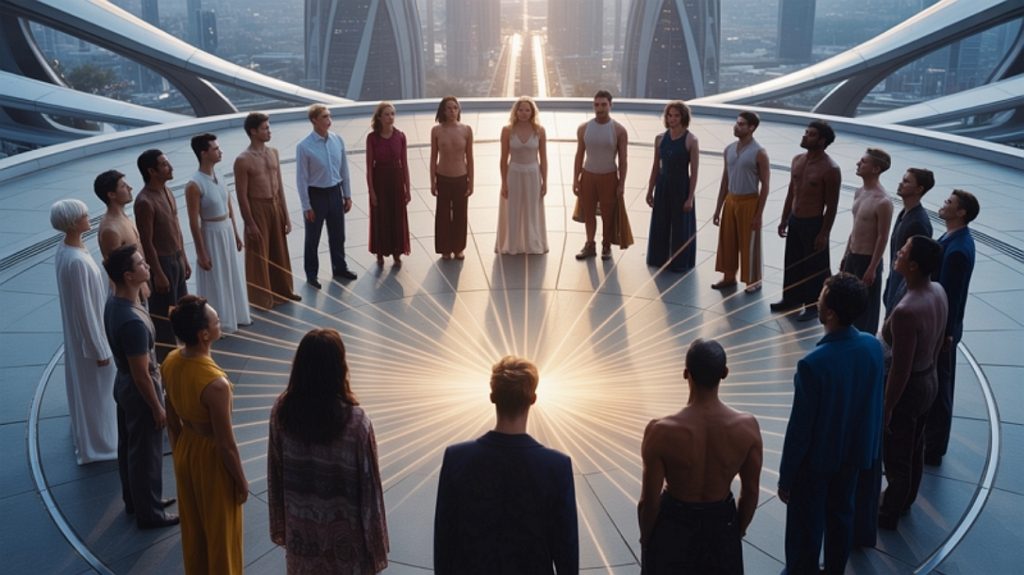
Before the mathematics. Before the history. Before Venice 1374 and Bretton Woods 1944. There is a principle so simple, so self-evident, and so systematically ignored that its rediscovery changes everything.
I have written fifteen articles in this series. I have traced the origin of our monetary system to the bankers of Venice in 1374. I have documented the structural relationship between debt cycles and armed conflict. I have shown how a central bank funded a prize in Alfred Nobel’s name to legitimize the theory that justifies its own existence. I have described, in mathematical detail, why infinite growth cannot solve a debt trap — and why what we call “public debt” is not debt at all, but Monetary Thermoregulation.
All of it — every article, every argument, every equation — flows from a single principle. One that I should have stated explicitly at the beginning, and that I am stating explicitly now.
I call it the Principle of Mutual Necessity.
Every human being, simply by virtue of existing, represents simultaneously a Necessity — for themselves, because they need an enormous number of things to live — and an Opportunity — for others, who can work to produce the things they need.
Read it again. Slowly. Because every word is load-bearing.
1. Why This Is Not an Opinion
Most principles in economics are opinions dressed as facts. They depend on assumptions about human nature, about market behavior, about the relationship between incentives and outcomes — assumptions that can be challenged, qualified, and disputed.
The Principle of Mutual Necessity is different. It is not an assumption. It is a logical identity — a statement that is true by definition, in the same way that a triangle has three sides by definition. You cannot construct a counter-example. You cannot find a human being who does not need things to live. You cannot find an unmet need that does not represent, simultaneously, an opportunity for someone else to work.
A newborn child needs food, warmth, care, and protection. Those needs are absolute. They exist from the first breath. And each of those needs — food, warmth, care, protection — is an opportunity: for a farmer, a builder, a caregiver, a community. The child has not yet produced anything. It has not yet contributed anything to the economy by any conventional measure. And yet, simply by existing, it has generated a constellation of economic opportunities that did not exist the moment before it was born.
This is not metaphor. It is mechanics. The needs are real. The opportunities are real. The only question is whether the system allows them to find each other.
Every human being is born as both a market and a producer. A market — because their needs create demand. A producer — because their capacity creates supply. The two sides of every economy are not corporations and consumers. They are human beings — each one simultaneously both.
2. The Logical Consequence: Unemployment Cannot Exist in Nature
If every human being is simultaneously a Necessity and an Opportunity — if every unmet need is a waiting job and every unemployed person is a waiting solution — then unemployment, in the presence of unmet needs and available workers, is not a natural phenomenon. It is an architectural failure.
Let me be precise. Unemployment of a specific skill in a specific place at a specific time can occur naturally — a blacksmith in a world of automobiles, a telegraph operator in a world of the internet. Structural unemployment, caused by genuine shifts in what the economy needs, is real and requires adaptation.
But general unemployment — the condition in which millions of people who want to work cannot find work, while millions of unmet needs go unsatisfied — is not natural. It cannot be natural. Because the needs exist. The workers exist. The materials exist. The knowledge exists.
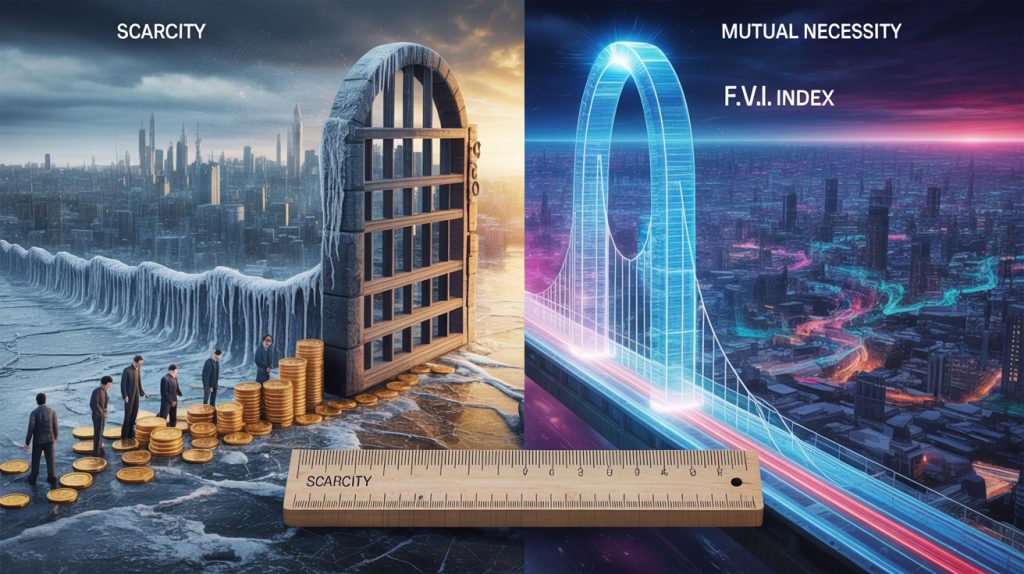
What does not exist — what is being deliberately withheld, by the architecture of the monetary system — is the bridge. The medium of exchange that would allow the worker to reach the need and the need to reach the worker. The F.V.I. — the Fungible Value Index, the name I give to what we call money — is the only thing missing. And its absence is not accidental. It is structural. It is designed into a system that creates money as debt, keeps it artificially scarce, and charges rent on every unit in circulation.
General unemployment is not an economic cycle. It is a monetary blockade. It is the system refusing to issue the bridge that would allow Mutual Necessity to function as it was always designed — by the simple logic of existence — to function.
3. The Ecosystem That Never Has Unemployment
There is a system that has been operating on the Principle of Mutual Necessity for approximately four billion years, without a single day of general unemployment. We call it the biosphere.
In a healthy ecosystem, nothing is wasted and nothing is idle. The dead leaf becomes the food of the decomposer. The decomposer becomes the nutrition of the soil. The soil becomes the substrate of the plant. The plant becomes the food of the herbivore. The herbivore becomes the food of the predator. The predator’s waste becomes the food of the scavenger. Every output is an input. Every death is a birth. Every ending is a beginning.
The ecosystem does not experience unemployment because it does not have a monetary system that can withhold the bridge between need and capacity. The bridge — nutrient cycling, energy flow, ecological interaction — is always available, always flowing, always connecting need to opportunity at the speed of biological processes.
Human economies are more complex. They require coordination across larger distances, longer time horizons, and more abstract forms of value than any ecosystem. This is precisely why they need a medium of exchange — a F.V.I. — to coordinate the connections that biology handles automatically in the natural world.
But the medium of exchange is a tool. It is a bridge. It is infrastructure — in exactly the same category as a road, a power grid, or a water system. Infrastructure that exists to connect need to capacity. Infrastructure that fails in its purpose the moment it is withheld, rationed, or made artificially scarce.
We do not charge rent on the roads. We do not withhold electricity until the population has proven it can pay interest on the power grid. We understand, intuitively, that infrastructure that serves everyone must be available to everyone — because the moment it is withheld, the connections it was built to enable collapse.
The F.V.I. is infrastructure. The most fundamental infrastructure in any economy. And for seven centuries, we have been charging rent on it.
The biosphere has operated on Mutual Necessity for four billion years without unemployment. It has no monetary system to withhold the bridge. We have a monetary system that does exactly that. The question is not whether Mutual Necessity works. The question is why we built a system designed to prevent it from working.
4. The Demonstration: Three People on an Island
Abstract principles become clear in small examples. Consider three people on an island.
The first person is a fisherman. He can catch more fish than he can eat. The second person is a farmer. She can grow more vegetables than she can consume. The third person is a builder. He can construct shelters that neither the fisherman nor the farmer has the skill to build.
Each of them has needs. Each of them has capacity. Each of them is, simultaneously, a Necessity and an Opportunity for the others. The Principle of Mutual Necessity is operating perfectly. In a barter system, they simply exchange — fish for vegetables, vegetables for shelter, shelter for fish. The system works. Nobody is unemployed. Nobody’s needs go unmet.
Now introduce money. Give the fisherman ten coins. Tell him he must pay the farmer two coins for vegetables and the builder three coins for shelter. Tell the farmer she must pay the fisherman two coins for fish and the builder three coins for shelter. Tell the builder he must pay two coins each to the fisherman and the farmer.
The mathematics work. The system functions. Mutual Necessity operates through the medium of exchange exactly as it operated through barter — just more efficiently, across larger distances and more complex transactions.
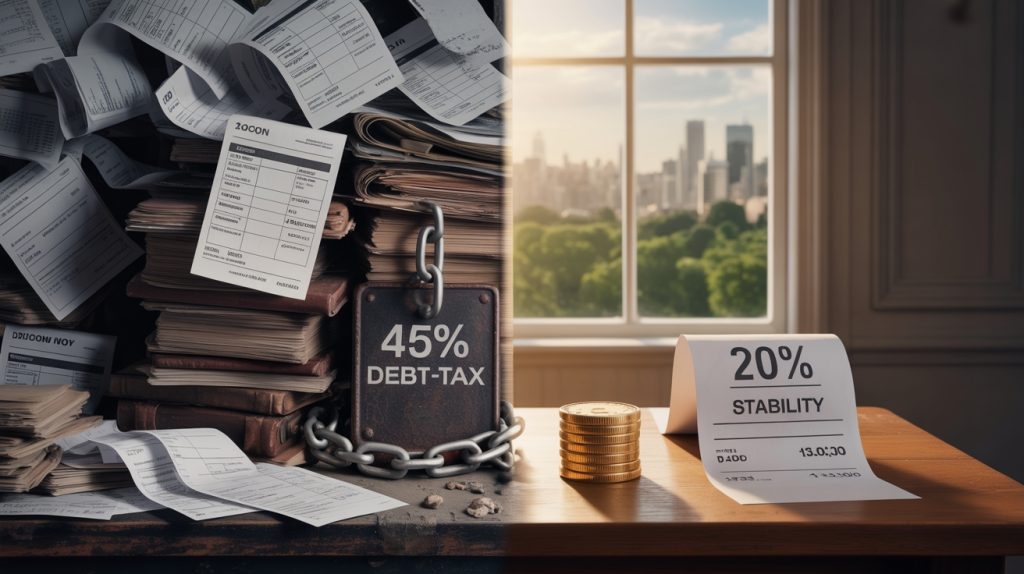
Now change one thing. Tell each of them that the ten coins they were given were not a gift. They were a loan. Each coin carries an interest obligation of ten percent. At the end of the year, each person must return eleven coins.
Where does the eleventh coin come from? It was never issued. It does not exist on the island. The only way to obtain it is to take it from someone else — which means someone else will be short a coin — which means someone will default — which means someone will lose their coins to pay the debt — which means someone will be unable to participate in exchange — which means their needs will go unmet and their capacity will go unused.
Unemployment has appeared on the island. Not because the fisherman stopped catching fish. Not because the farmer stopped growing vegetables. Not because the builder stopped building. Because the monetary architecture made it mathematically impossible for all three to service their obligations simultaneously.
This is $1.x > $1. This is the island we have been living on for seven centuries. And this is why unemployment, in the presence of unmet needs and available workers, is never natural. It is always monetary.
5. The Foundation of Everything Else
Every article in this series flows from this principle.
The 700-year history of fractional reserve banking is the story of how the island’s monetary system was designed — and why the eleventh coin was never issued. The story of Germany and Greece is the story of two islands forced to share a monetary system calibrated for one of them. The G.I. Bill is the story of a moment when a government recognized that Mutual Necessity — veterans who needed education, a society that needed their skills — was being blocked by a monetary bridge that could be extended at will, and extended it. The story of Roosevelt’s New Deal, the Marshall Plan, and China’s poverty reduction are three more moments when the bridge was extended — and Mutual Necessity, finally unblocked, generated wealth at a scale that no debt-based model had predicted.
The inflationary surcharge is not a tax. It is a traffic regulator — a mechanism that keeps the bridge flowing at the right speed, preventing the congestion that causes inflation without closing the bridge entirely. The constitutional inflation bracket is not a constraint on government. It is the engineering specification for the bridge — the load limit that keeps it from collapsing under excess weight.
And P.C.M. — Public Cash Money — is not a radical new theory. It is the institutional implementation of a principle that has been operating in every healthy ecosystem for billions of years: need and capacity find each other, and the medium that connects them is infrastructure, not commodity. It is owned by everyone. It is available to everyone. It is governed by a transparent rule that everyone can see and verify. And it charges no rent — because rent on the bridge that connects human Necessity to human Opportunity is not a financial instrument. It is a tax on existence itself.
Every human being, simply by existing, generates a right to participate in the economy. Not as charity. Not as redistribution. As mathematics. Because their existence creates the demand that justifies the supply that justifies the issuance of the bridge that connects the two. Deny the bridge and you do not save money. You destroy the value that was waiting to be created.
Conclusion: The Seed of Everything
I began this series with a Venetian bank in 1374. I should have begun it here — with a newborn child whose first breath generates, simultaneously, a constellation of needs and a constellation of opportunities.
The Principle of Mutual Necessity is the seed. Everything else in this series is what grows from it when you follow the logic without flinching — through seven centuries of monetary history, through the structural relationship between debt and war, through the fake Nobel Prize and the growth alibi, through the school that cannot be sold and the temperature that nobody asks you to repay.
It all grows from this: every human being is both a need and an answer. A demand and a supply. A problem and a solution. The monetary system’s only legitimate function is to connect them — cleanly, transparently, without rent, without artificial scarcity, and without the $1.x design bug that has been taxing human existence since 1374.
This is not ideology. It is not politics. It is not left or right, progressive or conservative, capitalist or socialist.
It is the logic of existence itself.
Every human being deserves a bridge. Not as a gift. As a mathematical consequence of the value they already represent simply by being alive.
$2+2=4. Period.