 Public Cash Money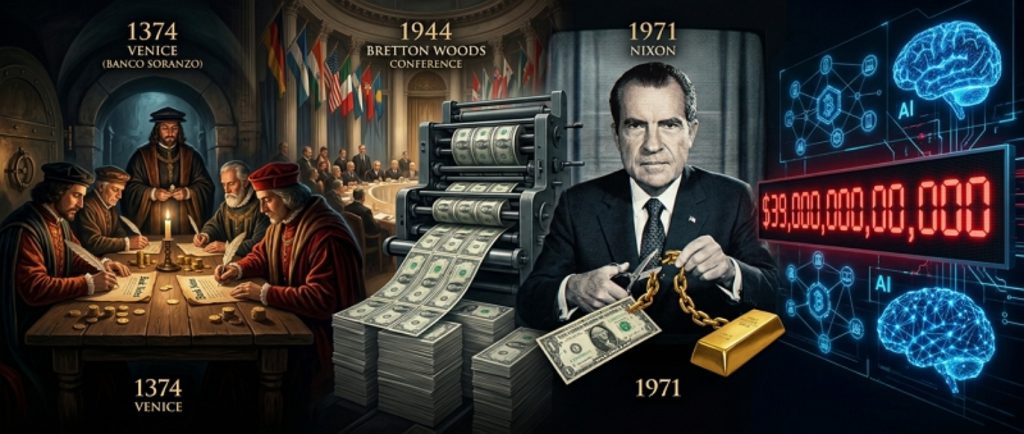
As an Italian, I carry a bitter awareness: when it comes to designing architectures that alter the course of history—for better or worse—we are second only to the Levantine merchants. The world’s first modern bank, the Banco Soranzo, was born in Venice in 1374. It wasn’t an ethical choice, but a desperate response to a technical problem that today’s “gold-bugs” conveniently ignore: gold was already insufficient back then.
1. The Gold Standard Myth Collapsed in the 14th Century
By the 1300s, the expansion of Venetian trade made a brutal truth evident: the velocity of commodity circulation was infinitely higher than the speed of precious metal extraction. Gold was heavy, dangerous to transport, and, above all, physically insufficient to lubricate a growing economy.
The Banco Soranzo was not born to “safeguard” wealth, but to substitute it. Merchants needed an agile instrument of exchange. The bank began collecting gold coins and precious metals in exchange for “Bank Notes” (the ancestors of modern banknotes). At that precise moment, the world stopped using real value and began using the Representation of Value.
2. The Legal Shift: From Regular Deposit to Lawful Theft
This is where the true systemic “bug” occurred. In ancient law, a deposit was “Regular”: if I gave 10 gold coins to a custodian, those 10 coins remained mine. The Banco Soranzo and Venetian bankers imposed the “Irregular Deposit”: once the gold was handed over, the bank became its legal owner, leaving the depositor with nothing but a “credit.”
This legal subtlety allowed the birth of Fractional Reserve Banking. Bankers noticed that only about 10% of depositors withdrew their physical gold at any given time. The remaining 90% circulated as “Bank Notes.” Their move? They began issuing “Notes” (promises of payment) for gold they did not have in their vaults, lending them to third parties with interest.
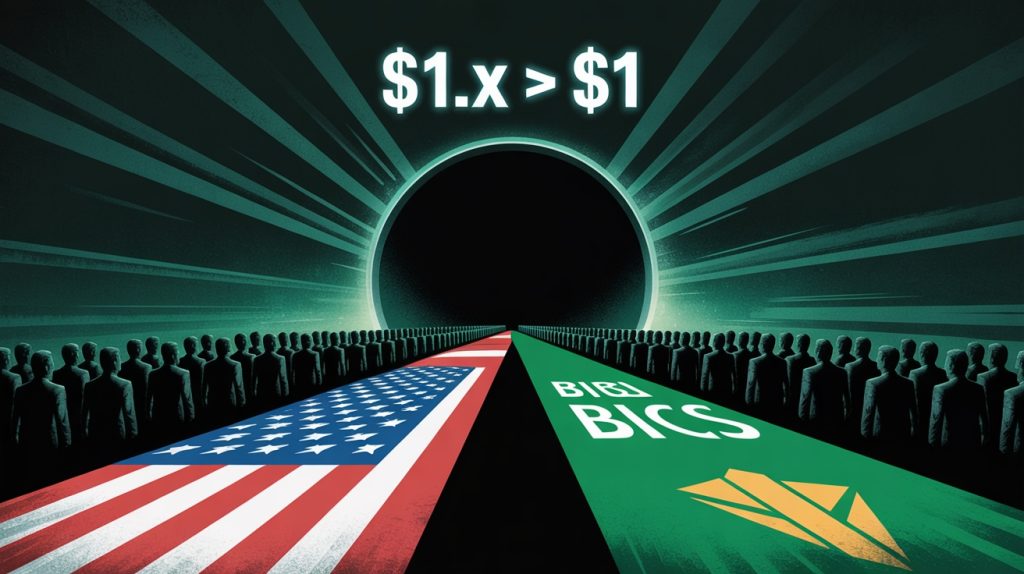
3. The Birth of $1.x: The Non-Existent Interest
The problem wasn’t just lending what they didn’t have, but how they lent it. When the bank issued a 100-florin “paper” credit note and demanded 105 florins back (Principal + Interest), it triggered a mathematical paradox: those 5 florins of interest had never been minted or issued.
The system forced debtors to fight for a monetary mass that was structurally smaller than the total debt. Failure wasn’t a possibility; it was the core algorithm. For seven centuries, we have dragged this error along, until 1944 at Bretton Woods, where this “Venetian software” was globally mandated as the only monetary operating system.
This is exactly why, in July 1971, Nixon unilaterally decoupled the Dollar from Gold. It wasn’t an “act of aggression” but a mathematical necessity. When he realized that ships loaded with Dollars (paper) were departing from Europe to reclaim physical Gold, he knew the vaults would be empty in weeks.
Nixon’s error wasn’t the decoupling itself—he had no other choice—but the failure to seize that historical moment to peg the currency to Inflation instead of Debt. At the time, the technical tools to mutually guarantee value did not exist. Today, however, we have them. Technology finally allows us to deploy a Blockchain (to preserve value) audited by an AI (by definition incorruptible) to provide the mutual guarantee that the value remains real and stable.
4. The Global Trap and the Illusion of Gold
To those who today invoke a return to the Gold Standard as a solution, we must answer with history: gold was the bank’s first accomplice. It was precisely its physical scarcity that justified the birth of fractional reserve and the “rental” of money. Returning to gold means returning to 1374, ready to fall back into the same debt-rental trap ($1.x).
Today, we face
in debt (in the US alone) not because we spent too much, but because we are using a measurement system that is broken by design. We do not own our money; we have been renting it for 700 years, paying an “extortion fee” on every single transaction in the form of interest on debt-issued currency.
Conclusion: There is Only One Titanic
This is perhaps why I feel a sense of historical guilt. Today, I no longer feel like an Italian Patriot: I feel like a Global Patriot. We must have the courage to abandon this Venetian architecture and shift to P.C.M. (Public Cash Money). We must issue value vertically, without debt, and use the I.V.F. (Fungible Value Index) monitored by AI and Blockchain as our new stable “meter.”
Either we save ourselves together by correcting this seven-century-old mathematical error, or we sink together. There is only one Titanic, and the $1.x iceberg makes no distinction for flags.
$2+2=4. Period.