 Public Cash Money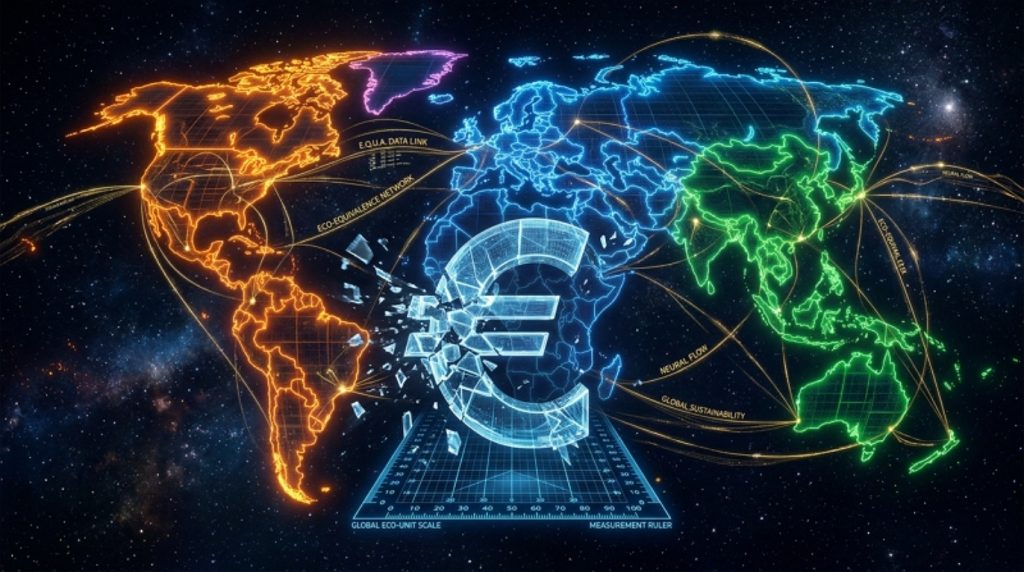
Why the Euro Failed and How E.Q.U.A. Will Fix Global Trade.
When we say “Eco-Equivalent,” we are talking about Economics, not Ecology. The current global monetary system, and specifically the Eurozone experiment, has proven a painful mathematical truth: you cannot use the same ruler to measure two different realities.
1. The Euro Lesson: Germany vs. Greece
Giving the same currency to Germany and Greece was a mathematical crime.
- The Result: A “strong” currency for Greece destroyed its exports and local economy, while a “weak” currency for Germany (relative to its power) allowed it to drain wealth from its neighbors.
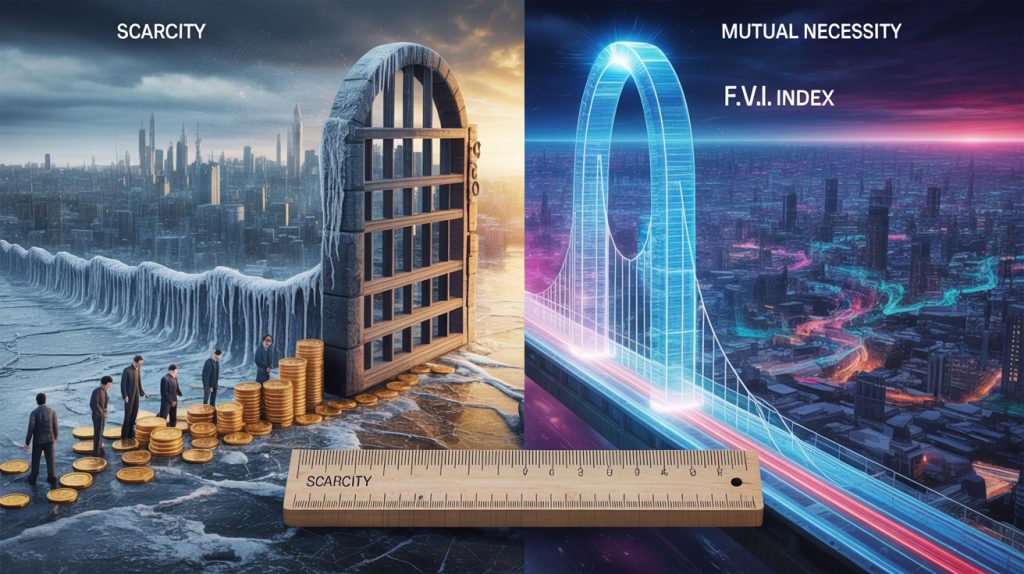
- The Trap: Without a sovereign F.V.I. (Fungible Value Index), Greece could not adjust its “meter” to reflect its productivity. It was forced into a debt-spiral to stay alive.
2. What is an Eco-Equivalent Area?
An Eco-Equivalent area is a group of one or more nations that share similar economic structures, productivity levels, and social needs.
- Voluntary Aggregation: Nations can choose to form an area (e.g., Italy, Spain, and Greece) or decide to run alone. No one is forced into a “straitjacket.”
- The Shared Pillars: To form an area, member states must share three fundamental infrastructures:A Shared Inflation Meter: The AI-Blockchain engine measuring the real F.V.I. A Common Treasury: To issue the P.C.M. based on the meter. A Unified Finance Ministry: To manage expenditures and the 0.5% surcharge if needed.
3. E.Q.U.A.: The Supranational Reference
All these different areas are linked by E.Q.U.A. (Eco-equivalent Quantitative Unit of Account).
- E.Q.U.A. is not a global reserve currency (which creates debt-slavery); it is a Forex reference inspired by Keynes’ 1944 “Bancor” proposal.
- It allows different Eco-Equivalent areas to trade fairly. If an area chooses a low inflation bracket (2%), its currency appreciates; if it chooses a higher one (4%), it depreciates. The system balances itself naturally without the need for predatory loans.
4. Sovereignty and Flexibility
If a country wants to “run alone,” it is free to do so. It maintains its own F.V.I. and its own rules. But if it violates the international agreement (e.g., changing the 2-4% bracket unilaterally), it is simply excluded from the E.Q.U.A. exchange system. No wars, no sanctions—just mathematical consequences.
Conclusion: 2+2=4. Period.
The world doesn’t need a single, global “digital cage.” It needs a network of honest, eco-equivalent areas that respect the local reality of work and productivity.
We are moving from a system of Extortion Fees to a system of Mathematical Balance.