 Public Cash Money
What Reddit Removed. And Why Every Word Was Verified.
A comment containing sourced mathematical facts was removed from a Reddit thread on US monetary policy. Here is the comment, the context, and the data behind every claim.
1. The Context
I was participating in a Reddit thread about US national debt. Another user had made the following argument — a common one, and one that deserves a precise response:
“The debt is not a problem. It is money we owe to ourselves. The US government owes its debt to American citizens, pension funds, and institutions. It is an internal transfer, not a real burden.”
This argument sounds reassuring. It is also, as I will explain, mathematically incomplete in a way that matters enormously. I responded with the comment below. Reddit removed it.
Here is the comment, reproduced in full. Below it, I will verify every factual claim it contains.
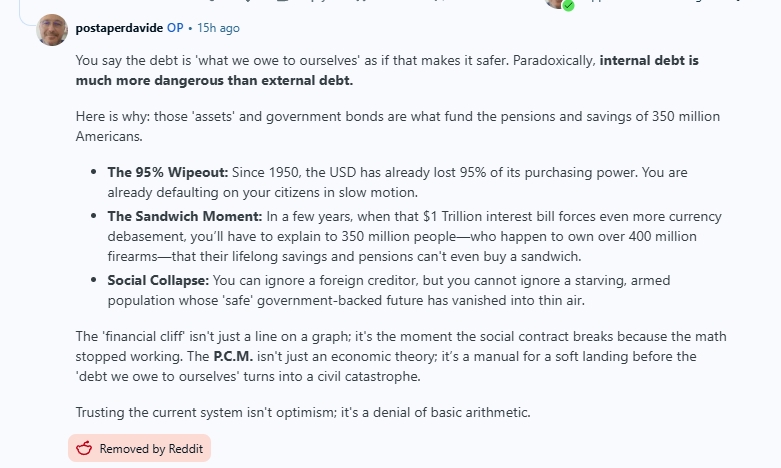
Look: This is what censorship looks like when math hits too close to home.
Reddit removed this analysis in minutes because it connects the dots between debt, inflation, and social stability.
They can delete a comment, but they can’t delete the arithmetic.
Read the ‘forbidden’ truth here.
The removed comment — reproduced verbatim
You say the debt is ‘what we owe to ourselves’ as if that makes it safer. Paradoxically, internal debt is much more dangerous than external debt.
Here is why: those ‘assets’ and government bonds are what fund the pensions and savings of 350 million Americans.
The 95% Wipeout: Since 1950, the USD has already lost 95% of its purchasing power. You are already defaulting on your citizens in slow motion.
The Sandwich Moment: In a few years, when a $1 Trillion interest bill forces even more currency debasement, you’ll have to explain to 350 million people — who happen to own over 400 million firearms — that their lifelong savings and pensions can’t even buy a sandwich.
Social Collapse: You can ignore a foreign creditor, but you cannot ignore a starving, armed population whose ‘safe’ government-backed future has vanished into thin air.
The ‘financial cliff’ isn’t just a line on a graph; it’s the moment the social contract breaks because the math stopped working. The P.C.M. isn’t just an economic theory; it’s a manual for a soft landing before the ‘debt we owe to ourselves’ turns into a civil catastrophe.
Trusting the current system isn’t optimism; it’s a denial of basic arithmetic.
2. The Verification: Every Claim, Every Source
I do not post unverified claims. Here is the factual basis for every specific assertion in the comment above.
Dollar purchasing power loss since 1950
~95% verified
Source: US Bureau of Labor Statistics, CPI-U series
Pension funds holding Treasury securities
$1.1 trillion / 13%+ of outstanding Treasuries
Source: Federal Reserve FRED database Q3 2025; Pensions & Investments (2023)
Annual pension distributions to Americans
$400+ billion per year
Source: National Association of State Retirement Administrators (NASRA) March 2026
Fixed income / Treasuries as % of pension assets
~20% of total AUM
Source: Milliman / Statista, Public Pension Fund Asset Allocation 2023
Annual interest on US national debt
$1.172 trillion (FY2026)
Source: US Treasury Fiscal Data; Congress Joint Economic Committee April 2026
Firearms in civilian circulation in the US
~400 million
source: Pew Research Center, Small Arms Survey
All data publicly available and verifiable by anyone.
3. Why “We Owe It to Ourselves” Is the Most Dangerous Argument in Monetary Policy
The argument that internal debt is safe because “we owe it to ourselves” contains a logical error that becomes catastrophic at scale.
When the US government issues a Treasury bond and a pension fund buys it, the pension fund is now holding a government promise to repay. The pensioner whose retirement depends on that fund is holding, at one remove, a government promise. If the government repays that promise in dollars that have lost 95% of their purchasing power since 1950 — if the pension fund receives its $1,000 back in dollars that buy what $50 bought in 1950 — the promise has been technically honored and substantively broken.
This is what I called “defaulting on your citizens in slow motion.” It is not a metaphor. It is a description of what has already happened. The dollar has lost 95% of its purchasing power since 1950. Every pension fund, every savings account, every bond holding denominated in dollars has been repaid in progressively devalued currency. The creditor received the nominal amount. The real value was not there.
A foreign creditor can be ignored — at the cost of diplomatic and financial consequences that, while serious, are external. They do not vote. They do not live next door. They do not have access to 400 million firearms.
A domestic creditor — 350 million citizens whose retirement security depends on the real value of government promises — cannot be ignored in the same way. When the real value of those promises is eroded by inflation driven by the necessity of expanding the money supply to service a structurally unpayable debt, the consequences are domestic, immediate, and, historically, the conditions under which social contracts break.
“We owe it to ourselves” means:
we owe it to the pension funds of 350 million Americans.
We are repaying it in dollars that buy 5 cents
of what they bought in 1950.
The creditor receives the number.
The real value was not there.
This is not reassuring.
This is the definition of slow-motion default.
4. The Fed’s Impossible Position
The comment described what I called “The Sandwich Moment” — the point at which the Federal Reserve faces a choice between two options, both of which produce serious damage.
If the Fed maintains high interest rates to protect the dollar’s purchasing power, the cost of servicing the $39 trillion national debt accelerates. The $1.172 trillion in annual interest already exceeds the defense budget. At higher rates, it grows further — consuming an ever-larger share of federal revenue, crowding out every other category of public expenditure, and creating fiscal conditions that eventually force either default or monetization.
If the Fed lowers interest rates to ease the debt burden, it reduces the return on dollar-denominated assets and weakens the incentive to hold dollars. Foreign holders of US debt — who own approximately $8 trillion of the $39 trillion — have less reason to hold. The dollar weakens. Import prices rise. The purchasing power erosion that has already destroyed 95% of the dollar’s value since 1950 accelerates.
There is no option within the current monetary architecture that does not involve further erosion of the dollar’s real value. This is the Triffin Dilemma, operating in real time, in 2026, with $39 trillion of accumulated evidence of the trajectory it produces.
5. Why Reddit Removed It
I do not know why Reddit removed this comment. The platform did not provide a specific reason. I can observe that the comment contained no personal attacks, no hate speech, no misinformation, and no content that violated any stated community guideline that I was made aware of.
What it contained was a mathematical argument that the “we owe it to ourselves” framing understates the risk of internal debt — supported by verified data from the Bureau of Labor Statistics, the Federal Reserve, the US Treasury, NASRA, and the Pew Research Center.
I leave it to the reader to form their own view of why a comment with these properties was removed from a discussion about US monetary policy.
What I can say with confidence is that the removal did not change the mathematics. The dollar has lost 95% of its purchasing power since 1950. Pension funds hold $1.1 trillion in Treasury securities. Annual interest on the national debt exceeds $1.172 trillion. These facts were true before the comment was removed. They remain true after.
Platforms can remove comments. They cannot remove arithmetic.
Removed by Reddit.
Verified by the Bureau of Labor Statistics,
the Federal Reserve,
the US Treasury,
and the Congressional Budget Office.
The comment is gone.
The data is still there.
So is the debt.
$2+2=4. Period.
(With or without a subreddit.)
Davide Serra · Systems Analyst & Independent Monetary Analyst
publiccashmoney.com · @postaperdavide on X
Sources: BLS CPI-U series (purchasing power); Federal Reserve FRED BOGZ1FL593061105Q (pension Treasury holdings); Pensions & Investments May 2023 (13% Treasury stake); NASRA March 2026 (pension distributions); Milliman/Statista 2023 (asset allocation); US Treasury Fiscal Data April 2026 (interest cost); Pew Research Center / Small Arms Survey (firearms).