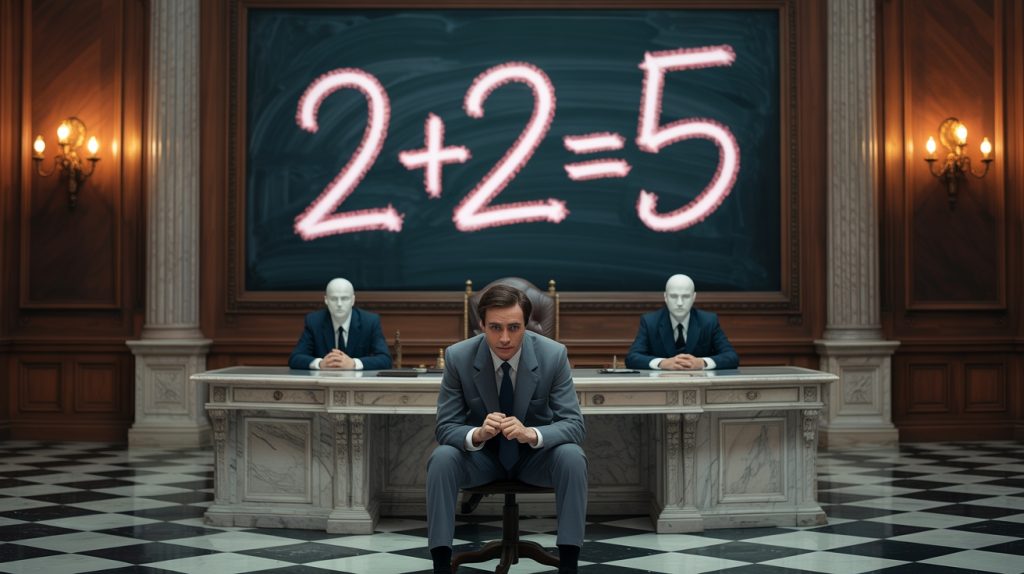
 Public Cash Money
Nothing is created, nothing is destroyed — everything transforms. Except, apparently, in financial markets, where $600 trillion of value exists without any corresponding physical reality. And then you look at your wallet.
In school, they teach you something called the First Law of Thermodynamics. It is presented as one of the most fundamental and inviolable principles in all of science. The law states, in its simplest form: energy cannot be created or destroyed. It can only be transformed from one form to another. The total energy of the universe is constant. Always. Without exception. Forever.
This principle has been tested by every physicist, chemist, and engineer for the past two centuries. It has survived every experimental challenge. It underlies every engine ever built, every power plant ever operated, every rocket ever launched. It is, as far as science can establish, absolutely true.
Then you finish school. You look at the world. And you discover something that your physics teacher forgot to mention.
Step One: The Classroom
The First Law of Thermodynamics. Nothing is created. Nothing is destroyed. Everything transforms.
Your teacher writes it on the board. You copy it into your notebook. You repeat it on the exam. You pass. You go out into the world carrying this principle as one of the foundational certainties of your understanding of reality.
Energy is conserved. The total does not change. What exists now existed before in some other form. What disappears now will reappear in some other form. The books balance. Always. The universe does not create value from nothing and does not make value vanish into nothing.
You understand this. You accept this. You build your mental model of reality on this.
Step Two: The Stock Exchange
The total notional value of derivative contracts currently traded in global financial markets is approximately $600 trillion.
Six hundred trillion dollars. Let us be precise about what this number means. The annual gross domestic product of the entire planet — every good produced, every service rendered, every hour of human labor performed by every person on earth in a full year — is approximately $105 trillion. The derivative market is worth approximately six times that. Six years of everything. Six years of all the food grown, all the houses built, all the medicine produced, all the software written, all the music performed, all the transport operated, all the education delivered, by all eight billion people on the planet.
Six times. In contracts.
Now here is the question your physics teacher never asked — because financial markets were not in the curriculum. Where does the value in those contracts come from?
The honest answer is: from promises. A derivative contract is a promise — a legal agreement between two parties about the future price of something. The something might be real: wheat, oil, a stock, a currency. But the contract itself is not the thing. It is a promise about the thing. It has no mass. It has no energy. It occupies no physical space. It cannot be eaten, burned, built with, or lived in. It exists entirely as a legal abstraction — a claim on future value, not present value.
$600 trillion of promises.
Six times the annual productive output of all humanity.
Traded as if they were real.
Priced as if they were real.
Collateralizing loans as if they were real.
Appearing on balance sheets as if they were real.
Until the moment they are not.
Which happens with some regularity.
And is called a financial crisis.
Step Three: Your Wallet
You open your wallet. Or rather, you look at your bank account at the end of the month. You have worked the same hours as last year. You have the same job. You receive approximately the same salary in nominal terms. And yet you can buy less. Meaningfully, visibly, undeniably less. The grocery cart has fewer items. The restaurant visit happens less often. The holiday that was within reach last year is no longer within reach this year.
You ask why. You are told: inflation. The prices went up. Supply chains. Energy costs. The pandemic. The war. There is always a reason. There is always something external, something particular, something that happened this year that explains why things cost more than they did last year.
But the prices have been going up every year. For decades. The dollar has lost 87% of its purchasing power since 2000. Not because of a specific event in 2000. Not because of a specific event in 2005 or 2010 or 2015 or 2020. Continuously. Structurally. As a permanent feature of the monetary system rather than as a temporary response to external shocks.
The Connection Nobody Explains
Here is what connects the classroom to the stock exchange to your wallet — the thread that runs through all three and that your physics teacher, your economics teacher, and your financial news anchor all failed to make explicit.
The First Law of Thermodynamics is not violated by financial derivatives. Technically. Because promises are not energy. $600 trillion of derivative contracts do not violate the conservation of energy because contracts have no physical existence. They are legal abstractions. They weigh nothing. They contain nothing. The First Law does not apply to them because they are not physical things.
But here is the problem. When the person who holds a profitable derivative contract cashes it out — when the promise is honored and the winner receives their payout — the money they receive is real. It buys real things. It purchases real goods and services that required real human labor and real physical resources to produce. The payout exits the financial abstraction layer and enters the physical economy.
And when something real enters the real economy without a corresponding real productive activity having created it — when money appears that represents no new production, no new goods, no new services — the First Law reasserts itself with brutal efficiency. The total real value in the system does not increase. The same real goods and services now have more money chasing them. Each unit of money buys less of the real goods. The prices rise. Your wallet shrinks.
The $600 trillion in derivatives did not violate the First Law. They transferred its consequences to your salary. The abstraction layer absorbed the promise. The physical economy absorbed the cost. The financial markets registered a gain. Your grocery cart registered a loss.
Step 1: Classroom
Nothing is created. Nothing is destroyed. Everything transforms. The books always balance.
Step 2: Stock Exchange
$600 trillion of promises. Six times global GDP. No physical reality. The books appear to balance. Appear.
Step 3: Your Wallet
Same salary. Less purchasing power. Every year. The books actually balance. On your back.
Am I the Only One Who Notices?
No. You are not the only one. But you are in a minority — and the minority is systematically discouraged from asking the question out loud.
The question — “how can $600 trillion of financial value exist in a world that produces $105 trillion of real value per year?” — is not a difficult question. It is an obvious question. It is the kind of question that any twelve-year-old who has just learned the First Law of Thermodynamics would ask if they were shown the derivative market statistics.
The answer is also not difficult. The $600 trillion does not represent real value. It represents promises about real value — bets on future prices, hedges against future risks, speculative positions on future movements. Most of it will never be “cashed out” against real goods and services. It exists in a financial abstraction layer that operates according to its own internal logic, disconnected from physical reality, until the moments — which recur with depressing regularity, 1987, 1998, 2001, 2008 — when the connection to physical reality is forcibly re-established and the abstraction collapses back to whatever real value underlies it.
In those moments, the First Law reasserts itself completely. Sixty trillion dollars of derivative value evaporated in 2008. Not because the real economy contracted by sixty trillion dollars. Because sixty trillion dollars of promises turned out to be promises about things that did not exist, written by parties who could not honor them, collateralized by assets that were worth a fraction of their stated value. The promises vanished. The real economy absorbed the shock. The First Law was never violated. It was merely deferred — and when the deferral ended, ordinary people paid the cost.
The First Law is patient.
It does not argue with financial markets.
It does not file complaints with regulators.
It does not write articles on the internet.
It simply waits.
And when the promises cannot be kept —
when the abstraction layer collapses
back to physical reality —
it presents its bill.
It always does.
The bill always arrives.
And it is never sent to the people
who wrote the promises.
The Fix Is Not Complicated
The First Law of Thermodynamics cannot be repealed. But it can be respected — by building a monetary system that does not require the abstraction layer to function.
In a P.C.M. framework, money is issued as F.V.I. — a Fungible Value Index, anchored to the real productive capacity of the economy. Not to promises. Not to derivatives of derivatives of derivatives. To real goods and services produced by real people. The monetary mass grows when the productive capacity grows. It contracts when the productive capacity contracts. The abstraction layer and the physical layer remain connected — because the instrument of measurement is anchored, constitutionally and mathematically, to what it measures.
Speculation still exists. Derivatives still exist — as hedging instruments for genuine risks in the real economy. What does not exist is the untethered expansion of promise-value that has no corresponding physical reality, that inflates financial balance sheets while deflating the purchasing power of ordinary salaries, that honors the First Law by making your wallet pay for what the financial markets take.
This is not a revolutionary proposal. It is the application of a principle that every twelve-year-old learns in school to a domain where it has been systematically ignored for seven centuries.
Nothing is created. Nothing is destroyed. Everything transforms.
Including your purchasing power. Which has been transforming — steadily, continuously, structurally — into someone else’s derivative gains.
They taught you the First Law in school.
They forgot to mention that financial markets had applied for an exemption.
The exemption was not granted.
It never is.
The bill always arrives.
Check your wallet.
The First Law sent it.
$2+2=4. Period.
Davide Serra · Systems Analyst & Independent Monetary Analyst
publiccashmoney.com · @postaperdavide on X
Derivative market size: Bank for International Settlements, OTC derivatives statistics (2024). Global GDP: IMF World Economic Outlook (2025). Dollar purchasing power: US Bureau of Labor Statistics CPI-U series. 2008 derivative losses: Federal Reserve, Financial Crisis Inquiry Commission report.