 Public Cash Money
THE GLOBAL HERALD
Saturday, October 18, 2030 · International Edition · $4.50
Just in Time
How the world stepped back from the edge and what the past four years have taught us about money, work, and the limits of what we thought was inevitable.
By Eleanor Marsh, Senior Correspondent · Houston Bureau | October 18, 2030
On the morning of July 4, 2028, a convoy of black cars made its way through the pine forests of Sam Houston National Park, forty miles north of Houston, Texas. The destination was a converted conference center on the shores of Lake Conroe — a place chosen, according to those involved in the planning, because it was large enough to accommodate delegations from 87 nations, far enough from any major city to discourage the kind of street theater that had accompanied previous international summits, and close enough to the symbolic heart of American history that the location itself would carry a message. It was Independence Day. The choice was deliberate.
Inside, at a horseshoe table that had taken three weeks to assemble and two weeks to argue about seating arrangements for, the representatives of those 87 nations opened what would become known, informally at first and then officially, as the Houston Conference. Or, as it appears in every subsequent treaty, economic agreement, and international legal document produced since: Bretton Woods 2.0.
The road to that table had been neither straight nor easy. And understanding how the world got there requires going back not to 2028, but to 2026 — to a quieter, more diffuse awakening that began not in government buildings or central banks, but in the accumulated frustration of hundreds of millions of ordinary people who had simply run out of explanations for why things kept getting worse.
At some point in 2026, the conversation changed.
People stopped asking who to blame
and started asking what was structurally wrong.
The signs had been accumulating for years. In the United States, the cost of health insurance for a family of three had crossed the federal poverty line — more money to stay healthy than the government’s own threshold for survival. In Europe, young people in their thirties were living with their parents not because of lifestyle choices but because the arithmetic of housing costs and stagnant wages had made independence mathematically impossible. In the developing world, food price volatility had returned with a ferocity not seen since the commodity crises of the early 2000s. The language used to explain all of this — supply chains, interest rates, geopolitical uncertainty — had become so familiar and so obviously insufficient that it had stopped being persuasive.
At some point in 2026, the conversation changed. The change was not dramatic. There was no single speech, no viral moment, no publication that crystallized it. It was more like a collective clearing of the throat — a moment when enough people in enough places simultaneously noticed that the standard explanations were not explanations at all but deferrals, and that the deferral had been going on long enough that it was time to ask the prior question. Not “why are things getting worse this year” but “why do things structurally tend to get worse, decade after decade, regardless of who is in power or what policies are tried?”
The answer that emerged — slowly, then all at once, through academic papers and documentary films and late-night conversations and parliamentary debates that went longer and stranger than anyone had expected — was about money itself. Not monetary policy in the narrow sense of interest rates and quantitative easing, but the fundamental architecture of how money was created, by whom, at what cost, and to whose benefit. The realization that every unit of currency in circulation had been borrowed into existence — and that the interest on that borrowing had been compounding for decades, for generations, for centuries — was not a new insight. But it was, in 2026 and 2027, an insight whose moment had finally arrived.
“It was like a magic eye picture,” recalled Dr. Amara Osei-Bonsu, then a junior economist at the Bank of Ghana and now one of the principal architects of the West African Monetary Area established under the Houston agreements. “Once you saw it, you couldn’t unsee it. The question was just: when would enough people see it at the same time to do something about it?”
The answer was early 2028. By then, the United States was carrying a national debt that had crossed the threshold the Congressional Budget Office had identified years earlier as the point at which interest costs would begin to exceed economic growth — the entry point of a self-reinforcing spiral. The interest bill had consumed the defense budget. The dollar had lost purchasing power at a rate that made the standard reassurances of central bankers sound increasingly disconnected from what people actually experienced at the grocery store. Several European governments had fallen over austerity programs that everyone knew were mathematically insufficient but nobody had an alternative to. And in emerging markets, the combination of dollar-denominated debt, commodity price volatility, and currency depreciation had produced social pressures that were no longer being contained by the usual toolkit.
The United States made its decision in February 2028. The internal deliberations have been partially declassified and make extraordinary reading. The core argument, advanced by a coalition of Treasury officials, Federal Reserve economists, and a bipartisan group of congressional leaders who had been quietly studying the problem for two years, was brutally simple: the window for an orderly transition was still open, but barely, and closing. Act now, from strength, and design the new architecture. Wait for the crisis to force the issue, and the architecture would be designed by the crisis — with no American input and no American leadership.
The invitations went out in March. They went not only to government ministers but, in an unprecedented move, to representatives of opposition parties, civil society organizations, and independent economic institutions. The organizers had learned from the failures of previous multilateral agreements: consensus ratified only by governments in power was consensus that dissolved with the next election. They wanted buy-in broad enough to survive political cycles.
By June, eighty-seven nations had confirmed attendance. Conspicuously, China and Russia sent observer delegations rather than full negotiating teams. Their position — that the conference was a mechanism for extending American monetary dominance under a new label — was stated publicly and not entirely without foundation as a concern, though the final agreements would address it more thoroughly than Beijing and Moscow expected.
The Chinese observer sat through the entire first week
without saying a word in plenary.
On Friday evening, he asked if he could have the full technical documentation.
He studied it over the weekend.
On Monday he said: ‘This is more interesting than we thought.
The conference opened on July 4th with a ceremony that was deliberately understated. No heads of state. No military bands. A string quartet played in the lobby of the Lake Conroe center while delegates collected their credentials. The symbolism of Independence Day was acknowledged in the opening remarks and not belabored. The work began immediately.
What followed was twenty-six days of negotiations that participants describe with a mixture of exhaustion and exhilaration. The technical details — the mechanisms for measuring monetary stability, the protocols for establishing equivalent economic areas, the governance structures for the new international reference framework — were genuinely complex and had been the subject of preparatory working groups for six months. But the conceptual breakthrough had happened earlier, and what the Houston Conference largely did was translate that breakthrough into institutional reality.
The key innovation — the one that made the Houston agreements structurally different from every previous international monetary arrangement — was the separation of money creation from debt. Participating nations would retain their sovereign currencies but issue them as direct instruments of their productive capacity, governed by publicly verified inflation measurements rather than by the borrowing requirements of their treasury departments. The interest that had been the invisible tax on every monetary transaction since the Venetian bankers of the fourteenth century would, for the first time, not be structurally embedded in the base money supply.
The agreements were signed on July 29, 2028. Implementation was set for October 31 — an aggressive timeline that everyone acknowledged was driven more by urgency than by comfort. China and Russia signed the final communiqué as observers, endorsing the framework’s legitimacy while declining to adopt it. Their formal position was that they would “monitor implementation and assess results.” Their informal position, according to several delegates who spoke to this reporter, was considerably more ambivalent.
The transition was not smooth. No one pretended it would be. The two years between November 2028 and now have included moments of genuine turbulence — exchange rate dislocations that took longer to stabilize than the models predicted, a brief but severe disruption in cross-border trade financing as institutions adapted to new settlement protocols, and political crises in three countries where the transition coincided with contentious elections and became a proxy battlefield for domestic grievances that had nothing to do with monetary architecture.
The European Union’s decision to retain its political union while allowing individual member states to return to national currencies — recalibrated against a common stability reference — was perhaps the most technically complex outcome of the Houston process. The debates within the EU about which countries were genuinely economically equivalent, and which had been yoked together in ways that served political rather than economic logic, were painful and occasionally bitter. They were also, ultimately, more honest than anything that had been said publicly about European monetary union in decades.
But two years in, the indicators that matter most are pointing in directions that even the cautious optimists at the Houston Conference did not dare project in their baseline scenarios.
Employment, across the participating nations, has recovered in ways that confounded the predictions of models built on the assumption that automation would inevitably displace human labor at scale. The predictions turned out to rest on a premise that the new monetary environment revealed as false: that cost minimization through automation was the dominant force in hiring decisions. When the monetary pressure that had made labor increasingly unaffordable — the continuous erosion of purchasing power that had compressed wages relative to costs for decades — was reduced, the calculus changed. Businesses that had been preparing mass automation programs discovered that their customers, no longer squeezed by the structural monetary tax of the old system, had more to spend — and that they preferred, when given a genuine choice, to spend it with businesses that employed human beings.
The robotics revolution, as it had been envisioned, required resources — physical materials, energy, manufacturing capacity — that the planet simply could not supply at the projected scale. The energy requirements of the automated economy that had been promised turned out, when subjected to honest accounting, to be staggering. The fusion power that had been anticipated to resolve this constraint remained, in 2030, a technology of great promise and uncertain timing. The gap between what automation required and what the physical world could provide had been obscured, in the old monetary environment, by financial instruments that could make promises about future resources without accounting for the physical reality of producing them. In the new environment, that gap became visible.
The result was not the defeat of technology but its reorientation. Artificial intelligence, freed from the imperative to replace labor at any cost, began to function as it had always been theoretically capable of functioning: as an amplifier of human capability rather than a substitute for it. The businesses that thrived were those that used it this way. The businesses that had bet on wholesale human replacement found themselves facing a market that had, quietly and without drama, stopped rewarding that bet.
We spent twenty years preparing for a future
where machines would do everything.
It turned out the future wanted humans to do things better,
with machines helping.
As for China and Russia: their decision to remain outside the Houston framework has not produced the economic isolation their governments feared or the dominance they hoped to leverage. Capital has moved — steadily, not dramatically, but consistently — from debt-based monetary environments to the new framework areas. The yield premium that investors demand to hold assets in systems still operating under the old architecture has risen steadily. Neither government has announced any formal reconsideration of its position. Both are, according to sources in the diplomatic community, having internal conversations that would have been unthinkable eighteen months ago.
Four years ago, standing in the pine forest outside Lake Conroe on a July morning, it would have been difficult to believe that any of this was possible. The problems seemed too large, the institutions too entrenched, the political will too absent. The window seemed to have closed.
It had not. It had been, to use the word that has become the informal motto of the Houston process, just enough open. Just in time.
A note to the reader
You would like this to be true, wouldn’t you?
Unfortunately, as you read this, it is still 2026.
The Houston Conference has not happened.
The $39 trillion is still there, growing at $7.6 billion a day.
The window is still open — but it is narrowing.
Everything described above is plausible. None of it is inevitable.
The difference between plausible and inevitable is the choices that are made in the next few years.
By people who have the power to make them.
The story above is fiction.
The arithmetic that makes it necessary is not.
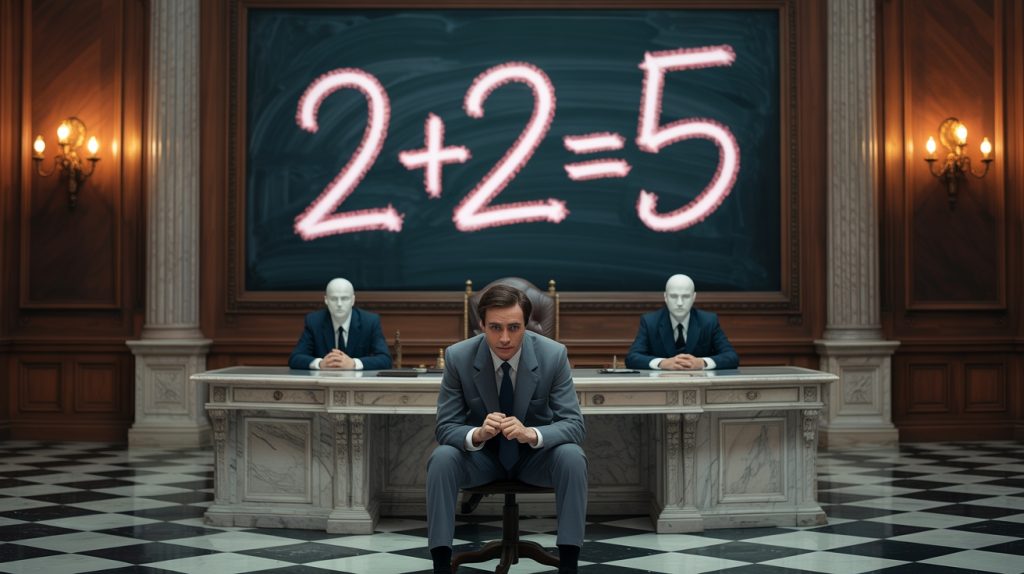
$2+2=4. Period.