 Public Cash Money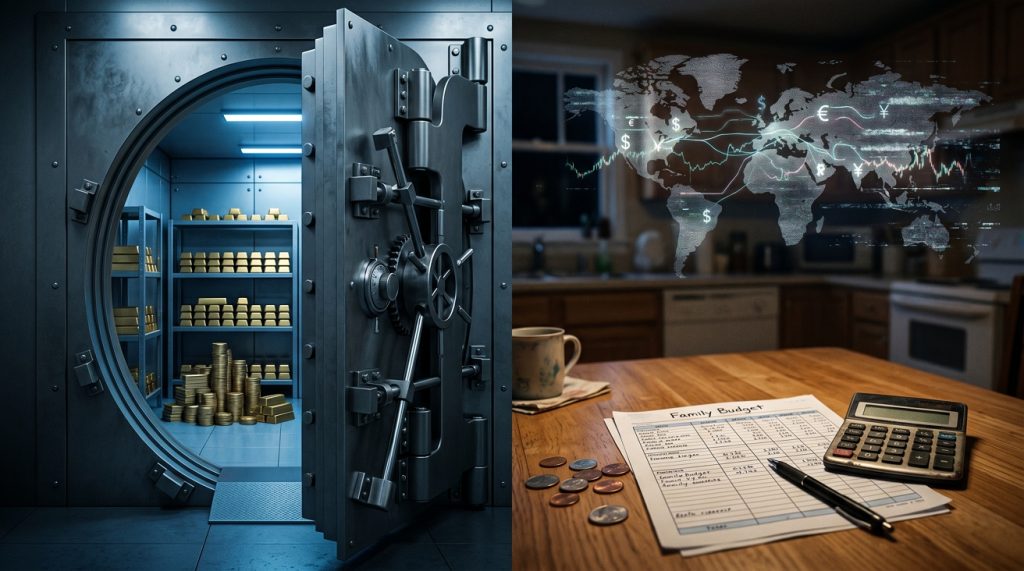
A series of verified facts. A series of open questions. No conspiracy. No accusations. Just data, arithmetic, and the questions they raise. There is a particular type of question that is not asked enough in public discourse. Not “what is happening?” but “why is this happening now?” Not “is this true?” but “what does it tell us that this is true?” This article asks that second type of question. It presents verified facts, cites the sources, and then asks, honestly and without claiming to know the answer, why these specific things are happening in this specific moment in history. The reader is invited to form their own conclusions.
Fact One: Physical Gold Is Moving. In Enormous Quantities. Between December 2024 and March 2025, the gold sitting in New York’s main exchange-approved vaults more than doubled, reaching approximately 1,350 tonnes, the highest level ever recorded. JPMorgan, Morgan Stanley, HSBC, and Deutsche Bank were among the most active movers. In February 2026 alone, US gold exports reached $17.88 billion, a historic record. VERIFIED. Sources: 247 Wall St. (May 2026), TradingKey analysis (May 2026), US export data. The official explanation: institutional arbitrage ahead of potential tariffs on gold imports. Buy in London, store in New York, sell at a premium if tariffs land. When tariffs were exempted in April 2025, the gold started flowing back out. The official explanation is plausible. And it may be entirely correct. The question worth asking: is it the complete explanation? Or is it also true that in a moment of exceptional monetary uncertainty, large institutions chose to hold physical gold, in physical vaults, outside the digital financial system, in quantities never seen before? Both things can be true simultaneously. The question is open. The data is not.
Fact Two: The Wealthiest People in the World Are Buying Land. A Lot of It. Bill Gates is the largest private farmland owner in the United States: approximately 270,000 acres across 19 states. He confirmed this himself in a Reddit AMA. Jeff Bezos owns approximately 420,000 acres. John Malone owns approximately 2.2 million acres. These are not rumours. They are documented, public, verified facts. VERIFIED. Sources: Land Report 2025, USDA data, Gates’ own public statements. The official explanation: farmland is a stable, long-term investment that diversifies a tech-heavy portfolio. Solid returns, inflation hedge, limited supply. Again, the official explanation is plausible. And it may be entirely correct. The question worth asking: what asset class, in a scenario of severe monetary instability or currency collapse, retains its value most reliably? Something that produces food, regardless of what currency is being used, regardless of what the exchange rate is, regardless of what the central bank decides tomorrow morning? The question is open. The land purchases are not.
Fact Three: The Institutional Bitcoin Moment. In January 2024, the SEC approved spot Bitcoin ETFs in the United States. The response was immediate and massive. By August 2025, BlackRock’s iShares Bitcoin Trust alone had accumulated $87.7 billion in assets under management, becoming the fastest ETF in history to reach the $100 billion milestone, faster than any equity or bond ETF ever launched. Total cumulative inflows into Bitcoin ETFs reached $136 billion by October 2025. VERIFIED. Sources: BlackRock filings, The Block, CoinTelegraph, Bloomberg ETF data. The official explanation: regulatory clarity opened a regulated, accessible pathway for institutional investors to hold a non-correlated asset. The official explanation is accurate as far as it goes. The question worth asking: institutions including pension funds and sovereign wealth vehicles are now allocating 1% to 3% of their portfolios to Bitcoin, described explicitly as mirroring gold’s role as an inflation hedge. What does it mean when the largest asset managers in the world, managing trillions of dollars of other people’s retirement savings, decide that a non-sovereign, fixed-supply, non-inflatable asset deserves a structural allocation in a diversified portfolio? What does that decision imply about their long-term confidence in sovereign currencies? The question is open. The $136 billion is not.
Fact Four: The Alternative Infrastructure Is Already Built. Project mBridge, a multi-central bank digital currency platform built on distributed ledger technology, reached its Minimum Viable Product stage in June 2024. It connects the central banks of China, Hong Kong, Thailand, the UAE, and Saudi Arabia. It has processed over $55 billion in cross-border transactions. The BIS, which co-developed it, handed the project over to the partner central banks in October 2024. ISO 20022, the new universal financial messaging standard, is in global rollout, replacing SWIFT’s legacy infrastructure with a system capable of carrying structured data, programmable conditions, and multi-currency settlement. VERIFIED. Sources: BIS press releases (June 2024, October 2024), Atlantic Council CBDC tracker, January 2026. The official explanation: improving cross-border payment efficiency, reducing costs, increasing financial inclusion. Again, the official explanation is accurate. These are real improvements over the current system. The question worth asking: who builds a complete alternative financial messaging and settlement infrastructure, capable of operating entirely outside the dollar-based correspondent banking system, for reasons of payment efficiency alone? And why does it involve precisely the central banks of the nations that have been most vocal about reducing dollar dependency in international trade? The question is open. The infrastructure is not hypothetical.
The Question Nobody Is Asking Out Loud and connects these four facts. They all represent the same behaviour, expressed at different scales and through different instruments: the conversion of monetary wealth into assets that retain value independently of the monetary system itself. Physical gold in a vault does not depend on any central bank. Land that produces food does not depend on any currency. Bitcoin with a fixed supply of 21 million units does not depend on any government’s printing decision. A cross-border payment infrastructure that bypasses SWIFT does not depend on dollar correspondent banking. None of these moves, individually, is evidence of anything beyond rational portfolio management. Taken together, in this specific historical moment, with public debt growing at $7.6 billion per day on average in the United States alone, with the dollar’s share of global reserves at its lowest since 1995, with the Treasury convenience yield having turned negative, they form a pattern. HYPOTHESIS, clearly labeled as such: the pattern is consistent with behaviour by large institutional actors who have concluded, privately, that the current monetary architecture is in a late stage of structural stress, and who are positioning accordingly, while maintaining enough exposure to the existing system to avoid triggering the collapse they are hedging against. This is a hypothesis. It may be wrong. The individual explanations for each behaviour may be entirely sufficient. But the hypothesis is not irrational, and it is worth naming.
The Part Nobody Mentions: The Solution Does Not Scale. Here is the observation that completes the picture, and that deserves more attention than it receives. Every strategy described above, gold, farmland, Bitcoin, alternative infrastructure, is a solution that scales with the capital you already possess. A family with $50,000 in savings cannot meaningfully protect itself with physical gold. Gold has wide spreads. Storage costs money. In a genuine monetary crisis, gold in a vault does not buy groceries tomorrow morning. The family cannot buy 270,000 acres of farmland. The family cannot move 1% of its portfolio into a Bitcoin ETF without taking on speculative risk that a billionaire’s diversified portfolio absorbs easily but a middle-class family cannot. The solutions available to those with $50 billion are structurally inaccessible to those with $50,000. This is not an accusation. It is arithmetic and it is the clearest possible illustration of the problem that runs through every article on this site: in a system where the monetary architecture structurally concentrates capital, even the tools for protecting against the failure of that architecture are distributed unequally. The wealthiest actors can hedge against the collapse. Everyone else can only wait for it. HYPOTHESIS, clearly labeled: if the current monetary architecture reaches a crisis point, the distribution of pain will follow the same logic as the distribution of protection. Those who could afford to prepare, prepared. Those who could not, will absorb the consequences.
The Question Remains Open and this article has not accused anyone of anything. It has presented verified facts, cited sources, asked questions, and labeled hypotheses as hypotheses. The facts are public. The data is government-issued or institutional. The questions are logical consequences of the data. If the answers are innocent, they should be easy to provide. If they are not easy to provide, the questions were worth asking.
$2+2=4. Period.
Davide Serra, Systems Analyst and Independent Monetary Analyst publiccashmoney.com, @postaperdavide on X
Sources: Gold movement data: 247 Wall St. (May 12, 2026); TradingKey analysis (May 2026); US Census Bureau export data. Farmland ownership: Land Report 2025; USDA data; Bill Gates Reddit AMA (2023). Bitcoin ETF flows: BlackRock IBIT filings; The Block cumulative flow data (October 2025); Bloomberg ETF Intelligence. mBridge: BIS press releases June 5, 2024 and October 31, 2024; Atlantic Council CBDC Tracker (January 2026). Dollar reserve share: IMF COFER database, Q4 2025. US debt growth: fiscaldata.treasury.gov, May 2026.