 Public Cash Money
The single most important distinction in monetary theory — explained with a ball, a thermometer, a clock, and a GPS. And why getting it wrong has produced $600 trillion of financial instruments that represent nothing real.
I have been writing about monetary theory for 26 years. I have explained the $1.x design bug, the history of Bretton Woods, the Triffin Dilemma, the Jekyll Island meeting, and the mathematics of compound interest on a structurally unpayable debt. I have used historical examples, economic data, and philosophical arguments.
And yet the question I receive most often — the one that appears in my comments, my messages, and my replies on X — is the simplest one of all: “But money is valuable. Why do you say it is just a measurement tool? I can use it to buy things. That means it has value.”
The confusion is understandable. It is also the root of nearly every misconception in modern monetary theory. So let me try again — with a ball.
1. The Ball and the Centimeters
I have a ball. It is round, red, and rubber. It exists physically, in the real world, independently of any measurement system. If every ruler on earth disappeared tomorrow, the ball would still exist. It would still be round. It would still bounce.
I measure the ball. Its diameter is 20 centimeters.
Now let me ask a question. What are centimeters?
Centimeters are a unit of measurement. They are a human convention — an agreed-upon standard that allows us to communicate precise information about physical dimensions. They are not the ball. They do not contain the ball. They do not generate the ball. They measure it.
Can centimeters generate more centimeters on their own? No. If I leave the ball in a drawer for a year, I will not come back to find it has grown from 20 centimeters to 22 centimeters because the centimeters multiplied. Centimeters do not multiply. They measure. When the ball grows — if I pump more air into it — I need more centimeters to describe it. The centimeters did not produce the growth. The growth produced the need for more centimeters.
Now: the ball costs €10.
What are euros? They are a unit of measurement. A human convention — an agreed-upon standard that allows us to communicate precise information about economic value. They are not the ball. They do not contain the ball. They do not generate the ball. They measure its value in a market at a given moment.
Can euros generate more euros on their own?
Centimeters cannot generate more centimeters.
Degrees cannot generate more degrees.
Seconds cannot generate more seconds.
Euros cannot generate more euros.
Unless the system is broken.
And ours is.
2. Four Measurement Tools That Never Lie
The confusion about money is not accidental. It has been cultivated for seven centuries by a monetary architecture that treats money as a commodity — something that can be owned, accumulated, rented, and made to generate returns by simply existing. To see why this is wrong, it helps to look at other measurement tools that nobody has managed to convince us are commodities.
The thermometer
What it measures
Temperature — the thermal energy present in a physical system. The degrees on the thermometer represent the heat in the room, not the other way around.
Can it generate more of itself?
No. If the room gets warmer, you need more degrees to describe it. The degrees did not produce the warmth. The warmth produced the need for more degrees. A thermometer that generates degrees without the room getting warmer is not measuring. It is lying.
The clock
What it measures
Time — the passage of physical reality from one state to another. The seconds on the clock represent the duration of real events, not the other way around.
Can it generate more of itself?
No. You cannot invest seconds and receive more seconds. You cannot rent out your clock and collect interest in minutes. Time passes. The clock records it. No financial instrument exists that generates more time by holding it.
The GPS coordinate
What it measures
Position — the location of a physical object in space. The coordinates represent where you are, not the other way around.
Can it generate more of itself?
No. If your GPS says you are at 41.9028° N, 12.4964° E, those coordinates do not generate more coordinates by sitting still. If the coordinates change without you moving, the GPS is broken — it is reporting a position that does not correspond to reality.
The ruler
What it measures
Length — the physical dimension of real objects. The centimeters represent the size of the wall, not the other way around.
Can it generate more of itself?
No. If the wall grows, you need more centimeters to describe it. The centimeters did not build the wall. The wall produced the need for more centimeters. A ruler that grows by itself — without the thing it measures growing — is not a ruler. It is a broken instrument reporting false measurements.
Four measurement tools. None of them can generate more of themselves without the thing they measure growing first. None of them are treated as commodities. Nobody invests in centimeters. Nobody rents out seconds at interest. Nobody speculates on GPS coordinates.
And yet we have spent seven centuries treating money — which is a measurement tool of exactly the same logical category — as a commodity that can be owned, accumulated, rented, and made to generate returns by simply existing.
3. What Happens When the Ruler Pretends to Be the Wall
When a measurement tool is treated as the thing it measures — when the centimeters are confused with the ball, when the degrees are confused with the heat, when the euros are confused with the value they represent — something predictable happens. The measurement tool starts growing independently of what it is supposed to measure.
Centimeters that grow without the ball growing are not measuring the ball anymore. They are measuring nothing. They are pure abstraction — numbers that refer to themselves rather than to any physical reality.
In monetary terms, this is what happened when financial derivatives were invented. A derivative is a financial instrument whose value is derived from — and whose price moves with — the price of an underlying asset. A futures contract on wheat is a derivative. Its value moves with the price of wheat. The wheat is real. The derivative measures — or rather, bets on — the wheat’s price.
So far, so reasonable. The centimeters are connected to the ball.
But then derivatives were created on derivatives. Options on futures. Swaps on options. Synthetic CDOs that referenced other CDOs. Financial instruments whose value derived from other financial instruments whose value derived from other financial instruments — layers of measurement tools, each measuring the layer below it, until the connection to any underlying real asset became so remote and so complex that no human being could trace it reliably.
The centimeters started measuring other centimeters. The rulers started measuring other rulers. The GPS coordinates started referencing other GPS coordinates. And the total nominal value of all these measurement tools measuring measurement tools reached, by current estimates, approximately $600 trillion — roughly six times the annual productive output of the entire planet.
Six times the GDP of the entire planet.
In financial instruments that measure
other financial instruments
that measure other financial instruments.
Centimeters measuring centimeters.
Six layers deep.
Connected to the original ball
by a chain so long and so complex
that nobody can reliably trace it.
This is not investment.
This is a broken ruler
reporting measurements
that correspond to nothing real.
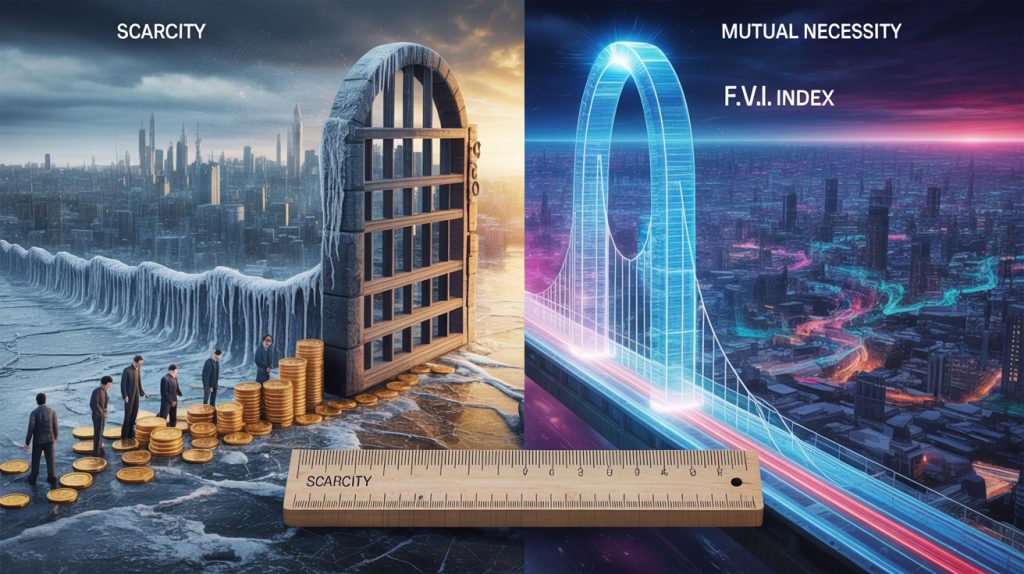
4. Why I Renamed Money the F.V.I.
The name “money” is the problem. Not the only problem — but a significant one. Because “money” sounds like a thing. A noun. An object. Something you can own, accumulate, and make grow.
Centimeters do not sound like a thing. Degrees do not sound like a thing. Seconds do not sound like a thing. They sound like what they are: units of measurement. Tools. Conventions. Abstractions that we use to describe real physical phenomena.
This is why I call it the F.V.I. — Fungible Value Index.
Every word in that name is deliberate. Fungible — because any unit of it is interchangeable with any other unit of equal denomination, just as any centimeter is interchangeable with any other centimeter. Value — because what it measures is the value of real goods and services produced by real human beings through real productive activity. Index — because it is a measurement, not a thing. An index does not generate more index by sitting in a bank account. The CPI does not generate more CPI. The Dow Jones does not generate more Dow Jones points. An index measures. It does not produce.
If we called money what it actually is — a Fungible Value Index — the conversation about monetary policy would be fundamentally different. Nobody would ask “how do we make the F.V.I. grow?” They would ask “what is the F.V.I. measuring, and is it measuring it accurately?” Nobody would argue that the F.V.I. should generate returns by being held. They would argue about what the F.V.I. should be anchored to — what real productive reality it should represent.
The renaming is not marketing. It is precision. And precision, in monetary theory, changes everything.
5. The Answer to “But Money Has Value”
Let me return to the objection I started with. “But money is valuable. I can use it to buy things.”
Yes. And a ruler is useful. You can use it to measure things. Its usefulness does not make it the thing it measures. The ruler is useful because it accurately represents the dimension of real objects. Money is useful because it accurately represents the value of real goods and services. The usefulness is a property of accurate measurement — not of the instrument itself.
A ruler that lies — that reports 25 centimeters when the object is 20 centimeters — is not useful. It is dangerous. It produces errors in everything that depends on the measurement. A monetary system that lies — that reports value where no value exists, that generates measurement units disconnected from any real productive activity — is not useful. It is dangerous. It produces the $600 trillion in derivatives that evaporated in 2008 and will evaporate again, and the $39 trillion in national debt that corresponds to no real productive asset, and the family health insurance that costs more than the federal poverty line because the dollars used to price it have been stretched beyond any relationship to the productive reality they are supposed to represent.
The ball is real. The centimeters are not the ball. The productive capacity of the human economy is real. The F.V.I. is not that capacity. It measures it. When the measurement is accurate, it serves everyone. When the measurement is disconnected from what it measures, it serves only those who control the measurement instrument.
The ball is 20 centimeters.
The centimeters did not make the ball.
The euros did not make the value.
The F.V.I. does not generate F.V.I.
It measures value.
When it stops measuring and starts pretending to be value —
that is when you get $600 trillion
of centimeters measuring centimeters
six layers deep
with no ball in sight.
$2+2=4. Period.