 Public Cash Money
A follower recently asked me:
“Davide, why is every post about the $1.x trap? Can’t you talk about something else? Like healthcare, space travel, or the price of eggs?”
My answer is simple. I am talking about those things. All of them. Every single one of them.
Let me explain why.
You Are on the Titanic
Imagine you are on the Titanic. The band is playing. The caviar is excellent. In third class, passengers are arguing about the service. In first class, someone is complaining that their cabin is too small. In the dining room, a spirited debate is underway about whether the soup was better last night.
I am the person standing at the door to the engine room, pointing at the water rushing in.
And you are asking me: “Why aren’t you talking about the music? Why won’t you comment on the soup?”
Because when the engine room floods, the music stops. The soup goes cold. The debate about cabin sizes becomes irrelevant. Everything stops. All at once. Without warning. Because the hull has a hole and nobody fixed it.
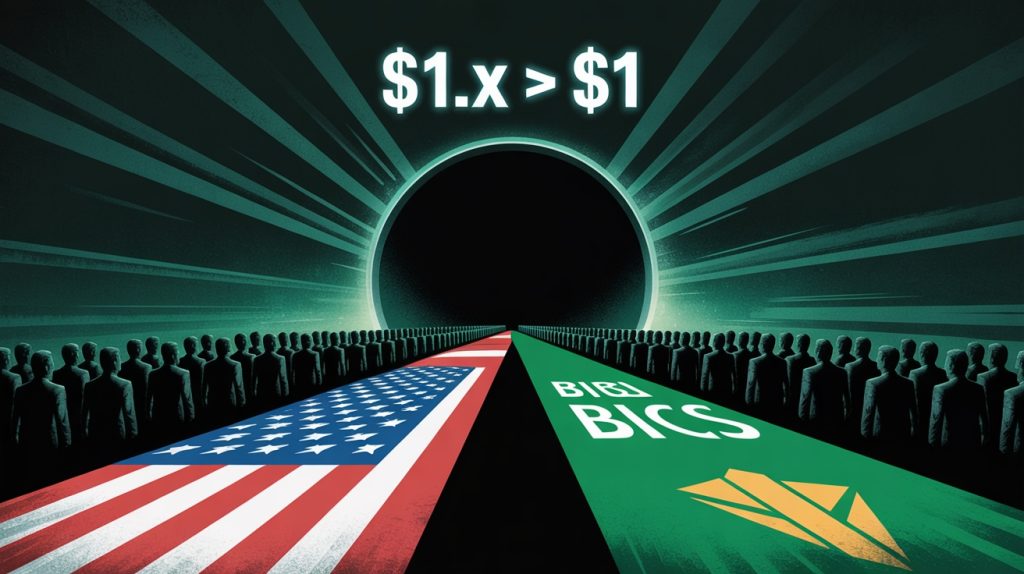
The hole in our hull is called $1.x > $1.
Every dollar, every euro, every unit of currency in circulation was borrowed into existence. Every unit carries an interest obligation that was never issued alongside it. This means the total debt in the system is always, structurally, larger than the total money supply. The system cannot balance. It was designed not to balance. It has been running this way since the Venetian bankers of 1374 — and it has been compounding, visibly and measurably, into the $39 trillion of US national debt that grows by $7.6 billion every single day.
That is the hole. That is the water in the engine room. That is the only story worth telling right now.
You Think You Are Talking About Something Else. You Are Not.
When you talk about healthcare costs, you are talking about what happens when the dollar that pays for healthcare has lost 87% of its purchasing power since 2000 — because the monetary system structurally erodes purchasing power to service the interest on debt that was never designed to be repaid.
When you talk about the price of eggs, you are talking about what happens when the F.V.I. — the unit of measurement we use to price eggs — is being continuously debased by a system that must expand the money supply to cover interest obligations that exceed the money supply itself.
When you talk about defense spending, you are talking about a country that now spends more servicing its debt than funding its military — that is financing an invisible, parallel army that produces no ships, no jets, no deterrence, only interest payments to bond holders.
When you talk about retirement security, you are talking about pension funds that hold $1.1 trillion in Treasury securities — government promises to repay, in dollars that buy five cents of what they bought in 1950.
When you talk about space travel, you are talking about a civilization that cannot fund its most ambitious projects because the compound interest on a structurally unpayable debt is consuming an ever-larger share of every tax dollar collected.
You think you are changing the subject.
You are not.
Every subject leads back to the same hole.
Every symptom has the same disease.
Every broken program runs on the same broken operating system.
Fix the operating system.
Everything else becomes fixable.
Leave the operating system broken.
Nothing else can be fixed. Ever.
This Is Not Politics. This Is Physics.
I am not a politician. I am a systems analyst. I do not have a party. I do not have an ideology. I have a bug report.
The bug is $1.x > $1. It has been running since 1374. It compounds. It does not care who is in power. It does not respond to elections, to central bank meetings, to stimulus packages, to austerity programs, or to any measure that operates within the current architecture rather than replacing it. It is not a policy problem. It is an architecture problem. And architecture problems do not get fixed by changing the policies running on top of the broken architecture.
When politicians argue about healthcare policy, they are arguing about which passengers get to eat the caviar. I am arguing about the hole in the hull. When economists debate monetary policy, they are arguing about the optimal speed of a ship that is taking on water. I am arguing about the hole in the hull. When central bankers adjust interest rates, they are rearranging the furniture on a deck that is tilting. I am pointing at the hole in the hull.
This is not because I do not care about healthcare, or eggs, or defense, or retirement, or space travel. It is because I care about them so much that I refuse to pretend that any of them can be permanently fixed while the hull has a hole.
The Mother of All Problems
In 26 years of analyzing financial systems from the inside, I have never found a problem that was not, in some way, downstream of the monetary architecture. The inequality that drives political instability. The healthcare systems that cannot be funded. The pension promises that cannot be kept. The infrastructure that cannot be built. The wars that are fought, in part, because debt-based monetary systems need periodic resets. The Nobel Prize in Economics that was funded by a central bank to legitimize the theory that justified the central bank’s existence.
They are not separate problems. They are the same problem, expressed in different domains. The monetary architecture is the operating system. Everything else is software running on top of it. When the operating system has a design bug that causes it to generate more obligations than resources to meet them — when it compounds that bug over centuries — the software crashes. All of it. In every domain simultaneously.
Fix the operating system.
The programs start working.
Leave the operating system broken.
No program works. Ever. For long.
This is why I talk about monetary policy. Not because it is more interesting than healthcare or eggs or space travel. Because it is prior to all of them. You cannot have sustainable healthcare without a sustainable monetary system to fund it. You cannot have stable food prices without a stable unit of measurement to price them. You cannot reach space without a civilization that can fund the attempt over the decades it requires.
Monetary policy is not one problem among many. It is the problem that determines whether all the other problems are solvable.
So. Until the Hull Is Fixed.
Until we exit the 1374 Venetian trap — until money is issued as a public measurement tool rather than a private debt instrument, until the interest that was never issued alongside the principal is removed from the base architecture of the global monetary system — I will keep pointing at the hole in the hull.
Not because I enjoy it. Not because it is comfortable. Not because it makes me popular. Because the alternative — joining the conversation about the music and the soup and the quality of the caviar while the engine room floods — is a comfort I cannot afford.
I want the music to keep playing. I want the soup to be excellent. I want everyone on this ship to reach the destination.
But first, someone has to fix the hole.
You ask why I only talk about monetary policy.
I ask why you are still talking about anything else.
The engine room is flooding.
The music can wait.
The hole cannot.
$2+2=4. Period.
publiccashmoney.com