 Public Cash Money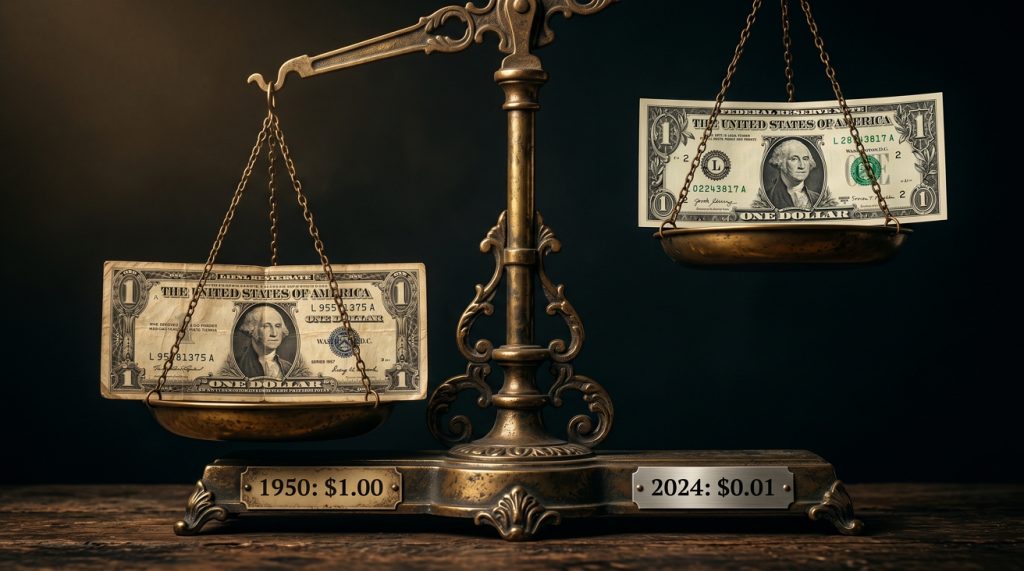
Inflation Has Always Existed. That’s Not the Problem.
Inflation is not a modern invention. It has existed in every monetary system in human history, from Roman emperors shaving silver off coins to medieval kings debasing currencies to finance wars and the question has never been whether inflation exists but is who controls it, how much there is, and who pays the price. History gives us the extreme examples: Weimar Germany 1923, where people carried wheelbarrows of banknotes to buy bread. Zimbabwe 2008, where inflation reached 89.7 sextillion percent annually. Venezuela in the 2010s, where the bolivar became worth less than the paper it was printed on. In every case the mechanism was the same: money creation without any connection to real productivity. Emission without limit, the meter shrank so fast it became invisible and these are the cases everyone knows. They are useful precisely because they make the mechanism visible but the interesting case, the one that concerns us directly, is the slow version: the one that takes 80 years and calls itself stability.
The Dollar Has Lost 99% of Its Purchasing Power Since 1950 and this is official data, not a conspiracy theory. This is the data, certified by the US government itself: one dollar in 1950 had the purchasing power of approximately $13 today according to the Bureau of Labor Statistics CPI calculator, which means that today’s dollar is worth less than 8 cents compared to 1950. Let that sink in: the official number, certified, published and remember: this is the number they are willing to admit. But here is the paradox that should make everyone stop and think: this happened entirely under a system where money is created by banks. We have been told for decades that private bank money creation keeps inflation under control and that the market self-regulates while central bank independence is the guardian of price stability. The dollar lost 99% of its value under exactly that system so either the theory is wrong, or the data is wrong or both.
The Adaptive Basket is how They Hide a Shrinking Meter: here is where it gets interesting and instructive because the official inflation index, the CPI, is calculated on a basket of goods. The idea is simple: track the price of what people actually buy, and you measure inflation and this is reasonable in theory. In practice, the basket is adjusted over time and the adjustments always go in the same direction! Here is a concrete example: imagine that prosciutto crudo becomes too expensive for average families. Instead of registering that prosciutto is now unaffordable, which would show up as inflation, the statisticians say: “People are now buying mortadella instead and they are equivalent protein sources.” And mortadella enters the basket replacing prosciutto so the index stays stable but the family can no longer afford prosciutto. Nobody calls this what it is: a reduction in the standard of living. This is not a technical adjustment: it is a political choice dressed as methodology. Every time the basket adapts downward, a little bit of real impoverishment disappears from the official statistics and the thermometer does not break. It gets recalibrated to always show a comfortable temperature while the patient gets sicker and the result is: the official inflation number is always lower than what your grocery bill tells you! Always, without exception, because the grocery bill does not have a methodology department.
Bubble vs Inflation: Two Different Mechanisms, one Confused Conversation. Before going further it is worth making a distinction that almost nobody explains clearly: a bubble is when one asset class rises in price faster than everything else. Housing in 2006. Tech stocks in 2000. Crypto in 2021. A bubble inflates one sector while the rest of the economy continues more or less normally. When it pops, that sector crashes. It is destructive but localized. Inflation is different. Inflation is when everything rises together but not because specific assets are being speculated on, but because the unit of measurement itself is shrinking. The meter gets shorter so a house costs more, but so does bread, gasoline, healthcare, education and a haircut and not because they all became more valuable simultaneously but because the dollar measuring them became worth less. The confusion between bubbles and inflation is not accidental: it allows central banks to point at bubbles as isolated events, manage them with interest rates, and declare victory, meanwhile the slow structural inflation, the one that has been running for 80 years, continues quietly in the background. One is a fever while the other is a slow change in body temperature that nobody notices until you compare today’s thermometer to one from 1950.
Inflation in the Current System: A Feature, Not a Bug and here is the part that requires intellectual honesty to say out loud: in the current monetary system, inflation is not a malfunction but a mechanism because it serves a precise function: the transfer of value from those who hold money to those who issue it. Every year that the dollar loses 3% of its value, everyone holding dollars loses 3% of their savings but that value does not disappear: it is redistributed, quietly, without a vote and without a law or without anyone signing anything. This is why the official target is 2% but not zero and not negative. Exactly enough to drain value continuously without causing the kind of visible alarm that Weimar or Zimbabwe produced because it is the slow version, the invisible version, the one that takes 80 years and calls itself monetary policy.
Inflation in PCM: Chosen, Measured, and Positive: Public Cash Money maintains a target inflation band of 2% to 4% not because inflation is unavoidable, but because a small, controlled, transparent inflation serves two legitimate functions. The first is behavioral: if money never lost value, the rational choice would be to hold it indefinitely: Why invest in a business, take a risk, hire people, build something, if keeping cash under the mattress guaranteed the same purchasing power in 30 years? A small inflation rate is the nudge that keeps capital moving. It is the difference between a river and a swamp: the second is structural while the banking system, which PCM considers fundamental and necessary, requires a minimal inflation environment to function. Banks intermediate between savers and borrowers, without any inflation, the real cost of debt rises over time, lending contracts, credit tightens, and the economy stagnates. A controlled inflation band keeps the system liquid but here is the fundamental difference: in PCM, inflation is a parameter. It is set consciously, transparently, and for defined purposes. It is the thermostat, not the fever while in the current system, inflation is a drain. It extracts value from everyone holding the currency and redistributes it through the debt mechanism and it is structural, hidden, and serves the system rather than the people using it.
Same word. Opposite meaning. That is what this article is about.
$2+2=4. Period.

Great content! Keep up the good work!