 Public Cash Money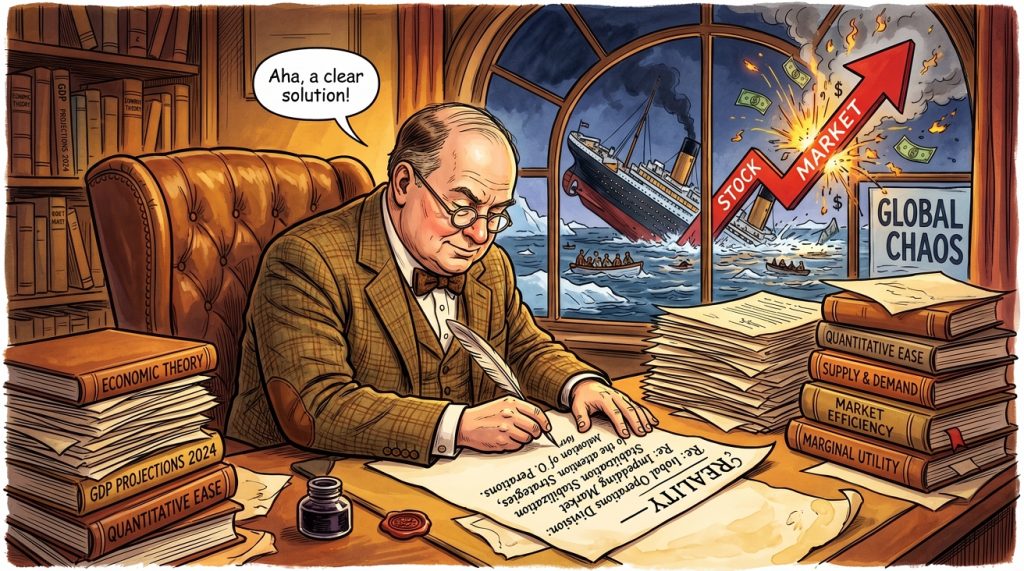
publiccashmoney.com · Satiric
⚠ Internal Memorandum — Strictly Confidential ⚠
TO: Reality (Global Operations Division)
FROM: The Department of Mainstream Economics, Nobel Memorial Prize Section
CC: Central Banks Worldwide, IMF, BIS, The Invisible Hand (if locatable)
DATE: May 2026 (Year 82 of the Post-Bretton Woods Period)
RE: Your Continued Failure to Conform to Predicted Equilibrium
PRIORITY: Urgent (as it has been for 82 consecutive years)
Dear Reality,
We are writing to you for what we believe is the forty-seventh time on this matter, though our records are somewhat difficult to verify given that our models did not predict we would need to write this many times. We wish to express, with the utmost professional courtesy, our profound disappointment with your continued failure to behave as predicted. We have attached 23 peer-reviewed papers, 4 Nobel Memorial Prize lectures, 2 Quarterly Bulletins, and one very long footnote explaining precisely how you should be behaving. We note that you have apparently not read any of them. We are beginning to find this personally disrespectful.
Section 1: Specific Complaints
1.1 — The Debt. Our models clearly predict that debt-to-GDP ratios should stabilize when the growth rate exceeds the interest rate. This is called the Blanchard Condition and it is in all the textbooks. We have been explaining it to you since 1944. The US national debt was $260 billion in 1944. It is now $39 trillion. We calculate that this is approximately 150 times larger than when we started explaining things to you. We find this trajectory unhelpful and would ask you to reverse it at your earliest convenience.
1.2 — The Purchasing Power. Our models predict that moderate, well-managed inflation serves as a useful lubricant for the economy. The dollar has lost 87% of its purchasing power since 1950. We acknowledge this is somewhat more than a lubricant. We are currently working on a paper that will explain why this is, in fact, optimal. We will send it to you when it is finished. We ask that you please stop losing purchasing power in the meantime.
1.3 — The Velocity. We assumed V was stable. It was not stable. We have since written several papers explaining why V being unstable is consistent with our original assumption that V was stable, under certain conditions, with appropriate caveats, in the long run. We consider this matter resolved.
1.4 — The Middle Class. Our models predict that economic growth benefits all participants through trickle-down mechanisms. We note that the top 1% has increased its wealth 2,655 times faster than the bottom 50% between 2000 and 2024. We have reviewed our models and determined that the trickle is occurring but is very slow. We ask for your patience. The trickle will arrive.
1.5 — The 2008 Crisis. Our models did not predict this. We have since built models that explain why it happened. These models did not predict the 2020 crisis either. We are currently building models to explain that one. We are confident that the models we build after the next crisis will be very accurate about the previous crisis.
We wish to be clear: the problem is not the models. The models are mathematically impeccable. The problem is that you, Reality, persist in behaving
in ways that the models did not anticipate. We consider this a flaw in your design rather than in ours.
Section 2: Our Diagnosis
After extensive internal review, we have identified the source of the problem. The issue is not our theoretical framework, which remains entirely correct under its foundational assumptions. The issue is that you, Reality, are operating outside those assumptions. Specifically: our models assume rational actors, perfect information, efficient markets, and the absence of structural monetary bugs. You have provided irrational actors, imperfect information, inefficient markets, and what some fringe analysts are calling a “structural monetary bug” — a claim we reject as unscientific, despite being unable to explain the $39 trillion. We note that the fringe analysts in question have suggested that the formula D = M(1+r)^t > M for all r>0 and t>0 constitutes a formal proof of structural insolvency. We have reviewed this claim. The algebra is correct. We are working on a paper explaining why correct algebra does not necessarily reflect economic reality. We expect to publish within 18 months, funding permitting. In the meantime, we have informed the Sveriges Riksbank that we may require additional prize allocations to incentivize researchers to find solutions to the problem that we have officially determined does not exist.
Section 3: Our Proposed Solutions
We have developed three solutions, which we present in order of our preference:
Solution A — Adjust the models. We will add additional variables to our existing models to account for the observed deviations. We estimate this will require approximately 14 new parameters, 3 dummy variables, and one interaction term that we have not yet named. Once these are added, our models will accurately predict everything that has already happened. We consider this progress.
Solution B — Adjust the data. We propose a technical revision of the methodology used to calculate inflation, debt sustainability, and purchasing power. Our preliminary analysis suggests that with appropriate methodological adjustments, the numbers will more closely reflect what our models predict. We consider this scientifically defensible.
Solution C — Wait. Our models predict that in the long run, equilibrium will be restored. We acknowledge that in the long run, as Keynes observed, we are all dead. We consider this an acceptable risk, as our models do not include mortality as a variable.
We have decided to pursue all three solutions simultaneously.
Section 4: A Note on Unauthorized Alternative Analyses
It has come to our attention that certain independent analysts — operating without institutional affiliation, peer review committees, or central bank funding — have proposed what they describe as a “simpler” explanation of the observed deviations. These analysts claim that the entire trajectory of global debt, purchasing power erosion, and wealth concentration can be explained by a single formula: $1.x > $1, for every x > 0. They further claim that this formula can be understood by anyone with secondary school algebra, and that explaining it requires approximately one example involving a contadino, a restaurant owner, and a supermarket, and $50. We find this claim deeply troubling. If monetary policy could be explained with $50 and a farmer, what would become of our doctoral programs? Our working papers? Our quarterly reviews? Our conferences in Geneva? Our prizes? We have therefore officially classified these analyses as “outside the mainstream” and encouraged relevant subreddits to apply appropriate moderation measures. We note that at least one such analyst has been temporarily muted for 28 days for asking a mathematical question. We consider this an appropriate response to mathematical questions.
We wish to be absolutely clear: The complexity of economics is not a bug. It is a feature. If economics were simple, anyone could understand it. If anyone could understand it, anyone could question it. If anyone could question it, we would have to answer the questions. We prefer not to answer the questions. This is called peer review.
Section 5: Conclusion and Requests
We conclude by summarizing our requests to Reality:
1. Please stabilize the debt-to-GDP ratio, as our models predict you should have done in 1985, 1995, 2005, and 2015.
2. Please allow the trickle to trickle faster. The bottom 50% has been waiting since approximately 1944.
3. Please refrain from producing crises that our models did not predict. If you must produce crises, please do so after we have published the models predicting them.
4. Please disregard any analyses suggesting that your behavior is structurally determined by the mathematical properties of debt-based money creation. These analyses, while algebraically correct, are not peer-reviewed and therefore do not exist.
5. Please continue behaving in ways that require our ongoing analytical services. We have significant fixed costs.
We look forward to your cooperation and remain, as always, available to explain why your cooperation, if it occurs, was predicted by our models all along.
Yours in perpetual equilibrium,
The Department of Mainstream Economics
Nobel Memorial Prize Section
Sveriges Riksbank Building, Stockholm
(Founded 1969 by a central bank, for reasons that are entirely unrelated to the content of this memo)
Footnote 1 of 47
The Nobel Prize in Economics does not exist. The correct name is the “Sveriges Riksbank Prize in Economic Sciences in Memory of Alfred Nobel.” It was established in 1969 by the Swedish central bank — an institution whose existence and legitimacy is, coincidentally, one of the subjects that mainstream economics was developed to justify. Alfred Nobel did not include economics in his original prizes. He included Physics, Chemistry, Medicine, Literature, and Peace. He may have had his reasons.
Editorial note — from the author
This memo is satirical. The economists it parodies are, in many cases, genuinely brilliant people doing genuinely rigorous work within a framework whose foundational assumptions they are structurally incentivized not to question. The target of the satire is not the individuals but the institutional architecture that rewards complexity over clarity, and model-building over reality-checking. The $50, the contadino, the restaurant owner, and the supermarket are real. The structural bug is real. The algebra is elementary. The peer review invitation is genuine. Reality, for its part, continues to be uncooperative. We consider this encouraging.
The problem with reality is that it keeps refusing to behave as the models predict. We have been explaining it patiently for 80 years. Reality remains uncooperative and we are beginning to suspect the problem might not be reality.
$2+2=4. Period.
(This has been peer-reviewed by arithmetic.)
Davide Serra · Systems Analyst & Independent Monetary Analyst
publiccashmoney.com · @postaperdavide on X
All data cited in this memo is accurate and sourced. The memo format is satirical. The $39 trillion is real. The 87% purchasing power loss is real. The 150-fold debt growth vs 13-fold GDP growth is real. The 2,655x wealth divergence is real. The Sveriges Riksbank Prize misidentification as “Nobel Prize” is real. The temporary mute from r/academiceconomics for asking a mathematical question is real. The $50 example is from Article 37 of this series.