 Public Cash Money
I am a systems analyst. My job is to identify structural risks before they become structural failures. This is the most important risk I have ever identified.
Before you read. This article contains no predictions. I do not know exactly what will happen if the window closes. I do not know the timeline. I do not know the sequence of events. What I know — with the same confidence that an engineer knows a compromised bridge is dangerous before knowing exactly when it will fail — is that the structural risk is real, that it is increasing, and that the window in which it can be addressed from a position of strength is narrowing. This is a risk analysis. Read it as one.
In structural engineering, there is a concept called the inspection window — the period during which a known defect can be identified, assessed, and repaired before it causes a catastrophic failure. Miss the window and the defect does not disappear. It progresses. The structure continues to function, apparently normally, right up until the moment it does not.
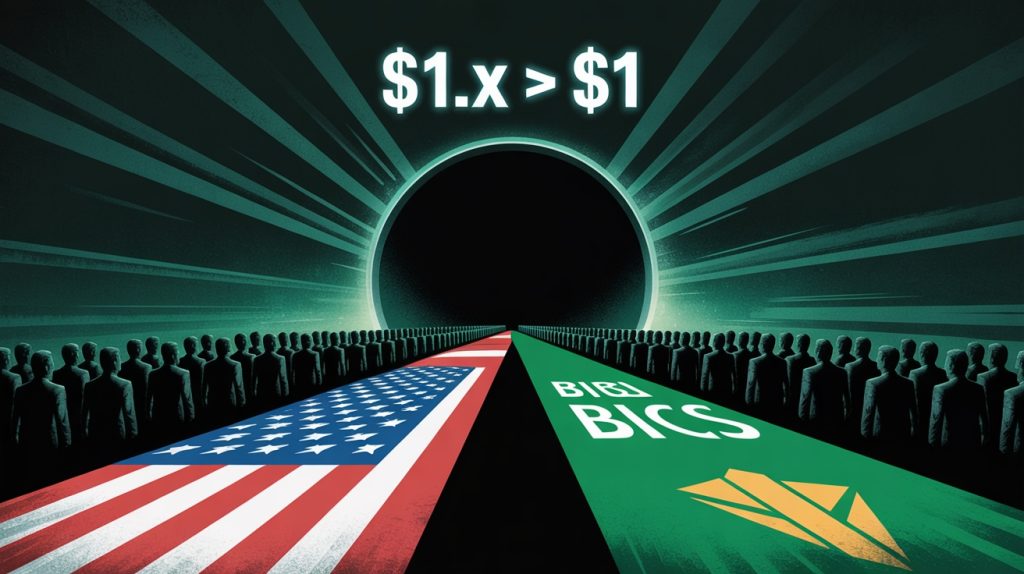
The global monetary system has a known defect. I have described it in eighteen previous articles — the $1.x design bug, the structural impossibility of servicing compounding debt with a money supply that was never issued in sufficient quantity to cover the interest. The defect has been running since Venice in 1374. It was globally mandated at Bretton Woods in 1944. It has been progressing, visibly and measurably, for decades.
There is a window in which it can be repaired. The window is open today. I do not know how long it will remain open. But I know — with the same certainty that the engineer knows about the bridge — that it is narrowing. And I know something else, drawn from the historical record of every great power that has ever faced this kind of structural monetary crisis: the instinct is almost always to wait. To defer. To extract the maximum benefit from the existing system for as long as possible. And to reform only when the collapse forces the issue.
By then, the window is closed. And the options available after the collapse are not the options available before it.
1. What Made 1944 Possible
To understand the window, we must understand what opened it in 1944 and what is slowly closing it today.
In July 1944, the United States arrived at Bretton Woods with assets that no other nation possessed. It held two thirds of the world’s gold reserves. Its industrial base was intact — the only major economy that had not been physically destroyed by the war. It was the world’s largest creditor. Its currency was the only one credibly backed by physical gold at a fixed rate. And it had just demonstrated, in the preceding five years, the military and organizational capacity to project power across two oceans simultaneously.
From that position — a position of overwhelming, unambiguous, uncontested strength — the United States proposed a new monetary architecture and the world accepted it. Not out of admiration. Out of necessity. There was no alternative. The alternatives had been bombed into rubble.
That position no longer exists. This is not a criticism of America. It is a description of arithmetic. Eighty years of the exorbitant privilege have produced $39 trillion in national debt. The manufacturing base that won the Second World War has been substantially relocated. The gold reserves that backed the dollar’s credibility were decoupled from the currency in 1971. The military superiority that underwrote American diplomatic weight is increasingly contested. None of this means America is weak — it remains the world’s largest economy and its most powerful military force. But the margin of dominance that made Bretton Woods possible in 1944 has narrowed. And a narrower margin means a smaller window.
In 1944, America proposed a new monetary order from a position of total dominance. The world had no choice but to accept. Today, America can still propose. Today, the world still has reasons to accept. Tomorrow — if the window closes — neither of these things may be true.
2. The Pattern That History Keeps Repeating
I am not the first analyst to observe that great powers facing structural monetary crises tend to reform late rather than early. The historical record is consistent, and it is not encouraging.
Rome faced its monetary crisis gradually and visibly. The denarius — the Roman silver coin that had served as the empire’s monetary foundation for centuries — was debased continuously from the reign of Nero onward. By the third century AD, coins that had once been 90% silver contained less than 5%. The emperors who presided over this debasement were not stupid. They understood what they were doing. They did it because the alternative — reforming the monetary system from a position of political weakness, against the resistance of those who benefited from the existing arrangements — was harder than continuing the debasement for one more year. And then one more year. And then one more. By the time the crisis became impossible to ignore, the institutional capacity to implement a coherent reform had itself been eroded by the same forces that had produced the crisis. Rome did not reform its monetary system before the collapse. It reformed after — incompletely, repeatedly, and ultimately unsuccessfully.
Britain faced its moment of monetary transition in the aftermath of the Second World War. The pound sterling had been the world’s reserve currency for over a century — a position built on the reality of British industrial dominance and imperial reach. By 1945, both the dominance and the reach had been substantially diminished by the cost of two world wars. The Bretton Woods conference in 1944 was, among other things, the moment at which Britain was asked to accept the transfer of monetary primacy to the United States. Keynes negotiated as long as he could. But the arithmetic was unambiguous. Britain’s transition from reserve currency issuer to ordinary currency was managed — but only because America imposed the new architecture, not because Britain chose it. Left to its own devices, Britain would almost certainly have deferred the transition indefinitely. The window was closed by external force, not by internal wisdom.
Argentina offers perhaps the most instructive case — not because it is a great power, but because it has repeated the same structural monetary error so many times, in such clear sequence, that it has become an almost clinical demonstration of what happens when reform is deferred past the point of voluntary possibility. Argentina has defaulted on its sovereign debt nine times since independence. Each default was preceded by years of visible, measurable, publicly documented deterioration in the monetary foundations of the economy. Each default was followed by a period of painful reform — reforms that would have been far less painful if implemented before the default. And each reformed system eventually reproduced the conditions that led to the previous default, because the underlying architectural problem was addressed symptomatically rather than structurally.
Rome debased its currency for three centuries before the system failed completely. Britain held its reserve currency status a generation past the point it was sustainable. Argentina has repeated the same structural error nine times without fixing the architecture. The pattern is not coincidence. It is human nature, applied to institutions: extract the maximum from the existing system for as long as extraction is possible. Reform when there is no other option. By then, the options have changed.
3. The Signals That the Window Is Narrowing
I do not make predictions. But I do read signals. And the signals that the window is narrowing are not hidden. They are visible in public data, documented in official reports, and observable in the behavior of institutions that have strong incentives to be accurate about these things.
The first signal is the debt service trajectory. Interest payments on US national debt have now exceeded the defense budget — a threshold that, once crossed, has historically marked the transition from manageable fiscal stress to structural fiscal pressure. The $9 trillion in debt to be refinanced in 2026 at rates four to eight times higher than the original issuance rate represents a step-change in the annual interest burden that has no precedent in the post-war era. These are not projections. They are scheduled events.
The second signal is the erosion of dollar-denominated trade. The proportion of global trade settled in dollars has been declining gradually but consistently for over a decade. Bilateral currency agreements between major economies have been multiplying. The mechanisms of dollar dependency — the pricing of commodities in dollars, the settlement of international trade in dollars, the holding of dollar reserves by central banks — remain dominant but are no longer universal. The erosion is slow. But slow erosion, compounded over years, produces large structural changes.
The third signal is institutional. The multilateral institutions that the Bretton Woods architecture created — the IMF, the World Bank, the system of dollar-denominated international finance — are increasingly contested. Their legitimacy, once assumed, is increasingly questioned by the nations that did not design them and do not believe they were designed in their interest. An institution whose legitimacy is contested is an institution whose ability to anchor a new monetary agreement is diminished.
The fourth signal is the most difficult to quantify and the most important. It is the signal of political attention. Bretton Woods 1.0 was possible not only because America had the power to propose it, but because the political leadership of the time had the intellectual framework to understand what needed to be done and the institutional capacity to do it. The question of whether that combination — power, intellectual framework, and institutional capacity — currently exists is one I leave to the reader. But it is a question worth asking. And the honest answer is not obviously reassuring.
4. The Worst Case: A Territory, Not a Map
I have said I will not make predictions. I will keep that commitment. But there is a difference between predicting a specific sequence of events and describing the territory of risk — the range of outcomes that become possible if the window closes before the reform is made.
What I can say, as an analyst, is this: the worst case scenario for a disorderly collapse of the current monetary architecture is not a scenario I can describe precisely. I do not know its timeline. I do not know its trigger. I do not know its sequence. What I know is that it belongs to a category of systemic failures that share certain characteristics — and those characteristics are worth understanding, not as predictions, but as the outer boundary of the risk territory.
When the reserve currency of a global monetary system loses its function in a disorderly way — not through a managed transition but through a crisis of confidence — the effects are not contained to financial markets. They propagate through every system that depends on the monetary infrastructure for its functioning. Supply chains that depend on dollar-denominated contracts. Energy markets that depend on dollar-denominated pricing. Food distribution systems that depend on dollar-denominated financing. The complexity of modern global supply chains means that a disorderly monetary disruption would have cascading effects in physical systems that most people do not associate with monetary policy.
What happens to the social fabric of a society when those physical systems are disrupted simultaneously, at a scale and speed that outpaces the institutional capacity to respond, in a political environment already stressed by decades of inequality and eroding institutional trust — I genuinely do not know. History offers some examples. None of them are reassuring. None of them are precise enough to serve as a reliable template for what a 21st century version of this failure would look like.
What I do know is this: the America that emerged from a disorderly monetary collapse would not be the America of 1944. It would not be in a position to propose a new monetary architecture from a position of strength. It would be occupied — as you are occupied after any major structural failure — with the immediate, urgent, overwhelming task of managing the consequences. Bretton Woods 2.0, in that scenario, would happen eventually. But it would not be designed in New Hampshire. It would not be designed by America. And it would not necessarily be designed with the interests of ordinary people — in America or anywhere else — as its primary constraint.
I am not predicting a catastrophe. I am describing the territory that becomes accessible if the window closes before the reform is made. The territory is large. Its contents are uncertain. Its outer boundaries are visible in the historical record of every previous reserve currency transition that was not managed in advance. None of those boundaries are comfortable.
5. The Asymmetry of Timing
There is an asymmetry in the timing of this decision that I want to state as clearly as I can.
If Bretton Woods 2.0 is designed and implemented before the window closes — from a position of American strength, through a multilateral process, with the institutional framework of P.C.M. as its foundation — the cost is political. It requires admitting that the current system has a fatal flaw. It requires accepting a transition that distributes the exorbitant privilege more broadly. It requires the kind of institutional courage that is rare in democratic systems, where the incentive structure rewards short-term extraction over long-term architecture.
If Bretton Woods 2.0 is designed after the window closes — in the aftermath of a disorderly collapse, from a position of crisis rather than strength — the cost is civilizational. Not metaphorically. Literally. The physical systems that sustain modern civilization — food, energy, medicine, communication — are built on a monetary infrastructure whose stability is currently taken for granted. The cost of discovering, suddenly and without preparation, what happens when that infrastructure fails is not a cost that can be accurately quantified in advance. It can only be experienced.
The asymmetry is stark. Act before: pay a political cost. Act after: pay an unknowable cost, in an unknowable currency, to an unknowable degree.
Every year of deferral narrows the window further. Every trillion of additional debt reduces the margin of maneuver. Every erosion of dollar-denominated trade reduces the leverage that makes a voluntary transition possible. The window is not closing at a fixed rate. It is closing at an accelerating rate — because the forces that are narrowing it are themselves compounding.
6. Why Greed Will Probably Win — And Why That Makes This Worse
I want to be honest about something that systems analysts are rarely honest about in public: the probability distribution of outcomes.
The reform-before-collapse scenario requires a political system to voluntarily surrender a privilege that the entities who control that political system have been extracting for eighty years. It requires those entities to accept a transition that reduces their structural advantage — not because they are forced to by a crisis, but because an analyst has shown them that the alternative is worse.
History does not offer many examples of this happening. Rome did not choose to reform its monetary system before the crisis made reform impossible. Britain did not voluntarily surrender the pound’s reserve status — it was transferred by the arithmetic of the post-war settlement. Argentina has never voluntarily fixed its monetary architecture — it has only fixed it, temporarily, when the alternative was complete collapse.
The pattern suggests that the most probable outcome is not reform before collapse. It is deferral until the collapse forces the issue. Not because the people involved are evil — most of them are not. But because the incentive structure of the current system rewards those who extract the maximum from it for as long as possible, and punishes those who advocate for reform before the crisis makes reform unavoidable.
I am stating this not as a prediction but as a risk assessment. The most probable path, based on the historical pattern of similar situations, leads through the crisis rather than around it. And the crisis, when it comes, will not arrive with a warning that gives ordinary people time to prepare. It will arrive the way crises always arrive — suddenly, after a long period of gradual deterioration that everyone could see and nobody acted on.
Conclusion: The Engineer’s Responsibility
When an engineer identifies a structural defect in a bridge, they have a professional and moral obligation to report it — regardless of whether the report is convenient, regardless of whether the people responsible for the bridge want to hear it, regardless of whether the defect will cause a failure tomorrow or in twenty years.
The obligation exists because the people who use the bridge have a right to know about the risk. They cannot make informed decisions — about whether to cross the bridge, about whether to demand that it be repaired, about whether to find an alternative route — if the engineer who has seen the defect keeps silent.
I am not a bridge engineer. I am a monetary systems analyst. But the obligation is the same.
The defect is real. The window is open but narrowing. The historical pattern of similar situations is not encouraging. The worst case territory, while I cannot map it precisely, is large enough and dangerous enough to warrant the alarm.
I do not know exactly what will happen if the window closes. I do not know the timeline. I do not know the trigger. I do not know the sequence.
What I know is that the bridge has a defect. That the defect is visible. That the inspection window is open. And that every day we spend debating whether the defect is real is a day we are not spending fixing it.
This is not a prediction. It is a risk analysis. The risk is real. The window is open. The margin is narrowing. And the cost of acting before the crisis is a fraction of the cost of acting after. The bridge has a defect. We can see it. The inspection window is still open. $2+2=4. Period.