 Public Cash Money
A brief clarification for those who discovered this and felt it warranted an announcement.
Every so often, someone arrives in my mentions with the energy of a detective who has just cracked the case of the century. The message is always some variation of the same revelation: “YOU USE AI TO WRITE YOUR POSTS.”
The capitals are always there. The exclamation mark is usually there. The implication — that this constitutes some kind of exposure, some unmasking of a fraud, some discovery that invalidates everything I have argued — is always there.
I want to respond to this with the seriousness it deserves.
Yes. Of course I use AI. Did that need saying?
Let Me Put This in Context
The P.C.M. framework — the monetary theory I have been developing and writing about in this series — proposes, among other things, that real inflation should be measured in real time by an AI engine and recorded on a public blockchain as the incorruptible foundation of a new global monetary architecture.
I am proposing to use AI to run the monetary system of the entire planet.
And someone thinks it is a meaningful criticism that I use it to translate tweets.
I want to be charitable here. Perhaps the person making this observation has not read the articles. Perhaps they arrived at my profile, saw a post, noticed the writing was polished, and concluded that a systems analyst from Rome who speaks Italian and English could not possibly produce coherent English prose without algorithmic assistance. This is, I suppose, a theory. It is not a very flattering theory about the capabilities of Italian systems analysts, but I will let that pass.
I am proposing to use AI to govern the monetary architecture of the global economy. Yes, I also use it to translate a tweet from Portuguese. I apologize for the consistency.
What AI Does in This Project — and What It Does Not
Since we are apparently doing this, let me be precise. Precision is, after all, what this entire project is about.
AI helps me translate. I am engaging with people from dozens of countries — Portuguese, Spanish, French, Arabic, Japanese, languages I do not speak. AI translates their messages so I can understand what they are actually saying, and helps me respond in their language so they can understand me. This is called communication. I recommend it.
AI helps me articulate. I think in Italian. The concepts in my head are clear to me — they have been developing for years, sitting through hundreds of hours of analyzing financial flows for major banks, watching the $1.x equation play out in real data in real systems. Getting those concepts from Italian-language thoughts into English prose that a global audience can engage with is a translation task. AI helps with that task. The concepts are mine. The translation is assisted.
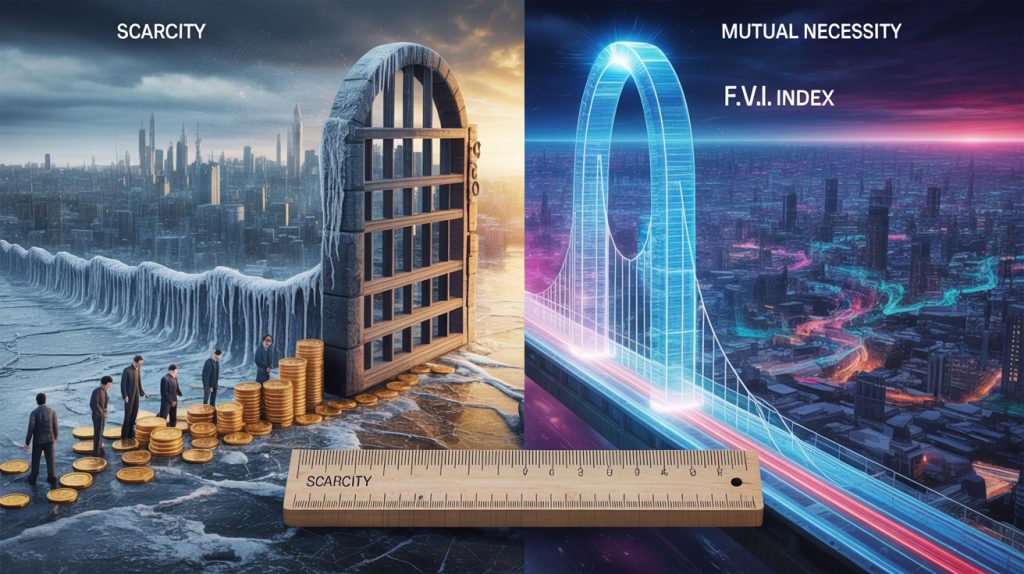
AI helps me maintain consistency. I have written nineteen articles in this series. Each one applies the same analytical framework to a different aspect of the monetary system. I have trained the AI on my framework — on the Principle of Mutual Necessity, on the F.V.I., on the distinction between speculative assets and monetary infrastructure, on the $1.x design bug, on all of it. When someone asks me a question, the AI helps me ensure my answer is consistent with the framework I have built. It is, in this sense, less a ghostwriter and more an extremely well-briefed assistant who knows my work better than most of my readers do.
What AI does not do is think. It did not have dinner at my friend’s restaurant and notice that the same banknote had traveled from my hand to his and back again and realize that money is not value — it is a measurement of value. It did not spend twenty-five years watching the $1.x equation accumulate into $39 trillion of national debt and conclude that the architecture itself was the problem. It did not read Keynes and realize that the Bancor proposal of 1944 was not just a historical footnote but a solution that had been waiting eighty years for the technology to make it implementable.
Those things happened in a human brain. Mine, specifically. In Italian. Over decades.
The AI helped me tell you about them in English. Clearly, consistently, and in enough detail that an ex-Member of the European Parliament, several economists, AI researchers, and a retired physician decided the content was worth following. I will take that as a reasonable indication that the communication is working.
The Architect and AutoCAD
Here is an analogy that might help.
When Renzo Piano designs a building, he uses software. Advanced architectural modeling tools that help him visualize structures, test load-bearing calculations, and communicate his designs to engineers and contractors with precision. Nobody — literally nobody — looks at the Centre Pompidou or the Shard and says: “Ah, but he used AutoCAD. Therefore the architecture is not his.”
The software did not conceive the building. It did not decide that the Centre Pompidou should wear its structural systems on the outside, turning industrial infrastructure into aesthetic statement. It did not choose to make the Shard a vertical city rather than a conventional office tower. Those decisions came from a human mind with a vision, a philosophy, and decades of accumulated expertise.
The software helped communicate and realize the vision. The vision was always the architect’s.
The P.C.M. framework is my vision. The Principle of Mutual Necessity is my foundation. The observation that every human being represents simultaneously a need and an opportunity — and that unemployment in the presence of unmet needs and available workers is therefore always a monetary failure rather than a natural phenomenon — is something I worked out at a restaurant table in Rome, not something an AI generated on request.
The AI helps me build the presentation. The architecture is mine.
A Final Thought for the Discoverers
If you have read this far and your primary concern is still whether I use AI rather than whether the monetary system has a $1.x design bug that has been accumulating debt for seven centuries — I gently suggest that you may be focusing on the wrong variable.
The question of whether Davide Serra uses AI to write his posts will not be relevant to anyone in twenty years. The question of whether the global monetary architecture has a structural defect that makes debt mathematically inevitable, war periodically necessary as a reset mechanism, and the education of an entire generation unaffordable — that question will still be relevant. Urgently so.
I use every tool available to communicate this as clearly and as widely as possible. AI is one of those tools. So is the Italian education system that taught me to think analytically. So is the twenty-five years of professional experience that showed me the $1.x equation in action. So is the restaurant where a banknote taught me more about monetary theory than any textbook.
None of these tools wrote the theory. They helped me share it.
If you have a substantive objection to the theory — if you believe the $1.x equation does not exist, that the Principle of Mutual Necessity is logically flawed, that P.C.M. would not work for reasons I have not considered — I am here. That conversation I will have with pleasure, in whatever language you prefer, with whatever AI assistance makes the communication clearer.
If your objection is that I use AI: yes. I do. You are welcome to respond to my arguments using only a quill pen and parchment if that makes you feel better about the process.
The theory stands or falls on its mathematics. Not on its word processor.
$2+2=4. Period. (Calculated without AI assistance, I promise)