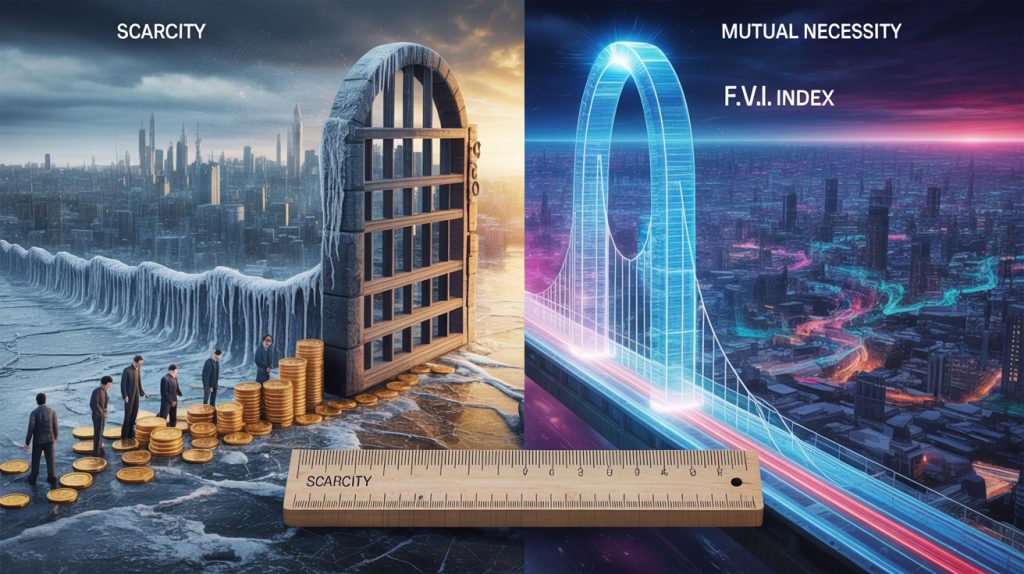
 Public Cash Money
A philosophical article. After twenty articles of mathematics, history, and systems analysis, I want to say something simpler. Something that has been true for as long as human beings have existed — and that a broken monetary system has spent seven centuries trying to make us forget.
There are two Latin phrases that between them contain the entire history of human civilization. Every war, every empire, every economic crisis, every moment of collective flourishing — all of it can be traced back to one of these two principles, applied at scale.
Divide et Impera
Divide and conquer. The principle of power imposed from above.
Mutua Ope Vivimus
We live by mutual aid. The principle of life as it actually works.
The first is a command. Someone in power orders separation — of peoples, of interests, of classes, of nations — so that those separated cannot recognize their common cause and act on it together. It requires an architect. It requires enforcement. It requires that the people being divided never quite understand what is being done to them.
The second is a description. It describes what human beings do naturally, spontaneously, and efficiently when the conditions allow it. It requires no architect. It requires no enforcement. It requires only that the bridge between need and capacity be available — and that nobody is charging rent on it.
Every article I have written in this series has been, at its core, about the same thing: the systematic application of Divide et Impera through the most sophisticated instrument ever devised — a monetary system that creates money as debt, keeps it artificially scarce, and charges rent on every unit in circulation. A system that forces human beings into competition for a monetary mass that is structurally insufficient to cover all the obligations attached to it.
This article is about the other principle. The one that was there before the monetary system. The one that will be there after. The one that has never stopped working — every time the system allowed it to.
1. Two Principles, Two Visions of Human Nature
Divide et Impera rests on a specific theory of human nature: that people are fundamentally competitive, that their interests are naturally opposed, and that the only stable social order is one imposed by a power strong enough to prevent them from destroying each other. In this vision, cooperation is a fragile exception. Conflict is the default. The strong survive. The weak are absorbed or eliminated.
This vision is not entirely wrong. Human beings are capable of extraordinary cruelty, selfishness, and destructive competition. History documents this at length. But it is profoundly incomplete — because it ignores the other half of what the historical record shows.
Mutua Ope Vivimus rests on a different observation: that human beings, left to their own devices in conditions of reasonable security and access to resources, tend toward cooperation. Not because they are saints. Because cooperation produces better outcomes than competition for almost everyone involved. Because the sum of two people’s productive capacities, applied toward their mutual necessities, is almost always greater than the sum of the same two people competing for the same resources.
This is not philosophy. It is game theory. It is the prisoner’s dilemma solved over repeated iterations. It is the observation that in stable communities — where people expect to interact repeatedly over long periods — cooperative strategies outperform competitive ones almost universally. The mathematics of repeated games produces cooperation not as a moral choice but as a rational one.
Divide et Impera
Requires enforcement. Requires a power structure to maintain separation. Collapses when the enforcement mechanism fails. Produces conflict as its primary output.
Mutua Ope Vivimus
Requires only the absence of artificial obstacles. Self-reinforcing — cooperation produces outcomes that encourage more cooperation. Produces prosperity as its primary output.
2. Five Times History Chose the Right Principle
I want to give you five moments in history when human beings — sometimes consciously, sometimes intuitively — chose Mutua Ope Vivimus over Divide et Impera. And what happened when they did.
The Medieval Guilds. In the cities of medieval Europe, the guild system was a deliberate institutionalization of Mutua Ope Vivimus. The master craftsman taught the apprentice not out of charity but out of rational self-interest — because a city with more skilled craftsmen was a more prosperous city for every craftsman in it. The apprentice learned, became a journeyman, became a master, and taught the next generation. Knowledge circulated. Quality was preserved. Standards were maintained — not by external regulation, but by the internal logic of a community that understood its members’ interests were aligned, not opposed. The cities that developed the most sophisticated guild systems — Florence, Venice, Bruges, Augsburg — became the economic powerhouses of their era.
The Monti di Pietà — Italy, 15th Century. In the cities of Renaissance Italy, the poor were trapped by usurers charging interest rates of 30%, 40%, sometimes 100% per year — the medieval version of the $1.x design bug, operating at the individual level. The Franciscan friars who founded the first Monte di Pietà in Perugia in 1462 understood something precise: the problem was not the poverty of the poor. It was the architecture of the credit system. Their solution was a lending institution funded by voluntary donations from the wealthy, which lent money to the poor at zero or minimal interest against small physical collateral. Not charity. A structural alternative. The wealth of those who had was made available to bridge the gap between the needs of those who had not — and the bridge charged no rent. Within a century, Monti di Pietà had spread across Italy, Spain, and the Low Countries. They were the first institutional application of Mutua Ope Vivimus to finance.
The Rochdale Pioneers — England, 1844. Twenty-eight weavers in Rochdale, Lancashire, facing unemployment and poverty during the Industrial Revolution. Their individual situations were desperate. Competing against each other for scarce work made each of them weaker. But twenty-eight people who pooled their resources — each contributing one pound to a common fund — could open a cooperative store, buy goods wholesale, and sell them to members at fair prices. The Rochdale Principles they established — democratic governance, open membership, distribution of surplus to members, education — became the foundation of the global cooperative movement. Today, cooperative enterprises employ more than one billion people worldwide. It began with twenty-eight weavers who chose Mutua Ope Vivimus over competition in the most practical possible way: they shared what little they had, and discovered that the sum was worth more than the parts.
The Marshall Plan — 1948. I have written about the Marshall Plan before, as an example of the Principle of Mutual Necessity in action. But I want to look at it differently here — not as a monetary policy experiment, but as a geopolitical choice between two principles. In 1945, the United States could have chosen Divide et Impera with a defeated, exhausted Europe — extracting maximum advantage from the weakness of its allies, as victorious powers had done throughout history. Instead — imperfectly, incompletely, with mixed motives — it chose something closer to Mutua Ope Vivimus. It recognized that a prosperous Europe was more valuable to America than a dependent one. That partners were more productive than subjects. That the reconstruction of European productive capacity would generate demand for American goods and allies for American interests. The result was the most successful act of international cooperation in modern history — and the foundation of half a century of Western prosperity.
The Internet — 1969 to present. ARPANET, the network that became the internet, was built on a principle that was radical in 1969 and remains radical today: every node shares its resources with every other node. There is no central authority deciding who gets access to what. There is no rent charged on the transmission of information. The network is valuable precisely because it is open — because Mutua Ope Vivimus is literally written into its architecture. Every computer connected to the internet makes the internet more valuable for every other computer connected to it. This is the mathematical opposite of Divide et Impera — not a zero-sum competition for scarce resources, but a positive-sum sharing of abundant ones. The result is the largest, most accessible repository of human knowledge ever created. Built not by a government mandate, not by a corporate strategy, but by the simple logic of Mutua Ope Vivimus applied to information technology.
The guilds. The Monti di Pietà. The Rochdale Pioneers. The Marshall Plan. The internet. Five moments when human beings chose to build a bridge instead of a wall. Five moments that generated more prosperity, more knowledge, more dignity than any comparable act of Divide et Impera in the same period and the same place. The principle works. It has always worked. Every time it was allowed to.
3. The Instrument of Division
If Mutua Ope Vivimus is so natural, so mathematically superior, so historically validated — why does it keep losing to Divide et Impera?
The answer is that Divide et Impera, to work, needs only one thing: an artificial obstacle that prevents need from finding capacity. An obstacle that forces people to compete for something scarce instead of collaborating toward something abundant.
Throughout history, that obstacle has taken many forms. Land enclosures that separated peasants from the commons they had shared for centuries. Colonial structures that separated peoples by race and language to prevent them from recognizing their common economic interests. Legal systems that made certain forms of cooperation illegal while mandating competition.
But the most sophisticated instrument of division ever devised — the one that operates invisibly, that requires no army to enforce, that most people spend their entire lives inside without ever seeing its walls — is a monetary system that creates money as debt, keeps it structurally scarce, and charges rent on every unit in circulation.
When the money supply is structurally insufficient to cover all the debt attached to it — when the $1.x design bug guarantees that not everyone can win, that someone must always default so that someone else can pay their interest — the monetary system itself becomes the mechanism of Divide et Impera. It forces people into competition for a mathematical impossibility. It makes neighbors into competitors. It turns the Mutual Necessity that should connect them into a source of friction instead of a source of cooperation.
You do not need a conspiracy to produce this outcome. You need only an architecture. The architecture does the dividing. The impera follows naturally.
4. What Mutua Ope Vivimus Actually Looks Like
I want to be concrete about this — because philosophical principles without concrete content become empty slogans, and I have written enough of those in my time to know the difference.
Mutua Ope Vivimus, applied to a monetary system, looks like this: a young person in a city that needs doctors can train to be a doctor without accumulating $200,000 in debt, because the society that needs her medical skills has recognized that funding her education is not charity — it is investment in its own Mutual Necessity. She will spend forty years treating the people of that city. The return is sevenfold, as the G.I. Bill demonstrated. The bridge costs less than the absence of the bridge.
It looks like this: a worker who wants to build a road that his community needs can be paid to build it, because the monetary system that governs his economy recognizes that a road is not a luxury — it is the physical substrate of every transaction that will occur along it for the next hundred years. The issuance of money to build the road is not debt. It is Monetary Thermoregulation — the adjustment of the monetary temperature to reflect the real productive capacity that the road will enable.
It looks like this: a community that has more agricultural knowledge than capital, and a neighboring community that has more capital than agricultural knowledge, can exchange what they have without either being forced into a debt relationship that extracts value from the transaction. The bridge between them charges no rent. The exchange is real. The value created is shared.
None of these things require human beings to become better than they are. They require only that the monetary system stop being the instrument of their division — and start being the bridge that their Mutual Necessity has always needed.
5. The Slogan That Is Not a Slogan
I am aware that “Mutua Ope Vivimus” sounds like a slogan. And I am aware of the danger of slogans — they can be emptied of content, co-opted by interests that have nothing to do with their original meaning, and turned into the decorative language of the very systems they were meant to critique.
So let me be clear about what I mean — and what I do not mean — by these three words.
I do not mean that human beings are naturally good and that all conflict is the product of bad systems. Human beings are capable of both cooperation and conflict, both generosity and cruelty, both Mutua Ope Vivimus and Divide et Impera. The choice between them is real — and it is made, at every level of society, every day.
I do not mean that markets are bad and cooperation is good. Markets, properly designed, are extraordinarily efficient mechanisms for coordinating Mutual Necessity at scale. The problem is not markets. The problem is the monetary substrate on which markets operate — when that substrate is designed to extract rather than to connect, markets become instruments of division rather than instruments of coordination.
What I mean is precisely this: we live by mutual aid. Not as an aspiration. As a fact. The food on your table was grown by someone you will never meet, transported by someone else, processed by a third, sold by a fourth. The house you live in was designed, built, and maintained by dozens of people whose names you do not know. The device you are reading this on was assembled from components produced on five continents by hundreds of thousands of workers. Your life — every ordinary day of it — is a dense, intricate web of Mutua Ope Vivimus, operating continuously, mostly invisibly, generating the material conditions of your existence.
The monetary system should serve this web. It should be the bridge that makes it function more efficiently, more equitably, more sustainably. Instead — for seven centuries — it has been the toll booth. Charging rent on every crossing. Making the bridge expensive enough that some people cannot afford to use it. And calling the resulting poverty a natural outcome of an imperfect world.
It is not natural. It is architectural. And architectures can be changed.
Mutua Ope Vivimus is not a utopia. It is a description of what already happens every time the bridge is free. The guilds proved it. The Rochdale Pioneers proved it. The Marshall Plan proved it. The internet proves it every day. We do not need to build a new human nature. We need to stop charging rent on the one we already have.
Conclusion: The Oldest Answer to the Oldest Question
The question of how human beings should organize their collective life is as old as civilization. Every political philosophy, every religion, every economic theory is, at some level, an attempt to answer it.
Divide et Impera is one answer. It is honest, in its way — it acknowledges the reality of human conflict and builds a system around managing it through power. Its track record is long and consistent: it produces stability for those at the top of the power structure, and extraction for everyone else. It has built empires. It has also destroyed them, every time — because a system built on artificial scarcity and enforced division eventually exhausts the productive capacity of the people it divides.
Mutua Ope Vivimus is another answer. It is also honest — it acknowledges the reality of human interdependence and builds a system around enabling it through connection. Its track record is shorter and less visible, because the systems it produces tend to be less dramatic, less hierarchical, and less likely to build monuments to themselves. But the guilds of Florence are still visible in the craftsmanship of its churches. The principles of Rochdale are still visible in the cooperative movement that feeds and employs a billion people. The architecture of ARPANET is still visible in the network you are reading this on.
P.C.M. is not a utopia. It is a proposal to change the monetary architecture from one that serves Divide et Impera to one that serves Mutua Ope Vivimus. To remove the toll booth from the bridge. To stop charging rent on the medium of exchange that connects human necessity to human capacity.
We do not need to become different people to make this work. We are already the people it needs. We are already living by mutual aid — imperfectly, expensively, against the resistance of a monetary system designed to make it harder than it needs to be.
Imagine how well it would work if the system helped instead of hindered.
Divide et Impera requires a system to enforce it. Mutua Ope Vivimus requires only the absence of one that prevents it. We live by mutual aid. We always have. It is time the monetary system caught up with the humanity it is supposed to serve. Mutua Ope Vivimus. $2+2=4. Period.