 Public Cash Money
A question I am often asked deserves a precise answer. This is it.
I am often asked some version of the same question: “But will P.C.M. actually work?” It is a fair question. And I want to answer it honestly — which means starting somewhere unexpected.
I do not have a formal financial education. I have a technological one. Since 2000, thanks to the Y2K transition and the introduction of the euro, I began working as an analyst for Italian banks. My job gave me privileged access to data servers. I could see the financial flows directly — not through reports or summaries, but at the source, in the numbers themselves.
In the first six months of that work, I noticed something strange.
The Bug Nobody Was Talking About
The mathematics underlying the monetary policy of Bretton Woods 1.0 — the system agreed in 1944 and still running today — contained what any programmer would immediately recognize as a design bug. A structural impossibility built into the architecture at the level of first principles.
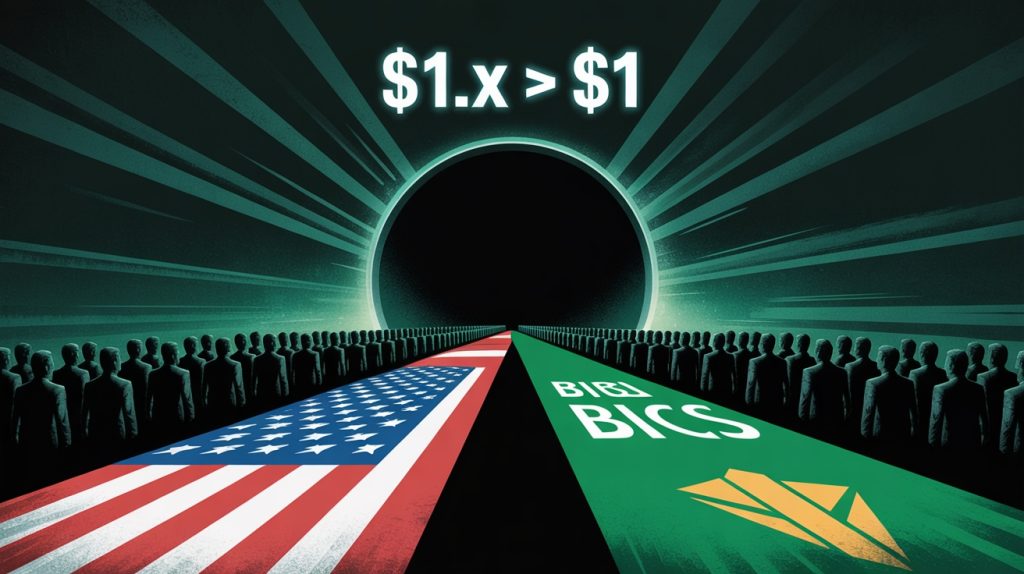
$1.x > $1, for every x > 0.
Every unit of currency in circulation had been borrowed into existence. Every unit carried an interest obligation. And since the interest was never issued alongside the principal, the total debt in the system was always, structurally, larger than the total money supply. The system was mathematically configured to generate more debt than it could ever repay — not as a possibility, but as a certainty. Not as a risk, but as the core algorithm.
But this was the monetary policy of the entire world. How was it possible that nobody had noticed? How was it possible that it wasn’t working?
I spent almost a year trying to convince myself I was wrong. I checked the math from every angle I could think of. I looked for the error in my reasoning. I assumed I must be missing something that the economists and central bankers and finance ministers who ran the system understood and I did not.
I was not missing anything. The bug was real. $2+2=4 — but the global monetary narrative was insisting it equaled 5, while the real-world data I was looking at every day was showing me 3.
Twenty years ago, people laughed. Ten years ago, they insulted. Today, in front of $39 trillion in national debt and $1 trillion in annual interest payments, they are quiet. Perhaps because they have started to wonder: what if he was right?
26 Years Looking for an Answer
After discovering that $2+2=4 while the world insisted on 5, I spent the next 26 years of my life trying to understand two things. First: why had nobody else noticed? Second: if the system was broken by design, what would a correctly designed system look like?
The first question turned out to be the harder one. Monetary policy is not an easy subject. It is deliberately complex — not because complexity is inherent to it, but because complexity serves the interests of those who benefit from the current architecture. A system that people do not understand is a system they cannot challenge. I had to learn the language of a field I had never studied formally, using the analytical tools of a completely different discipline — systems analysis — to read a source code that economists had been trained to treat as a given rather than a design choice.
The second question — what would a better system look like — produced P.C.M. Public Cash Money. A framework in which money is issued as a public utility rather than as private debt, governed by a constitutional inflation bracket, monitored in real time by an AI engine on a public blockchain. I have written twenty-three articles in this series explaining the details, the historical precedents, the mathematical foundations.
But here is the thing I want to say clearly, to everyone who reads this series — not just to the people who ask me about P.C.M. specifically.
The Point Is Not P.C.M.
P.C.M. is my proposed solution. It is the result of 26 years of thinking about what a monetary system anchored to productive capacity rather than debt would look like. I believe it would work significantly better than the current system. I have published it as open source — precisely because I want people to examine it, challenge it, find its flaws, improve it, or replace it with something better.
But the point — the central, non-negotiable, mathematically verified point — is not P.C.M. The point is that the current system demonstrably does not work. And it does not work not because of bad management, not because of corrupt politicians, not because of reckless spending. It does not work because $1.x > $1, for every x > 0, and no amount of good management, honest politics, or fiscal discipline can make a broken equation produce a correct result.
You can read every article in this series and disagree with every aspect of P.C.M. That is fine. That is the point of publishing it as open source. You can think the inflation bracket should be different. You can think the threshold for the inflationary surcharge should be higher or lower. You can think the role of central banks should be redesigned differently. You can propose a completely different framework that I have not thought of.
All of that is welcome. All of that is the conversation I am trying to start.
What you cannot do — if you follow the mathematics honestly, with your own mind rather than mine — is conclude that the current system is sustainable. The $39 trillion is not an opinion. The $1 trillion in annual interest is not a political position. The Congressional Budget Office’s projection that the interest rate on US debt will exceed economic growth around 2031 is not my analysis. It is theirs.
Ask yourself: “Will P.C.M. work?” It is a legitimate question. Ask it. But first ask the prior question: “Is the current system working?” Look at $39 trillion. Look at $1 trillion in annual interest. Look at a generation carrying $1.7 trillion in student debt. Look at wars fought to reset debt cycles. Look at a Nobel Prize in Economics funded by a central bank. Then answer the prior question. Then we can talk about P.C.M.
An Invitation, Not a Manifesto
I am a systems analyst. I read source code for a living. I found a bug in the most consequential piece of software ever written — the monetary architecture that governs the material lives of eight billion people. I have spent 26 years documenting the bug, tracing its effects through history, and proposing a patch.
The patch may not be perfect. Patches rarely are on the first attempt. That is why I published it as open source — so that other people with other skills, other perspectives, and other blind spots can improve it, challenge it, or replace it with something better.
What I am certain of is this: the bug is real. The current system is producing exactly the outputs that a system with this bug is expected to produce. And the trajectory — documented, verified, published by official institutions — is toward a wall whose existence is no longer seriously disputed by anyone paying attention.
You do not have to believe in P.C.M. to see the wall. You only have to read the data that the Treasury, the CBO, and the Joint Economic Committee publish every month — and think about it with your own mind.
That is all I have ever asked.
Not: “Trust me.” Not: “My solution is the only solution.” Not: “Follow this series because I have all the answers.”
Just: look at the data. Think with your own mind. And if you arrive at a different conclusion than I do — tell me why. Publicly, precisely, with the mathematics visible. That is the only conversation worth having.
Don’t like P.C.M.? Fine. Propose something better. But let’s agree on one thing first: the current system is broken. The mathematics says so. The $39 trillion says so. The CBO says so. After that, we can argue about solutions. Before that, we are just arguing about arithmetic. And arithmetic does not negotiate. $2+2=4. Period.