 Public Cash Money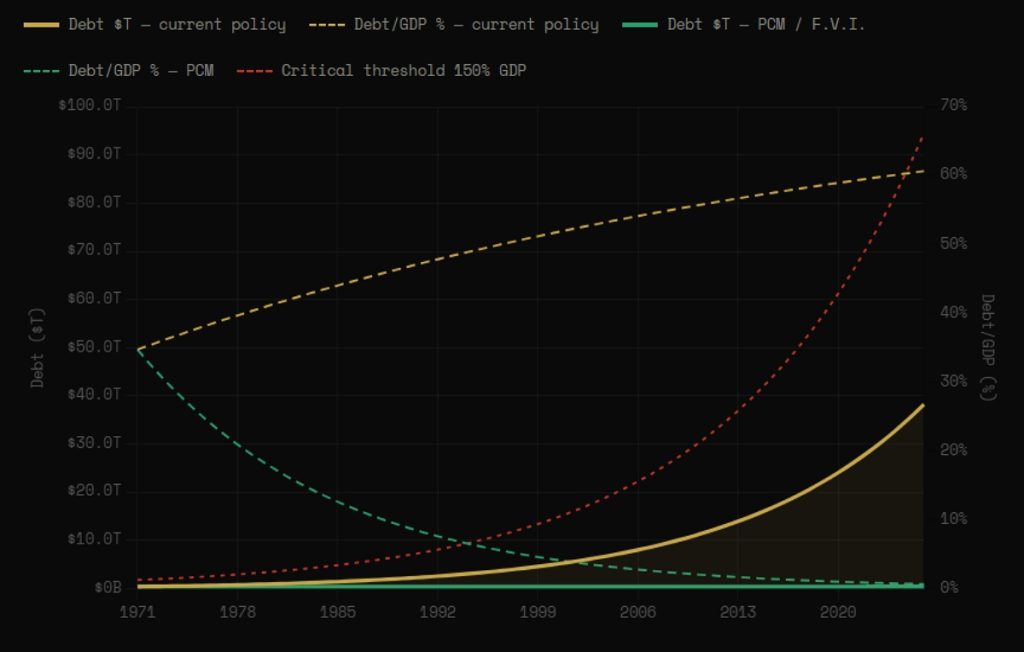
A mathematical model is not a crystal ball. It is a mirror. What you see in it depends entirely on what you put in front of it.
What This Tool Does
The PCM Debt Simulator is an interactive mathematical model that projects the trajectory of national debt under two scenarios simultaneously:
Scenario A — Current system: money issued as debt, with compound interest accumulating on the principal according to the Evil Formula D = M(1+r)^t.
Scenario B — PCM / F.V.I.: money issued directly by the Treasury against real productive capacity, with zero structural interest obligation on issuance.
You can set the starting year, the initial debt-to-GDP ratio, the average interest rate, the nominal GDP growth rate, and the primary deficit as a percentage of GDP. The simulator calculates and displays the resulting trajectories in real time, including the point at which the current system crosses the critical threshold of 150% debt-to-GDP — the level at which historical precedent suggests fiscal sustainability becomes extremely difficult to maintain.
What This Tool Is Not
This is the most important section on this page. Please read it before interpreting any result.
It is not a prediction. The simulator produces mathematical projections based on the parameters you set. It does not predict political decisions, wars, technological disruptions, pandemics, or any of the countless real-world events that affect actual debt trajectories. Real dynamics are non-linear and path-dependent in ways no mathematical model can fully capture.
It is not precise. The model assumes constant parameters throughout the projection period — constant interest rate, constant GDP growth rate, constant primary deficit. In reality, all three vary continuously and interact with each other in complex ways. The results should be read as illustrative order-of-magnitude estimates, not as precise forecasts.
It is not a political argument. The simulator does not take sides on tax policy, spending priorities, or any specific political question. It applies the same mathematical logic — compound interest on debt — regardless of which political party is in power or which policies are in effect.
It is not infallible. If you find an error in the model’s logic or calculations, please say so in the comments. PCM is Open Source. Peer review is actively welcomed.
How to Use It
Set the parameters. Observe the trajectories. Ask yourself what would have to be true for the current trajectory to be sustainable. Then change the parameters and observe what happens.
Some experiments worth trying:
Set the interest rate to 0% and observe what happens to the debt trajectory — this approximates what PCM / F.V.I. direct issuance would produce structurally.
Set the primary deficit to 0% and observe whether the debt still grows — it does, because the interest compounds regardless of spending decisions.
Set the starting year to 1944 and observe the full post-Bretton Woods trajectory.
Set the GDP growth rate above the interest rate and observe whether the r < g condition actually stabilizes the debt-to-GDP ratio over long periods — and for how long.
The simulator will not tell you what to think. It will show you what the mathematics implies, given the inputs you provide. What you conclude from that is your decision.
The default values are sourced from US Treasury, Bureau of Labor Statistics, and Congressional Budget Office data as of May 2026. The PCM scenario assumes F.V.I. issued directly by the Treasury with zero financing cost and zero primary deficit — an illustrative structural alternative, not a precise policy proposal.
Peer review actively welcomed at publiccashmoney.com
Brilliant. Top shelf work. Sharing your website to everyone I know now.
Thanks a lot for being able to analyse this in a way I can appreciate and understand 👍