 Public Cash Money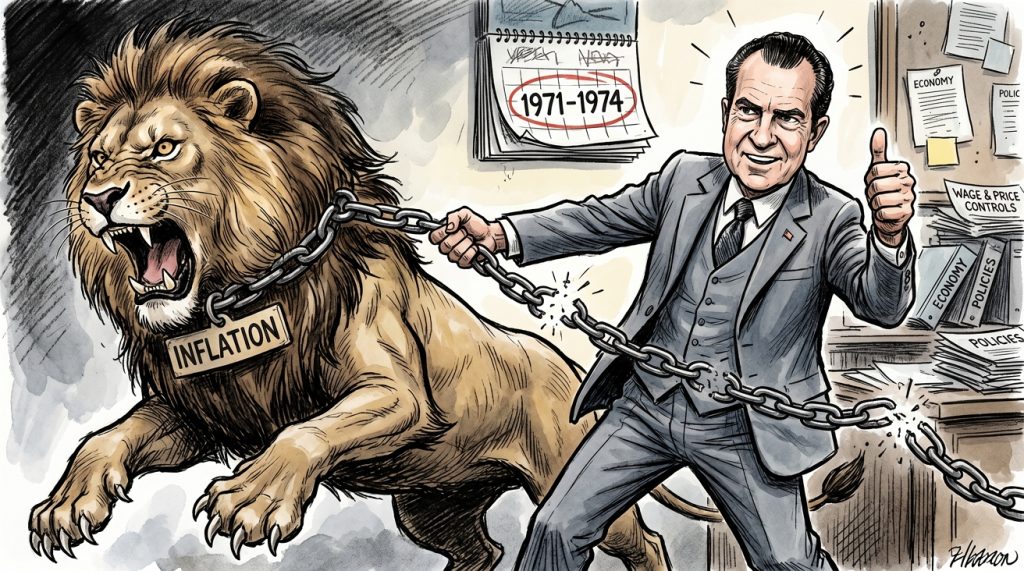
On August 15, 1971, Richard Nixon made two decisions that changed the world. One is remembered by everyone. The other is remembered by almost nobody. The forgotten one is the more instructive.
On the evening of Sunday, August 15, 1971, Richard Nixon appeared on American television to announce what he called the New Economic Policy. The speech is remembered, almost universally, for one thing: Nixon told the world that the United States would no longer convert dollars to gold at the fixed rate of $35 per ounce. The Bretton Woods system — the monetary architecture that had governed the global economy since 1944 — was effectively ended. This is the part of the speech that made history. It is the part that this series has documented extensively as the moment the last physical constraint on the $1.x design bug was removed. But Nixon announced something else that same evening — something that received enormous attention at the time and has been almost completely forgotten since, despite being one of the most instructive economic experiments in modern history. He announced a 90-day freeze on all wages and prices in the United States. Every salary. Every product. Every service. Frozen by executive order, enforced by law, effective immediately. What happened next is a masterclass in the difference between fixing a thermometer and curing a fever.
1. The Context: Why Nixon Did It
In the summer of 1971, the United States was experiencing an inflation rate of approximately 3% annually. By the standards of what would follow in the 1970s, this was mild. By the standards of the postwar period, it was alarming. The causes were structural: the Vietnam War had produced massive government spending financed by debt, the Great Society programs of the 1960s had expanded the fiscal base significantly, and the monetary expansion enabled by the Bretton Woods dollar-as-reserve-currency arrangement had been running for nearly three decades without the discipline that gold convertibility was supposed to impose. Nixon, facing a presidential election in 1972, needed to show decisive action on inflation. He had previously, and publicly, ruled out wage and price controls as inconsistent with a free market economy. On August 15, 1971, he imposed them anyway. The political logic was impeccable. The economic logic was fatally flawed. And the reason it was fatally flawed is exactly what this series has been documenting since Article 1.
2. The Success That Was Not a Success
The immediate response was euphoric. The Dow Jones Industrial Average rose 32.9 points the following day — its largest single-day gain to that point in history. The public, exhausted by inflation anxiety, responded with relief. Nixon’s approval ratings climbed. The controls appeared to work: during the 90-day freeze, inflation fell to an annual rate of approximately 4%. Nixon won the 1972 presidential election by one of the largest margins in American history — 60.7% of the popular vote, 49 states out of 50. The New Economic Policy was widely credited with stabilizing the economy. This was not a success. It was the appearance of a success — which is considerably more dangerous, because it obscures the problem while allowing it to grow. When you freeze a thermometer, the reading stops changing but the patient’s temperature does not: the fever continues. The thermometer merely stops reporting it so when you unfreeze the thermometer, it does not show you the temperature at the moment of unfreezing. It shows you the accumulated fever of all the time it was frozen. This is what happened to American prices between 1971 and 1974.
3. The Molla Compressa: What Happened When the Freeze Was Lifted
The 90-day freeze was followed by a series of phases — Phase Two, Phase Three, Phase Four — each progressively relaxing controls while attempting to maintain some degree of price discipline. None worked. A second full freeze was imposed in June 1973. By then, the consequences of suppressed price signals were becoming physically visible in ways that no economic statistic could capture. Ranchers stopped shipping cattle to market — because the controlled price they would receive did not cover their feeding costs, which were not controlled. Farmers drowned chickens rather than sell them at a loss. Supermarket shelves emptied as producers withheld supply rather than sell below cost. The system of prices — the information network through which a market economy coordinates the decisions of millions of producers and consumers — had been administratively silenced. The result was not stability. It was chaos. The entire Nixon wage and price control apparatus was abolished in April 1974. What followed was not a return to the 3% inflation that had prompted the controls. The compressed spring released with full force.
August 1971: Inflation: approximately 3% annually. Controls announced. Dow Jones +32.9% the next day.
Nov 1971 — Apr 1974: Series of Phase controls. Second freeze imposed June 1973. Ranchers stop shipping cattle. Farmers drown chickens. Supermarket shelves empty.
1973: Inflation: 8% annually. Despite — or because of — 32 months of price controls.
Early 1974: Inflation: approximately 15% annually. Five times the rate that had prompted controls in 1971. Nixon described this as “more appropriate to a banana republic.”
April 1974: All controls abolished. Nixon resigned August 8, 1974, as inflation topped 12%.
Sources: EBSCO Research Starters “Ninety-day freeze on wages and prices”; Cato Institute “Remembering Nixon’s Wage and Price Controls” (June 2022); Imprimis/Hillsdale College “Farewell to Wage and Price Controls” (July 1974); Wikipedia “Nixon shock.” From 3% to 15% in three years. This was not an accidental side effect of an otherwise sound policy. It was the mathematically predictable consequence of suppressing price signals without addressing the monetary cause of price pressure — and then releasing the suppression all at once.
4. What Nixon Actually Did: A Systems Analysis
Looked at from a systems perspective, Nixon’s price controls did something precise and quantifiable: they disconnected the information signal from the underlying reality it was reporting. Prices are not arbitrary numbers. They are information — compressed, distributed, real-time signals about the relationship between supply and demand for every good and service in an economy. When prices rise, they signal that demand exceeds supply or that production costs have increased. This signal, when it reaches producers, prompts them to increase supply. When it reaches consumers, it prompts them to reduce demand or find substitutes. The signal is not pleasant — inflation hurts real people in real ways — but it is functional. It is the economy’s immune system reporting an infection. Nixon silenced the signal. The infection continued. When the silence was ended, the signal had three years of accumulated infection to report. This is the systems analysis of what went wrong. But there is a deeper layer — the one that connects directly to the PCM framework. The infection Nixon was trying to treat was not caused by prices being too high. It was caused by the monetary architecture generating more obligations than the money supply could cover — the $1.x bug operating continuously since 1944, amplified by Vietnam War spending and Great Society programs that were financed through the same debt-based monetary system. The inflation was not the disease. It was the fever reporting the disease. Nixon froze the thermometer. The fever raged on. When the thermometer was unfrozen, it reported everything it had been prevented from reporting — all at once, in three years of double-digit inflation that destroyed the savings of an entire American generation and produced the stagflation of the 1970s.
5. The Lesson That Was Learned — and Immediately Forgotten
By 1973, even Nixon’s own advisors had concluded that the controls had failed. George Shultz, who served as Treasury Secretary, told Nixon directly: at least the debacle had convinced everyone “that wage-price controls are not the answer.” This lesson was accepted at the time with the exhausted clarity of people who had just watched a policy disaster unfold in real time. Wage and price controls disappeared from the mainstream policy toolkit for decades. But the deeper lesson — the one that would have required acknowledging the structural nature of the monetary problem — was never drawn. The conclusion was “controls don’t work,” not “the monetary architecture generates the inflationary pressure that controls are trying to suppress, and the architecture must be changed.” The first lesson fits within the existing framework. The second requires changing it and so the monetary architecture remained. The $1.x bug continued running. The inflation of the 1970s was eventually suppressed — not by addressing the architectural cause, but by Paul Volcker’s radical interest rate increases of the early 1980s, which produced the deepest recession since the Great Depression, destroyed hundreds of thousands of jobs, and caused a wave of business bankruptcies — before bringing inflation down to manageable levels. Another symptomatic treatment. Another cure that was almost as bad as the disease. Another refusal to ask the prior question: why does the architecture generate this pressure in the first place?
6. The PCM Alternative: Curing the Fever Instead of the Thermometer
The PCM framework, as documented in Chapter 3 of the Technical Framework, takes precisely the opposite approach to inflation management. It does not freeze prices. Prices are information — they must remain free to signal. Freezing them is not monetary policy. It is information suppression, with the predictable consequence that the information accumulates and eventually forces its way through in a concentrated burst. It does not target a single number. As Chapter 3 demonstrated, a single inflation target for structurally diverse economies is as rational as a single temperature setting for twenty rooms with different insulation. The constitutional bracket [2%, 4%] provides a range within which each area finds its structural optimum — not a single mandatory temperature for everyone. It acts on the monetary mass, not on the prices. When inflation approaches the upper bracket, the monetary mass is reduced through fiscal withdrawal — reducing the pressure that is causing prices to rise, rather than preventing prices from rising while the pressure accumulates. When inflation approaches the lower bracket, the monetary mass is expanded through direct Treasury issuance — increasing the monetary lubrication that allows economic activity to flow.
The thermometer is left to report accurately. The fever is treated at its source and this is not a revolutionary idea. It is what common sense would suggest if you understood that inflation is a symptom of monetary pressure rather than an autonomous phenomenon that can be suppressed by administrative fiat. Nixon understood this — his own advisors told him controls were not the answer. What he lacked was not knowledge of the symptom but willingness to address the architecture that generated it.
Nixon froze prices to fight inflation but inflation went from 3% to 15% in three years so ranchers stopped shipping cattle, farmers drowned chickens: Shelves emptied. The thermometer was frozen but the fever continued and when the thermometer was unfrozen, it reported everything it had been prevented from reporting: all at once.
The PCM framework does not freeze thermometers: It treats fevers at their source and before they become emergencies that require emergency measures
that make everything worse.
Conclusion: The Most Expensive Lesson in American Economic History
The Nixon price controls cost the American economy dearly — in the inflation that followed, in the recession produced by the Volcker shock that eventually ended it, in the savings destroyed, the businesses bankrupted, the workers unemployed. It was one of the most expensive economic policy experiments in American history. And the lesson it teaches is simple enough to fit on a single line: you cannot cure a fever by breaking the thermometer. The monetary architecture generates inflationary pressure. The pressure expresses itself in rising prices. Rising prices are the signal, not the disease. Suppressing the signal — by law, by administrative decree, by any mechanism that prevents prices from reflecting underlying monetary reality — does not reduce the pressure. It accumulates it. When the suppression ends, the accumulated pressure releases. The result is always worse than what the policy was trying to prevent. George Shultz said in 1973 that the debacle had convinced everyone that controls were not the answer. He was right that they are not the answer. The question that was never asked is: what is the disease that they were trying — and failing — to treat? The disease is the $1.x bug. The treatment is architectural. The thermometer is not the problem. The fever is. And the fever has been running since Bretton Woods in 1944.
3% inflation in August 1971: controls imposed: cattle withheld and chickens drowned so shelves emptied.
15% inflation by early 1974: controls abolished and Nixon resigned but the fever raged for another decade.
You cannot fix the fever by breaking the thermometer as like as you cannot fix the monetary architecture by freezing the prices it distorts. You can only fix the architecture and everything else is a compressed spring waiting to release.
$2+2=4. Period.
Davide Serra · Systems Analyst & Independent Monetary Analyst
publiccashmoney.com · @postaperdavide on X
Sources: Wikipedia “Nixon shock”; EBSCO Research Starters “Ninety-day freeze on wages and prices”; Cato Institute “Remembering Nixon’s Wage and Price Controls” (June 18, 2022); Imprimis/Hillsdale College “Farewell to Wage and Price Controls” (July 1974); Daniel Yergin and Joseph Stanislaw “The Commanding Heights: The Battle for the World Economy” (cited in Cato analysis); Economic Stabilization Act of 1970 (Wikipedia). All inflation figures from US Bureau of Labor Statistics historical CPI data.